

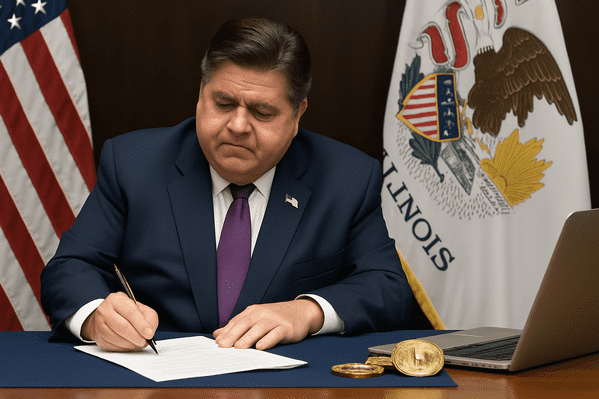

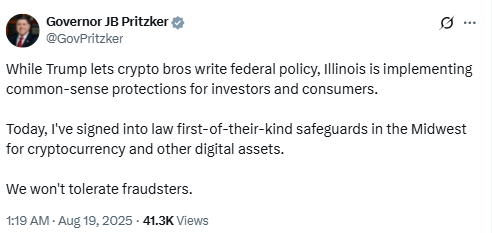
Illinois Governor JB Pritzker signed two new crypto consumer protection laws on Monday. During the signing, Pritzker criticized US President Donald Trump for allowing “crypto bros” to shape national policy.
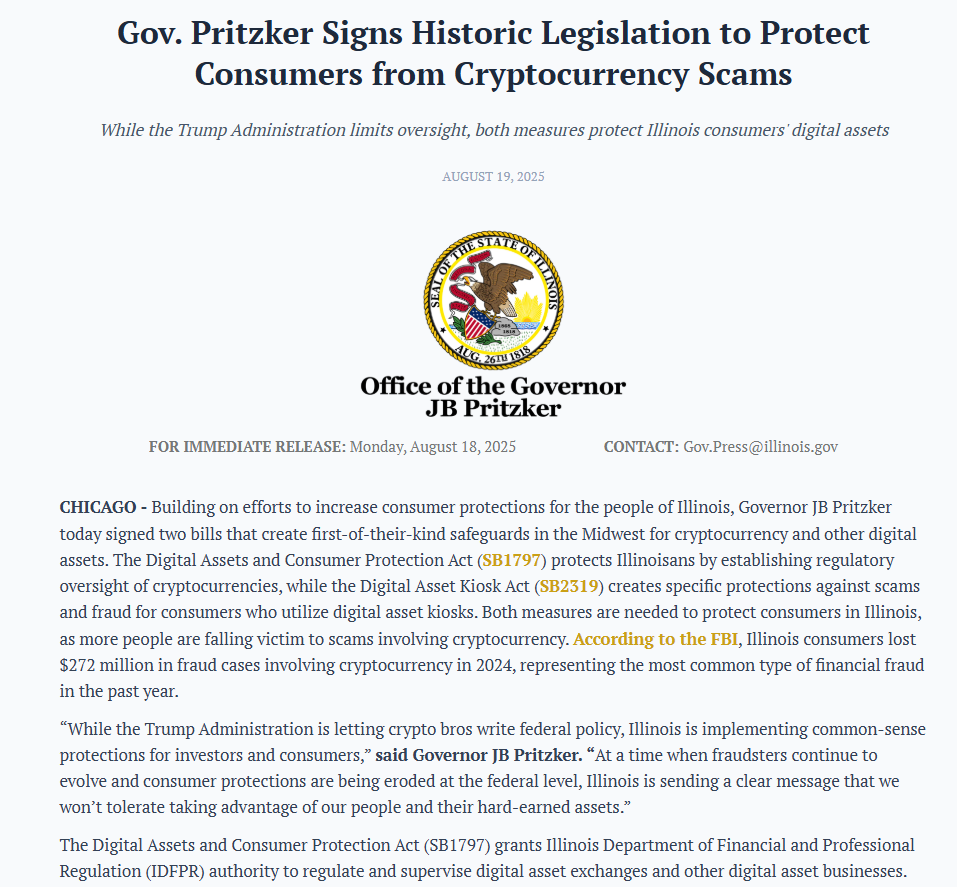
The Digital Assets and Consumer Protection Act (SB 1797) gives the Illinois Department of Financial and Professional Regulation oversight of crypto exchanges and businesses. The act passed the Illinois Senate in April.
The law requires crypto companies to hold enough financial reserves, use cybersecurity and anti-fraud measures, disclose investment risks, and maintain customer service standards similar to banks.
Pritzker said,
“At a time when fraudsters continue to evolve, and consumer protections are being eroded at the federal level, Illinois is sending a clear message that we won’t tolerate taking advantage of our people and their hard-earned assets.”
Illinois Regulates Crypto ATMs
Pritzker also signed the Digital Asset Kiosk Act (SB 2319), targeting crypto ATMs. The law requires operators to register with regulators, give full refunds to scam victims, cap transaction fees at 18%, and limit daily transactions to $2,500 for new customers.
Representative Edgar Gonzalez Jr. said,
“The people of Illinois deserve reliable, consistent safeguards, no matter the financial service they utilize for their hard-earned money.”
Illinois recorded significant losses from crypto fraud. According to the FBI, residents lost about $272 million in 2024, making the state the fifth-highest nationwide in fraud cases linked to cryptocurrency.
Illinois Pushback Against Trump’s Crypto Deregulation
The Illinois governor’s office continued to criticize Trump’s crypto policy, saying the administration “actively deregulated the crypto industry at a time when consumers are increasingly at risk of fraud.”
Officials pointed to Trump’s April 2025 signing of a bill that overturned an IRS rule. The rule had expanded the definition of a broker to include DeFi exchanges, giving regulators oversight. Its removal reduced federal supervision of decentralized finance platforms.
Illinois has taken a different approach compared to states like Texas and Arizona, which support broader crypto adoption. It is led by Democrats, emphasized crypto consumer protection through stricter regulation.
Illinois Rejects State Bitcoin Reserve
In January, Representative John Cabello introduced House Bill 1844, which proposed a strategic Bitcoin reserve for the state treasury. The bill would have required Illinois to buy and hold Bitcoin for five years.
The proposal did not advance past the committee stage. According to Bitcoin Laws, lawmakers rejected it before a full vote.
The rejection shows Illinois’s cautious stance toward large-scale Bitcoin investments by state institutions.


