



With low liquidity and small trading volume, the Solana-based “Shytoshi Kusama” token SHY is raising concerns. Is it truly linked to the Shiba Inu developer, or just using his name for attention? Here’s a closer look at what the data and context reveal.
SHY Trades With Modest Liquidity on Solana
SHY is a token built on the Solana blockchain, traded primarily on Raydium, a decentralized exchange. According to DexScreener, the SHY/SOL pair holds about $265,000 in liquidity, a market capitalization near $943,000, and around 6,500 holders as of Oct. 7.
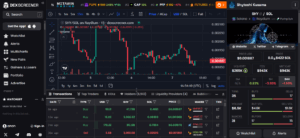
The token was created via Pump.fun, a Solana platform that lets users launch meme tokens with minimal coding and no formal auditing. Such platforms make token creation easy — but they also make scams easier. Most Pump.fun tokens survive only days or weeks, with a small fraction building active communities.
Interest around SHY grew after Lucie, the Shiba Inu marketing lead, mentioned it in multiple X posts. She tagged @ShyOnSolana and used the ticker $SHY alongside Shytoshi Kusama’s name. These posts fueled speculation that the token could be linked to the Shiba Inu ecosystem, given Lucie’s senior role.
However, Shytoshi Kusama himself has never confirmed any connection to the Solana-based token. There are also no references to $SHY on official Shiba Inu communication channels such as blog.shib.io or verified SHIB social accounts. Without such proof, the association remains unverified — a critical distinction between recognition and endorsement.
No Public Record of a Liquidity Lock
The liquidity pool on Raydium — roughly $265,000 — means there is money available for buying and selling. That gives $SHY some real trading depth. However, no visible record of a liquidity lock exists on DexScreener or Solscan.
In decentralized markets, a liquidity lock prevents developers from withdrawing funds that support trading pairs. When a project doesn’t show a verifiable lock, investors can’t confirm whether liquidity is safe or controlled by insiders. This is one of the main indicators analysts check when assessing potential scams.
To put it simply: locked liquidity builds trust; unverified liquidity creates doubt.
Additionally, SHY’s contract ownership has not been publicly renounced, and mint authority (the right to create new tokens) is not clearly shown as revoked. That means whoever deployed the contract may still hold power to alter supply or move liquidity — actions that could impact price stability. In legitimate, long-term projects, these permissions are often revoked or assigned to time-locked smart contracts. Their absence here increases counterparty risk.
Despite trading activity, SHY’s daily volume of about $6,500 is low compared to its total liquidity and holder count. Low volume alongside moderate liquidity often signals limited organic demand — trading sustained mostly by early holders or automated bots.
If volume continues declining, prices can fall quickly because there’s not enough genuine market participation to absorb sales.
Name Association Drives Credibility, Not Proof
Using “Shytoshi Kusama” in the token’s name is powerful marketing — but also problematic. The name is not trademarked, so technically anyone can use it. However, doing so creates an illusion of legitimacy and exploits the trust of the Shiba Inu community.
In past cases, several tokens have used celebrity or developer names without permission, drawing short-term attention before fading or collapsing. Without official endorsement, $SHY’s use of Kusama’s identity appears opportunistic rather than authentic.
SHY Price Chart Shows Persistent Downtrend
A daily chart from TradingView shows $SHY forming a descending triangle, a bearish structure defined by lower highs and a flat support line around $0.0020. The token trades below all major moving averages (20, 50, 100, and 200 EMA), reflecting sustained selling pressure since April.
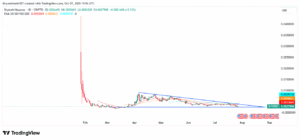
Volume has declined steadily through the summer, signaling waning interest. Unless $SHY price breaks above $0.0033–$0.0035 with strong volume, technical indicators point to continued downside. A close below $0.0020 could confirm a breakdown and expose the token to further losses.
The SHY to USD pair’s descending triangle suggests ongoing weakness. Support near $0.0020 has held multiple times but is weakening. If the token closes below that level, it could trigger another sell-off toward untested lows.
Conversely, a breakout above the descending trendline with heavy trading volume could spark a short-term rebound toward $0.0045–$0.0050, representing a potential 50–70% upside. However, given the token’s low liquidity and lack of fundamental support, any such rally would likely be temporary.
From a structural standpoint, $SHY’s Pump.fun origin, absence of a verified liquidity lock, and no formal SHIB endorsement continue to weigh on its credibility. With roughly $6,500 in daily trading volume, price stability remains fragile — even modest selling pressure could move the market.
In summary, a speculative bounce is possible, but the broader trend remains bearish and high-risk.


