


R3 launched a new division, R3 Labs, to take regulated real-world assets onto public chains, starting with Solana. The firm cites more than 17 billion dollars in assets already tokenized across its platforms.
The unit plans distribution on Solana for speed and scale across compliant markets. R3 named Richard Gendal Brown to lead the effort as chief executive.
SwissBorg pauses Solana staking after wallet incident
SwissBorg and staking provider Kiln reported an unauthorized access event on September 8, 2025, involving a wallet used for Solana staking operations. The firms said they activated an incident response plan immediately, contained the activity, and engaged security partners. As a precaution, SwissBorg paused Solana staking transactions on its platform while the scope of the incident is assessed and updates are communicated to customers and partners.
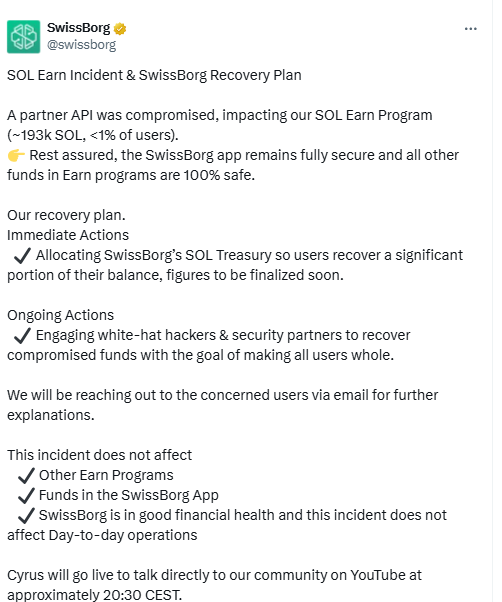
SwissBorg later detailed that the exploit occurred around midday CEST and impacted approximately 41 million dollars’ worth of SOL held in an external DeFi wallet operated with a counterparty for its SOL Earn strategy. The company emphasized it was not a breach of the SwissBorg platform, said fewer than 1% of users and about 2% of total assets were affected, and temporarily paused SOL Earn redemptions during recovery operations. SwissBorg added that user balances in the app remain unchanged and pledged to cover any gap after recovery efforts with security specialists and law enforcement conclude.
Press reports quantified the outflow at roughly 192,600–193,000 SOL (about 41–41.5 million dollars) and attributed the breach to a compromise of a partner’s API used for staking connectivity, while SwissBorg and Kiln continued their investigation and promised a full incident report. SwissBorg said it will provide further updates through official channels as fund tracing and remediation proceed.
Alpenglow upgrade clears validator vote
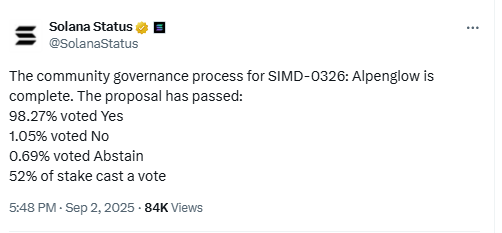
Solana validators approved the SIMD-0326 Alpenglow consensus overhaul with 98.27% “yes” votes and 52% of stake participating, completing a multi-epoch governance window that met the 33% quorum requirement. The vote used claimable tokens and three destinations (Yes, No, Abstain); the supermajority rule required Yes to be at least two-thirds of Yes+No. Officials published the final tally on X and in follow-ups, confirming passage and closing the community process.
The change replaces TowerBFT and Proof-of-History with two components: Votor and Rotor. Votor implements direct voting and finalizes blocks in a single round when roughly 80% of stake responds, or in two rounds at the 60% threshold, while cryptographic aggregates certify notarization, skip, and finalization. Meanwhile, Rotor redesigns data propagation with a single relay layer, reducing network hops and bandwidth overhead. In simulations with the current mainnet stake distribution, the team reports a drop in median time to finality from about 12.8 seconds to roughly 150 milliseconds, and sometimes near 100 milliseconds, subject to real-world conditions.
Engineers outlined rollout mechanics on the Solana forum, noting that the initial activation focuses on Votor’s voting and finalization, while Rotor ships in a subsequent update after its own review. They also detailed incentive changes that move votes off-chain, introduce on-chain certificate aggregates, and add a Validator Admission Ticket (initially 1.6 SOL per epoch) to maintain an economic barrier comparable to on-chain vote fees. Governance materials record the discussion period in epochs 833–838, stake capture in 839, and the voting window across epochs 840–842, culminating in the result disclosure.
Solana Mobile starts Seeker Season
Solana Labs launched Seeker Season on Sept. 8 inside the Solana dApp Store, introducing a weekly cadence of featured apps, on-device rewards, and exclusive onchain experiences limited to Seeker users. The company directs users to the dApp Store as the “command center” for each week’s activations and frames the program as a catalyst for the next wave of mobile-first Web3 apps.
The rollout highlights categories across DeFi and trading, gaming and entertainment, DePIN and infrastructure, and social and commerce. According to Solana Labs, Seeker owners should expect perks such as enhanced yields, early access to new releases, priority participation in location-based apps, and verified-user features in social and payments. The post also notes that the Solana dApp Store now lists 100+ apps and that Seeker’s Genesis Token and Seeker ID unlock eligibility for certain features and rewards.
For the opening week, Solana Mobile named Moonwalk Fitness as the first featured app and promoted an in-app boost available to Seeker users. The team announced the kickoff on X from both the @solanamobile and @solana accounts, reinforcing the program’s weekly rhythm of new spotlights and incentives aimed at growing on-chain mobile activity.

Institutions gain JitoSOL access through Copper
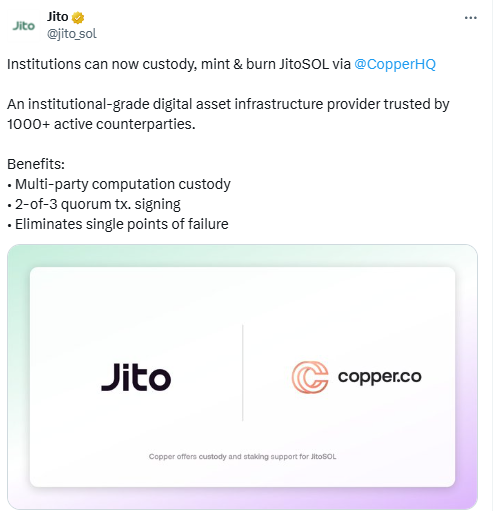
Copper said it now supports JitoSOL across custody and staking, giving institutional clients end-to-end access to mint, redeem (burn), custody, transfer, and trade the Solana liquid-staking token within the Copper Network. The firm framed the integration as expanding regulated rails for Solana staking and settlement on a single platform.
Operationally, Copper routes JitoSOL through its existing infrastructure, including MPC custody and ClearLoop for off-exchange settlement with connected venues. This setup lets clients keep assets in custody while they settle trades, which can reduce counterparty exposure and align with institutional workflows.
For context, Jito Labs and Copper both confirmed the integration on X, and recent ecosystem moves show broader institutional on-ramps forming around JitoSOL. In July, Anchorage Digital added mint and redeem support for JitoSOL, underscoring a growing set of qualified custodians around Solana liquid staking.
Context on R3 and Solana ties
R3 and the Solana Foundation formalized a collaboration on May 22, 2025, to let R3’s financial-institution clients route tokenized assets to Solana’s public mainnet. As part of the deal, Solana Foundation president Lily Liu joined R3’s board, aligning R3’s enterprise stack with a public-chain distribution option alongside its permissioned Corda platform.
Financial press identified participating or connected institutions in R3’s ecosystem—including HSBC, Bank of America, Euroclear, and the Monetary Authority of Singapore—and framed the move as a shift toward public blockchain rails for tokenization and settlement. Reports emphasized that R3 would continue to support private ledgers while enabling clients to choose Solana for scale and market access.
R3 followed the partnership by launching “R3 Labs” on Sept. 4, 2025, a division tasked with expanding tokenized real-world assets on Solana. The company stated it already tracks about $17 billion of tokenized assets across its platforms and will use Solana to broaden distribution in regulated markets.
SOL 4H: Rising wedge breakout points to ~27% upside
The structure shows a rising wedge, which is a pattern of higher highs and higher lows inside two converging upward trendlines. Price trades above the wedge’s upper boundary, so it already broke out to the upside and now rides a short, steeper support line.
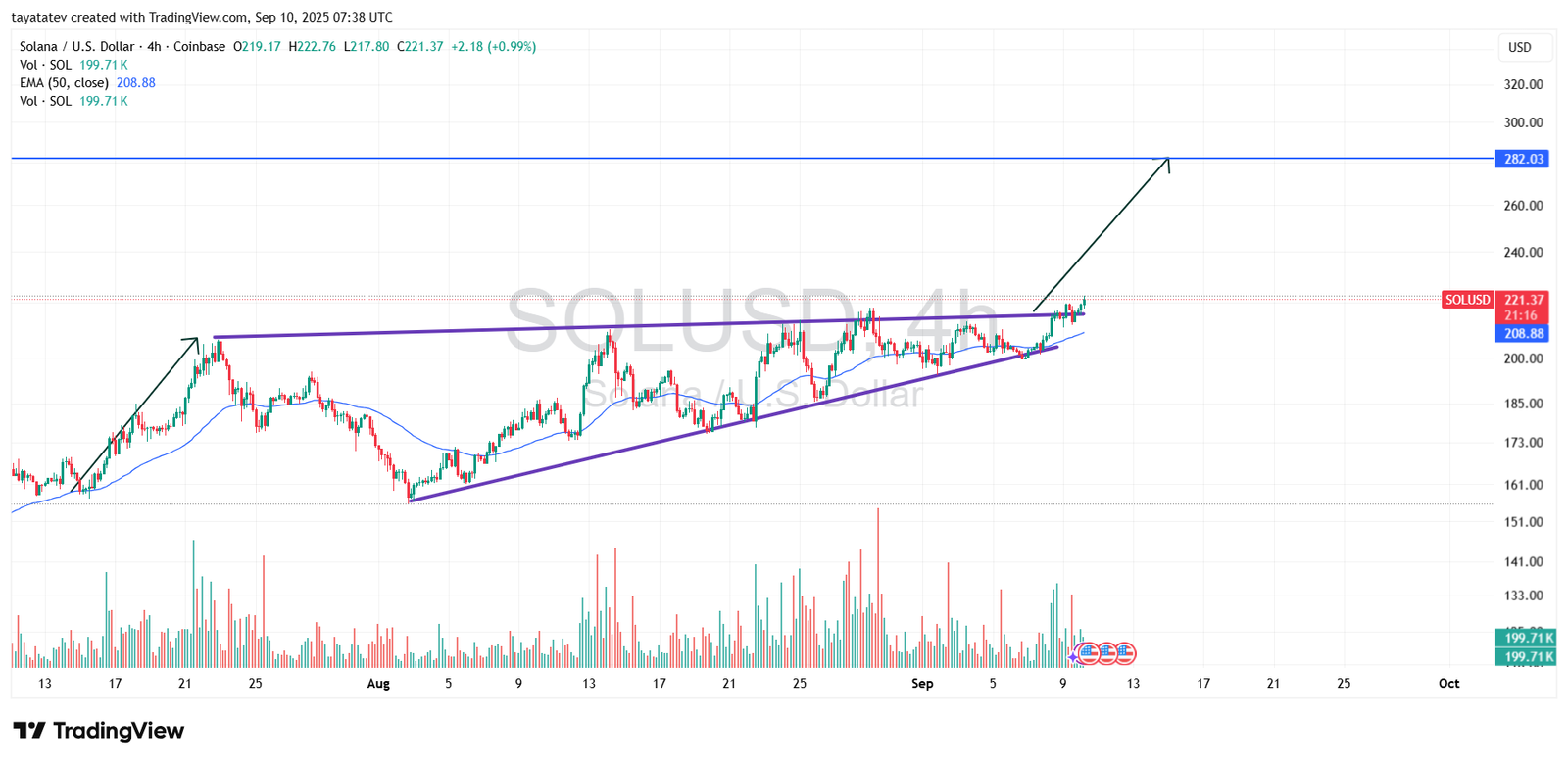
From the current price on the chart ($221.37), a 27% projection implies a target near $281.14. That aligns with the horizontal level drawn around $282 on the chart, so the measured move and the visible resistance converge in the same zone, strengthening the objective. Momentum looks constructive while price holds above the former wedge ceiling around the low-$220s, and the breakout path remains open toward that ~$281–$282 cluster if buyers sustain control.
Meanwhile, the 50-period EMA on the 4-hour chart sits at $208.88 and rises, which marks the next notable dynamic support beneath the breakout level. As price extends, traders typically watch for a shallow retest of the broken trendline or a continuation grind along the new, faster support line; however, a close back inside the wedge would weaken the breakout case and pivot attention to the EMA.
SOL 4h RSI: momentum presses the 70 band
Chart SOL/USD date: Sept 10, 2025 UTC (TradingView). The 14-period RSI prints 68.77, while its signal line sits at 64.94. The oscillator holds above the 50 midpoint since early September and stays above its signal line. That setup shows improving upside momentum on the 4-hour timeframe.

Recently, RSI climbed from the low-50s and now tests the 70 threshold. Historically on this chart, pushes into the 70–75 area have preceded short pauses rather than trend breaks. Therefore, a firm move through 70 would confirm strong momentum, while quick rejections often lead to brief consolidation before the next attempt.
The latest swing shows RSI making higher lows and a rising slope, which supports the breakout context from price charts. However, the oscillator has not printed a clear bearish divergence against price on this timeframe. As a result, the signal remains constructive while RSI holds above its signal line and the 50 level.
SOL 4h MACD: momentum turns positive and builds
Chart date: Sept 10, 2025, 07:54 UTC (TradingView). The MACD line sits at 3.85, the signal line at 3.02, and the histogram reads +0.82. The MACD crossed above the signal and the zero line in early September, so momentum has shifted to the upside and now accelerates as the histogram expands.
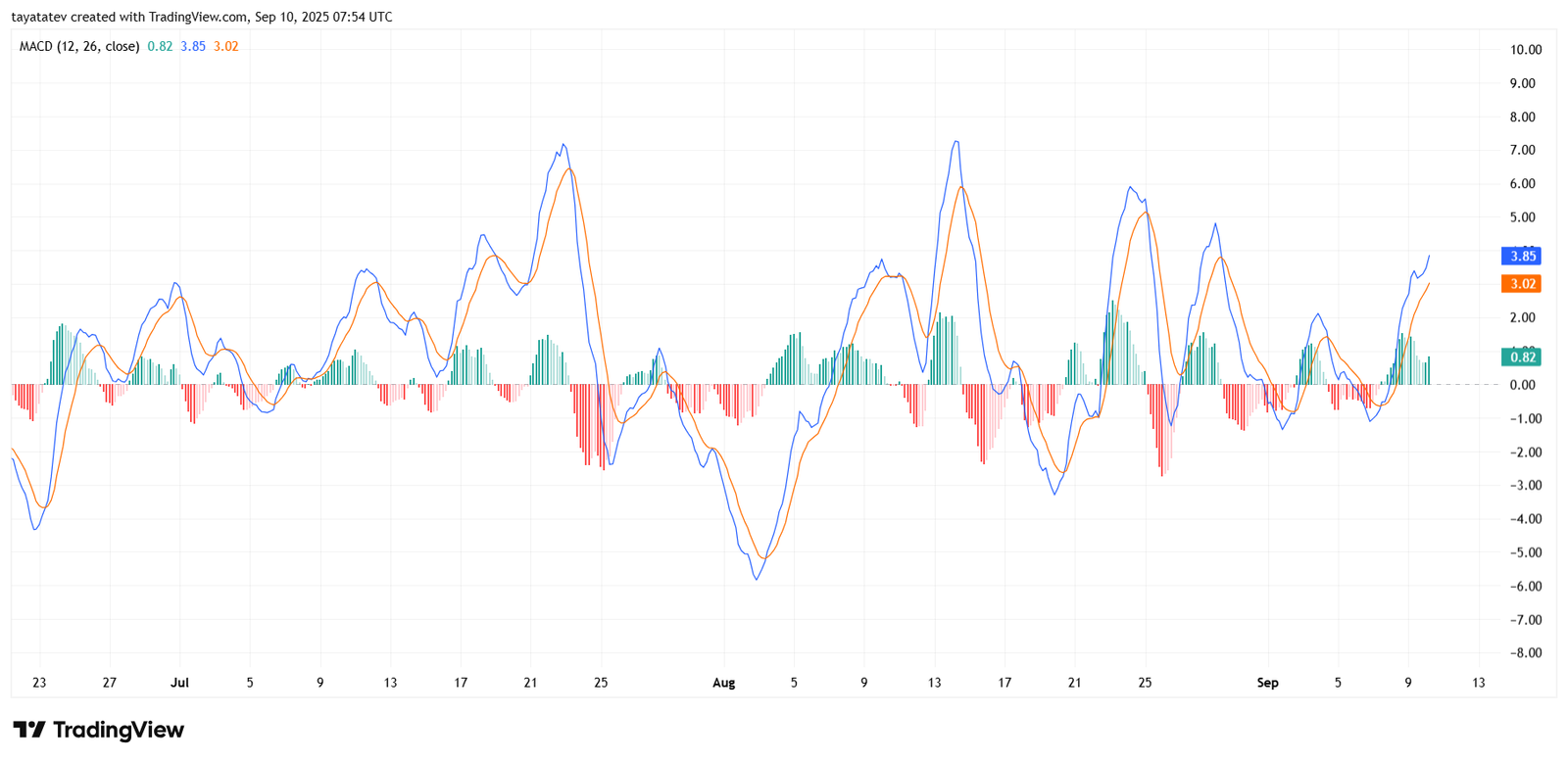
The lines rise in tandem and widen their spread, which indicates strengthening trend velocity on the 4-hour timeframe. Because both lines hold above zero, the move reflects more than a short bounce; it shows positive medium-short momentum consistent with the recent price breakout.
However, the current MACD amplitude remains below late-August peaks on this chart, so momentum has not reached prior extremes. If the histogram begins to contract while the lines still climb, that would signal waning acceleration rather than a reversal. Until then, the active crossover above zero supports a constructive backdrop for continuation on this timeframe.


