



Litecoin (LTC) and XRP (XRP) communities clashed this week after arguments erupted over the origins and value of both tokens.
Litecoin and XRP Advocates Trade Blows
The conflict between Litecoin and XRP communities began when Jonny Litecoin, a member of the Litecoin support team (as per his bio), questioned XRP’s role in payments.
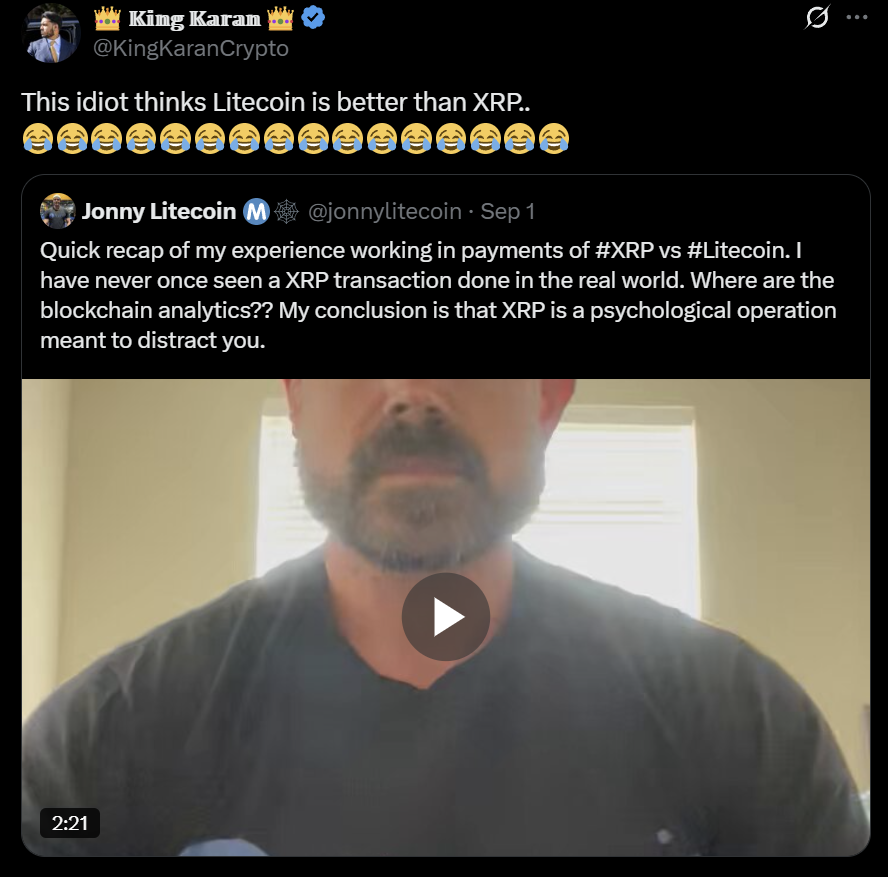
Jonny posted a video claiming he never saw XRP used in real-world transactions. The LTC supporter argued XRP operated as a distraction rather than a serious network. Expectedly, Jonny’s comments quickly drew ridicule. King Karan mocked him in a reply, saying his view placed Litecoin above XRP. The post spread quickly and attracted significant responses from both camps.
Jonny pressed his case further. He claimed every Litecoin had been mined fairly with electricity and computational power.
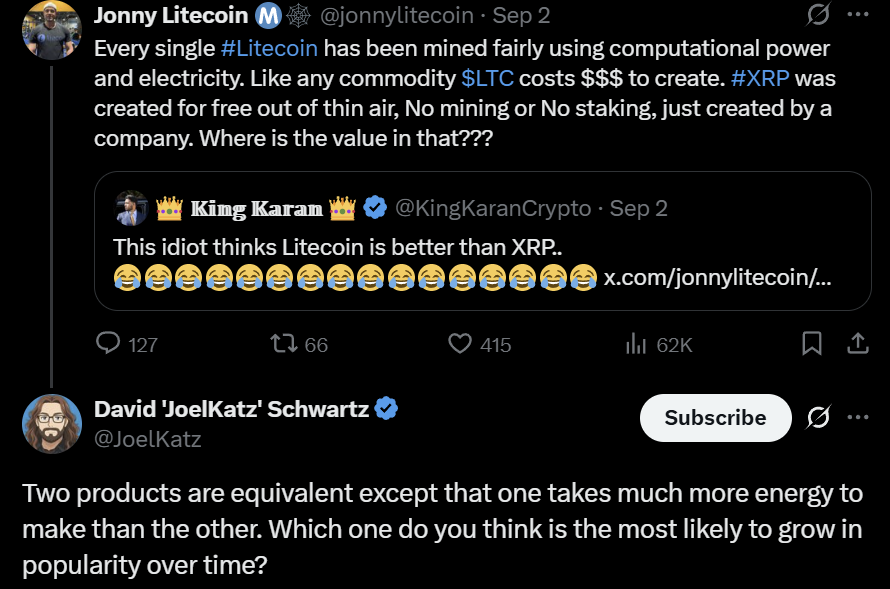
The Litecoin supporter argued XRP was created “out of thin air” without mining or staking. His position centered on proof-of-work as a mark of legitimacy. The framing implied energy costs gave Litecoin value, unlike XRP’s pre-mined supply.
Ripple CTO David Schwartz soon responded. He argued that two equivalent products should be judged by efficiency. Schwartz asked which asset would gain popularity: one that requires far more energy or one that produces no waste. The Ripple CTO’s reply shifted the debate toward sustainability and efficiency.
Jonny refused to back down. He replied that the product requiring more energy should gain more recognition over time. Moreover, Jonny claimed proof-of-work costs made Litecoin stronger as money. He added that broader adoption would depend on marketing, reliability, and integration into payment systems.
The exchange was simply another volley in a long-drawn battle between Bitcoin and Litecoin fans, who argue that proof of work adds legitimacy to the coins’ value, and the fans of altcoins, who value utility over origin.
Community Splits Over Value and Utility
The debate quickly spread beyond the main figures and drew in wider voices across social media.
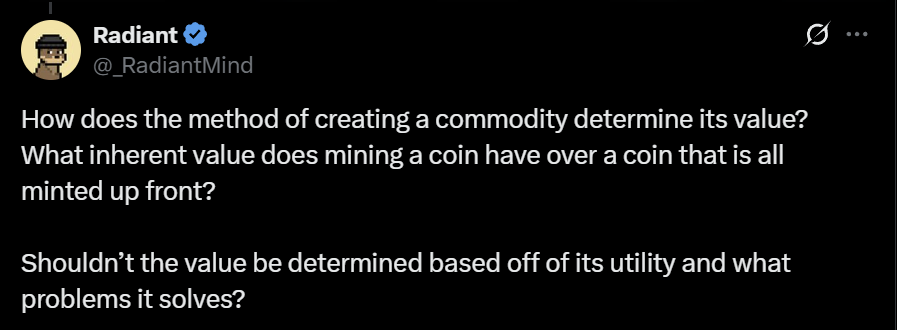
One user named Radiant challenged Jonny Litecoin’s stance, asking what inherent value mining added beyond energy use. He argued that value should be tied to utility and problem-solving. Another market participant, The Bearable Bull, made a similar point, stressing XRP’s ability to move value in seconds for less than a cent. The trader questioned why efficiency was being penalized instead of rewarded.
Other users openly dismissed the proof-of-work argument. An account with the username ‘Guy on the Earth’ called the discussion irrelevant, saying no one cared how a token was created. He argued that people cared about results, not emotional appeals, regarding energy use. Only One Way added that origin stories missed the bigger picture, saying technology should be judged on whether it improved society.
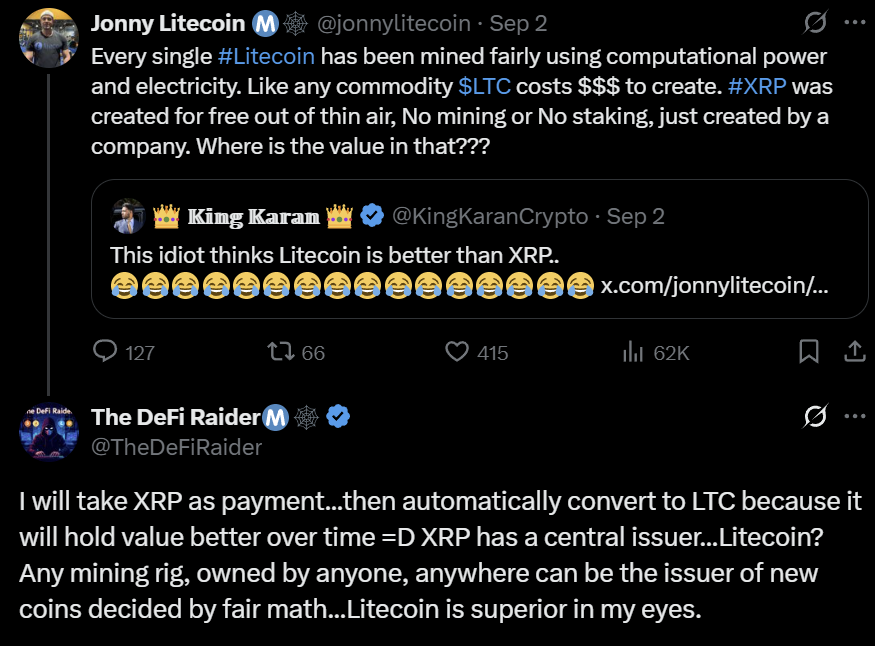
Some users sided with Jonny. The DeFi Raider claimed they would accept XRP as payment but immediately convert it to Litecoin. They pointed to decentralization as a key advantage, arguing that Litecoin’s mining gave it legitimacy that XRP lacked. Jonny himself doubled down, saying energy-intensive creation made Litecoin more reliable as money.
Despite these supporters, replies like Pritensor’s, which highlighted XRP USD pair’s stronger performance from bear market lows, showed the pushback was more substantial than the backing.
Analysts Frame Litecoin’s Structure Amid Tight Price Action
While arguments between Litecoin and XRP advocates exposed sharp philosophical divides, the LTC USD pair’s market behavior drew a more measured response. Analysts shifted focus away from social media disputes to study LTC’s tight structure on the charts.
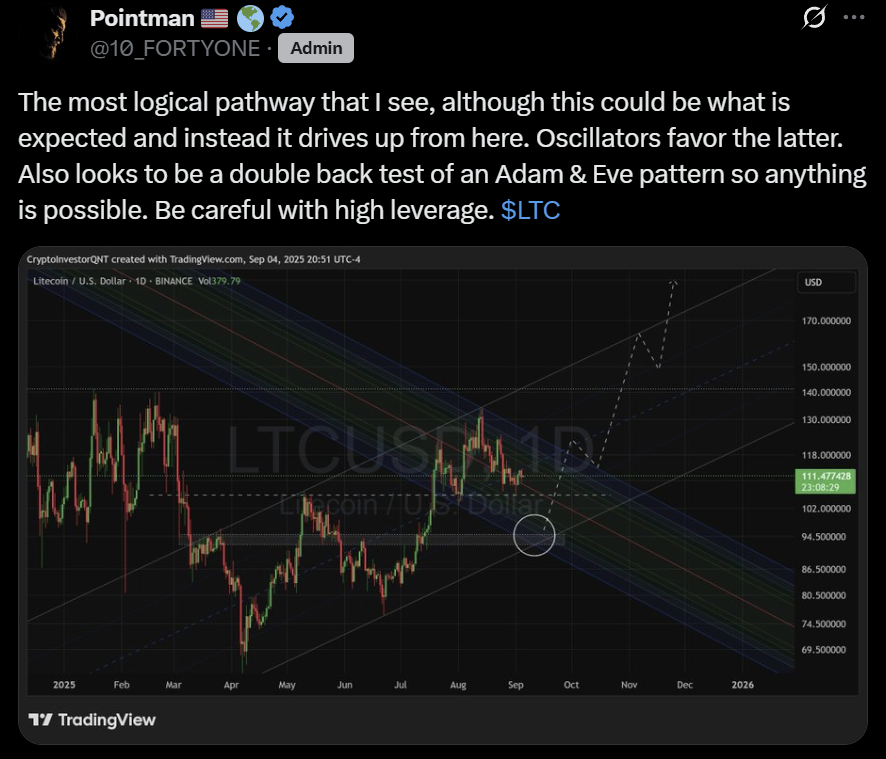
Pointman argued LTC hovered near a critical level, noting oscillators leaned bullish. The X-based analyst suggested the token could retest the $95–$100 area before attempting a larger rebound. Moreover, Pointman highlighted a possible Adam and Eve double bottom pattern, often seen near market reversals.
The analysis implied momentum was trying to shift upward, though confirmation was still needed. Our observation aligned with his caution, as the structure showed pressure from both sides.
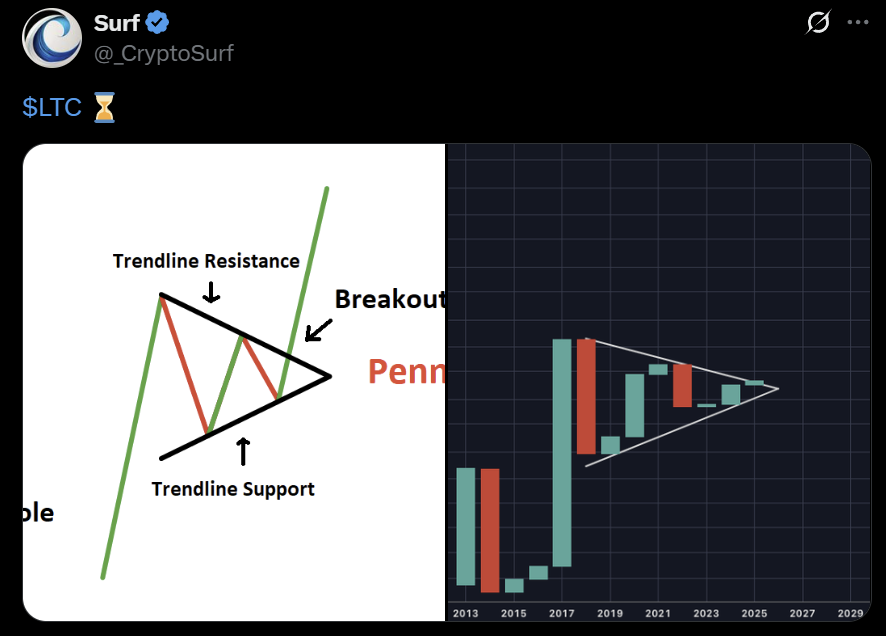
Independent analyst Surf presented a broader view, highlighting a multi-year pennant pattern visible on the logarithmic chart. He noted the structure neared its apex, signaling an eventual breakout.
The analyst did not commit to a direction but stressed volatility would expand once the compression ended. That view reinforced the long-term uncertainty around Litecoin. However, it seems the pennant highlights the scale of LTC’s stagnation, showing the market has been waiting years for a resolution.
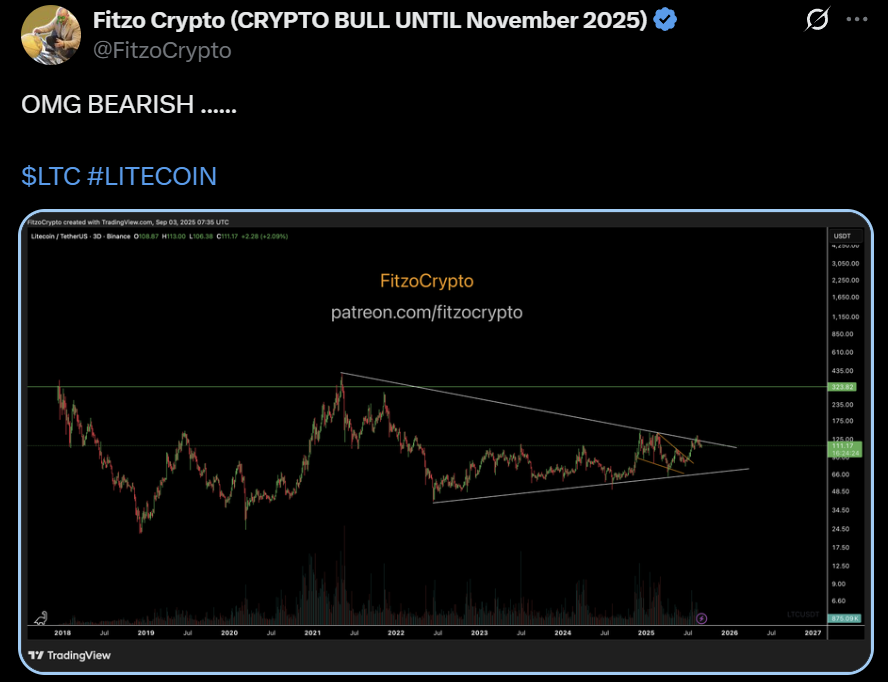
Fitzocrypto took the opposite approach, framing Litecoin inside a descending triangle since 2021. The X-based trader argued that repeated rejections at the upper trendline supported a bearish case. His chart emphasized lower highs and warned of breakdown risks. This contrasted with Surf’s neutral tone, offering traders a starkly different interpretation of the same consolidation.


