



An Ethereum analyst has argued that bearish positioning is unwarranted, pointing to accelerating Real World Asset (RWA) growth on the network. Over the past 12 months, the RWA sector has expanded by 850%, including a 50.9% increase in the last 30 days. Ethereum and zkSync now account for more than 80% of total RWA market share, with Ethereum holding the dominant share by value.
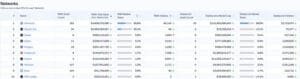
Total tokenized RWA value locked on Ethereum has surpassed $4 billion, supporting the network’s role as primary infrastructure for on-chain financial products such as bonds, treasuries, and credit.
ETF Inflows Rebound After Period of Weak Activity
The surge in tokenized real-world asset adoption coincides with renewed institutional participation through Ethereum spot ETFs. Between June 10 and June 12, these products recorded their strongest inflows since launch. CoinGlass data shows 66.64K ETH in net inflows on June 10, followed by 85.34K ETH on June 11 and 40.54K ETH on June 12.

BlackRock’s iShares Ethereum Trust (ETHA) contributed 36.64K ETH on June 12 alone. Fidelity, Bitwise, and Grayscale also reported positive flows, reversing the trend seen in previous weeks of mixed ETF activity. ETF activity has not been the only source of institutional interest. BlackRock also purchased 19,070.96 ETH, valued at approximately $48.4 million, on June 3.
Despite these developments, public company ETH holdings remain low. Coinbase holds 115,700 ETH, Bit Digital holds 27,623 ETH, and Exodus holds 2,550 ETH. Combined, public companies hold 146,056 ETH, equal to 0.12% of Ethereum’s circulating supply.

Institutional accumulation has coincided with a notable decline in ETH held on centralized exchanges. Exchange reserves have dropped to 18.7 million ETH, the lowest since early 2022. ETH is increasingly being withdrawn from trading platforms and moved to custodial or offline storage.
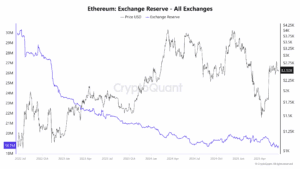
Meanwhile, exchange netflows turned positive last week, with more than 42,000 ETH moving into accumulation addresses. These trends suggest that short-term liquidity is decreasing, reducing potential sell-side pressure in the market.
You May Also Like: Ethereum’s EIP-7702 Feature From Pectra Upgrade Triggers Mass Wallet Theft
Ethereum Maintains Leadership in Stablecoins and RWAs
While ETH supply tightens on exchanges, the network continues to dominate key infrastructure sectors such as stablecoins and tokenized assets. Ethereum supports $31.1 billion in stablecoins, accounting for 96.8% of the tracked supply across blockchains. It also leads in RWA issuance, hosting the majority of tokenized treasuries and financial instruments deployed on-chain.
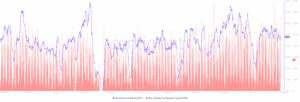
The strength of Ethereum’s infrastructure is also reflected in its developer activity. Santiment reports a development activity index of 54.14, supported by frequent contribution spikes in recent weeks.
These underlying signals are reflected in Ethereum’s current price behavior. ETH has moved within a defined range of $2,900 to $3,400, with repeated tests of resistance near the upper bound. This structure resembles prior accumulation phases in earlier market cycles.
Some chart-based forecasts suggest a potential move toward $4,000, with longer-term targets of $6,000–$8,000 shared by traders. These projections remain speculative and depend on continued ETF inflows, Bitcoin correlation, and macroeconomic stability.



