


PayPal announced a new crypto checkout tool for US merchants. The feature allows businesses to accept payments in more than 100 cryptocurrencies. Supported tokens include Bitcoin (BTC $118,161), Ether (ETH $3,804), Solana (SOL $185.93), USD Tether (USDT $0.9999), USD Coin (USDC $0.9997), and XRP ($3.15).
The crypto checkout tool connects with wallets such as Coinbase Wallet, MetaMask, OKX, Kraken, Binance, Phantom, and Exodus. Payments made with crypto will automatically convert into PayPal USD (PYUSD) or fiat currency at checkout. This approach removes exposure to price volatility for merchants while allowing customers to pay with various crypto tokens.
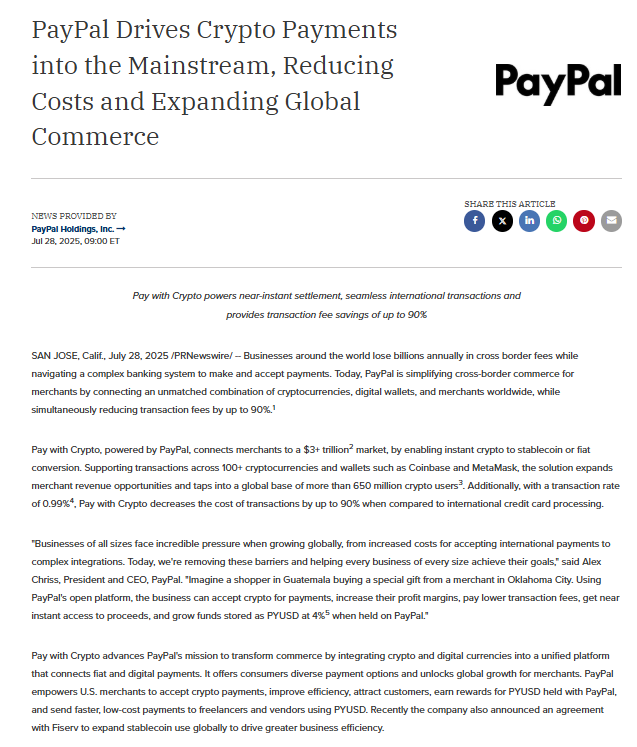
PayPal will apply a 0.99% transaction fee on crypto payments. For comparison, Visa fees begin at 1.75%. The crypto checkout tool is currently available only to US-based merchants, excluding those in New York.
PYUSD Stablecoin Growth and Cross-Border Payments
The crypto checkout tool also focuses on international transactions. PayPal highlighted that small and medium-sized businesses often face high costs for cross-border payments. This system aims to streamline those transactions by integrating crypto settlements with PYUSD stablecoin.
PYUSD’s market capitalization has grown nearly 80% since January 1, reaching $894 million, up from $497 million, according to CoinGecko. By connecting crypto transactions to PYUSD, the crypto checkout tool facilitates stable and predictable settlements for merchants.
PayPal’s launch coincides with a broader increase in stablecoin adoption. Stripe added USDC payments in October 2024, with users in 70 countries participating on its first day. In June, Stripe partnered with Coinbase, integrating fiat-to-crypto services and adding support for Coinbase’s Base network.
Competition From Stripe, Coinbase, and Crypto Tools
The crypto checkout tool places PayPal in direct competition with companies like Stripe and Coinbase. Coinbase launched Coinbase Commerce in 2018, enabling merchants to accept crypto through platforms such as Shopify and WooCommerce.
In 2024, Coinbase introduced the x402 protocol, which enables crypto payments using HTTP for automated systems and APIs. The protocol focuses on USDC transactions on Base network, expanding crypto’s use in automated payment systems.
These developments highlight increasing competition among payment providers offering crypto checkout tools and stablecoin options for merchants.
GENIUS Act Supports Crypto Payment Services
The crypto checkout tool follows the passage of the GENIUS Act, which provides clear regulation for using stablecoins in payments. This legislation enables companies like PayPal to integrate stablecoin payments within their platforms under defined rules.
Industries such as food and beverage, retail, travel, e-commerce, and real estate have increasingly adopted crypto payments. The crypto checkout tool positions PayPal to serve merchants in these sectors while expanding stablecoin-based transactions for cross-border trade.
By adding support for over 100 tokens, PayPal’s crypto checkout tool extends stablecoin and crypto payment functionality for US merchants within a regulated framework.


