Pi Coin Crashes 90% as Pi Network Faces Backlash Over Token Lockup and KYC Delays

Tatevik Avetisyan
By Tatevik Avetisyan 8 Min Read
Pi Coin Crashes 90% as Pi Network Faces Backlash Over Token Lockup and KYC Delays

Pi Network announced on August 2 that users can lock up Pi tokens to receive mining boosts of up to 200%. The feature applies to both pre-migration and post-migration users.

Pi Network Blog. Source: Pi Network

Post-migration lockups happen through the Pi Wallet, affecting Pi already on-chain. Pre-migration lockups, managed in the Pi app, adjust future transfer balances and reward rates. All lockups are binding and cannot be reversed once confirmed.

- Advertisement -

The announcement quickly drew criticism from the Pi Network community on X. Many users objected to the timing, pointing to unresolved migration and verification problems that limit access to Pi tokens.

Pi Network Users Cite KYC and Migration Delays

Community membershighlighted persistent KYC delays and stalled Mainnet migration. Some users said they had completed verification more than a year ago but still could not migrate their Pi tokens. This has left large token balances locked in pending states.

One user wrote on X:

- Advertisement -

“We’ve done KYC months ago and still can’t migrate. Why lock tokens we can’t move?”

Others noted that without migration, the lockup option holds little value.

Reports show that the migration queue remains long, with users awaiting confirmation despite completing all required steps. The lack of clear updates from the Pi Network Core Team has intensified complaints.

Pi Ecosystem Tools Remain Incomplete

Concerns extend beyond migration. Several Pi Network ecosystem features remain unfinished, including Pi Domains and Pi App Studio, which were previewed earlier but have yet to be fully released.

Users said the delays limit the practical use of Pi tokens. Many also cited ongoing technical bugs and demanded clearer updates from the Pi Network Core Team regarding progress on its roadmap.

The lack of active tools within the Pi Network ecosystem has fueled skepticism about locking up tokens for extended durations without access to functional services.

Pi Coin Price Decline Adds to Tensions

The backlash comes as Pi coin dropped 11% on Saturday, reaching an all-time low. The token has fallen nearly 90% since February, based on recent price data.

Market pressure is expected to increase as 160 million Pi tokens are scheduled to unlock in August, the largest single monthly release in Pi Network’s history. This supply increase could further impact prices already under strain.

- Advertisement -

Earlier this week, Pi Network introduced its lowest-ever mining rate. This change is part of its emission model, designed to slow new token output and focus on longer-term activity within the Pi Network.
Pi Coin Price Analysis Shows Sharp Drop in Early August

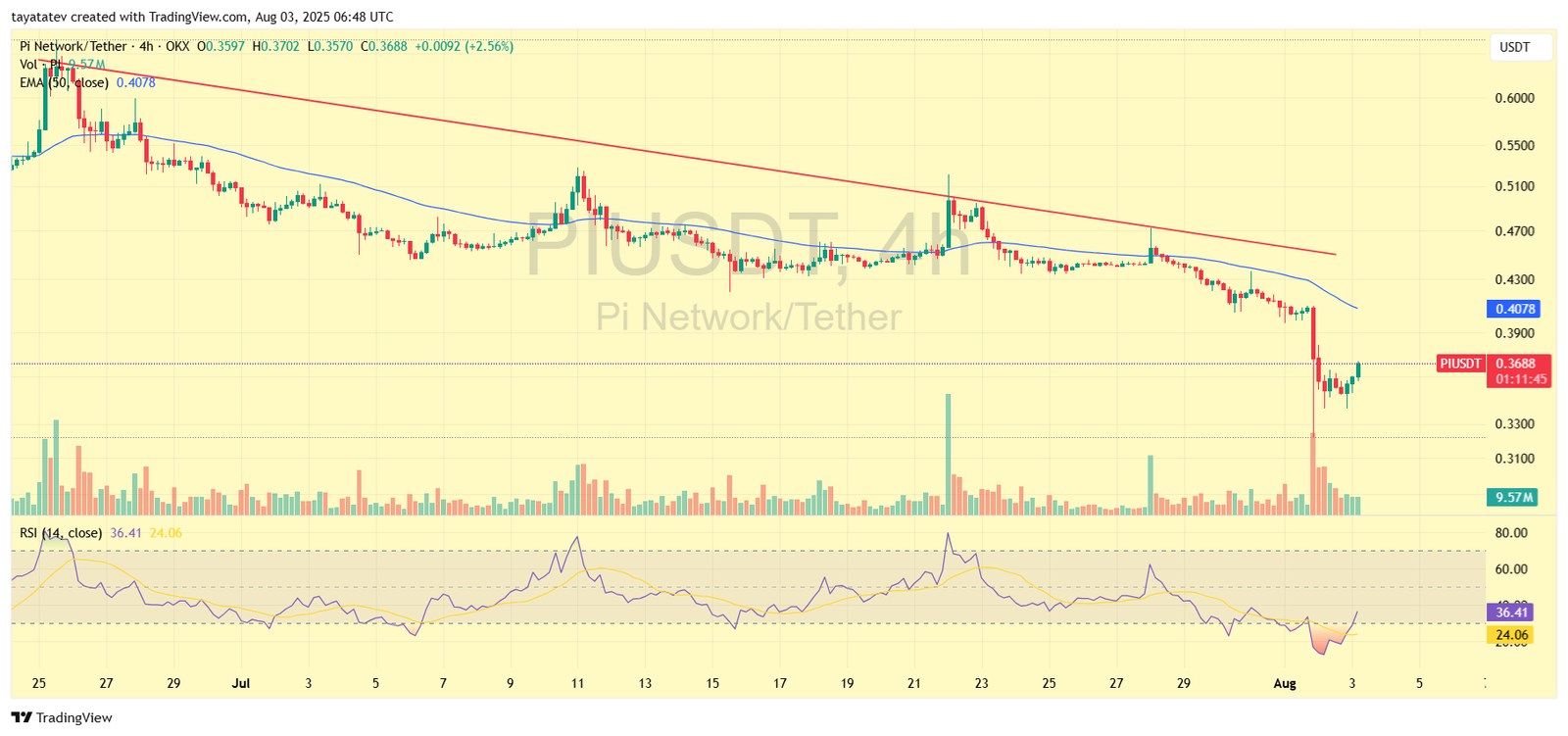
The Pi coin (PI/USDT) price chart from TradingView, dated August 3, 2025, displays a clear decline over recent weeks. The price fell from levels near $0.60 in late June to an intraday low close to $0.31 on August 2, 2025. This represents a drop of nearly 48% over this period.

Pi Coin Price Chart. Source: TradingView

The chart shows a downtrend marked by consistent lower highs, indicated by the red trendline. The 50-period Exponential Moving Average (EMA), shown at $0.4077, acted as resistance, with the price trading below it throughout July and early August.

The trading volume spike during the early August decline confirmed stronger selling activity, with volume reaching 7.92 million tokens during the sell-off. The Relative Strength Index (RSI), which measures market momentum, fell to 23.87 on August 2, indicating oversold conditions, as it dropped well below the neutral level of 50. By August 3, RSI slightly recovered to 33.76, signaling mild buying interest after the sharp fall.

The price is now at $0.3654, showing a small rebound from its lowest point but still far below its July levels near $0.47. This suggests sustained downward pressure on Pi coin, following both its steep price correction and broader market concerns tied to the network’s token unlock and ecosystem delays.

Pi Coin MACD Chart Shows Sustained Bearish Momentum

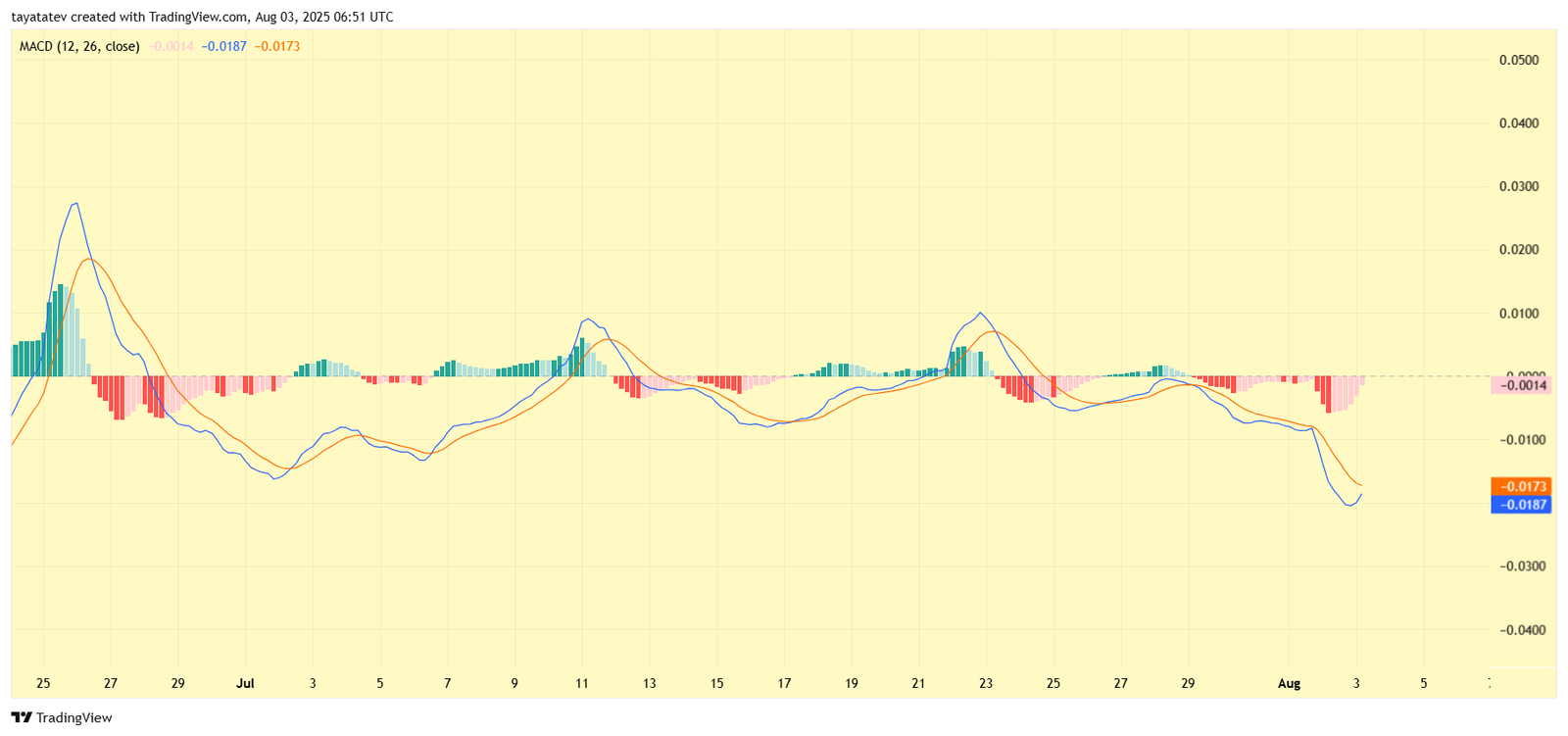
The Pi coin (PI/USDT) Moving Average Convergence Divergence (MACD) chart from TradingView, dated August 3, 2025, highlights ongoing downward momentum. The MACD line, currently at -0.0187, remains below the signal line at -0.0173, indicating continued bearish sentiment.

MACD Chart. Source: TradingView

The histogram, which measures the gap between the MACD line and the signal line, is still in negative territory at -0.0014, though it shows signs of narrowing slightly. This suggests that while selling pressure remains, it is slowing compared to the sharp declines seen in late July.

Throughout July, the MACD displayed multiple bearish crossovers, aligning with Pi coin’s steady price decline from levels near $0.47 toward the early August low around $0.31. The most recent crossover occurred in the final days of July, followed by deeper negative readings into early August.

These indicators confirm that Pi coin remains in a bearish phase, with selling pressure dominating over buying strength. Although the histogram shows slight improvement, the MACD and signal lines staying below zero point to a market still under pressure as of early August.

Pi Coin SMI Chart Indicates Weak Momentum Recovery

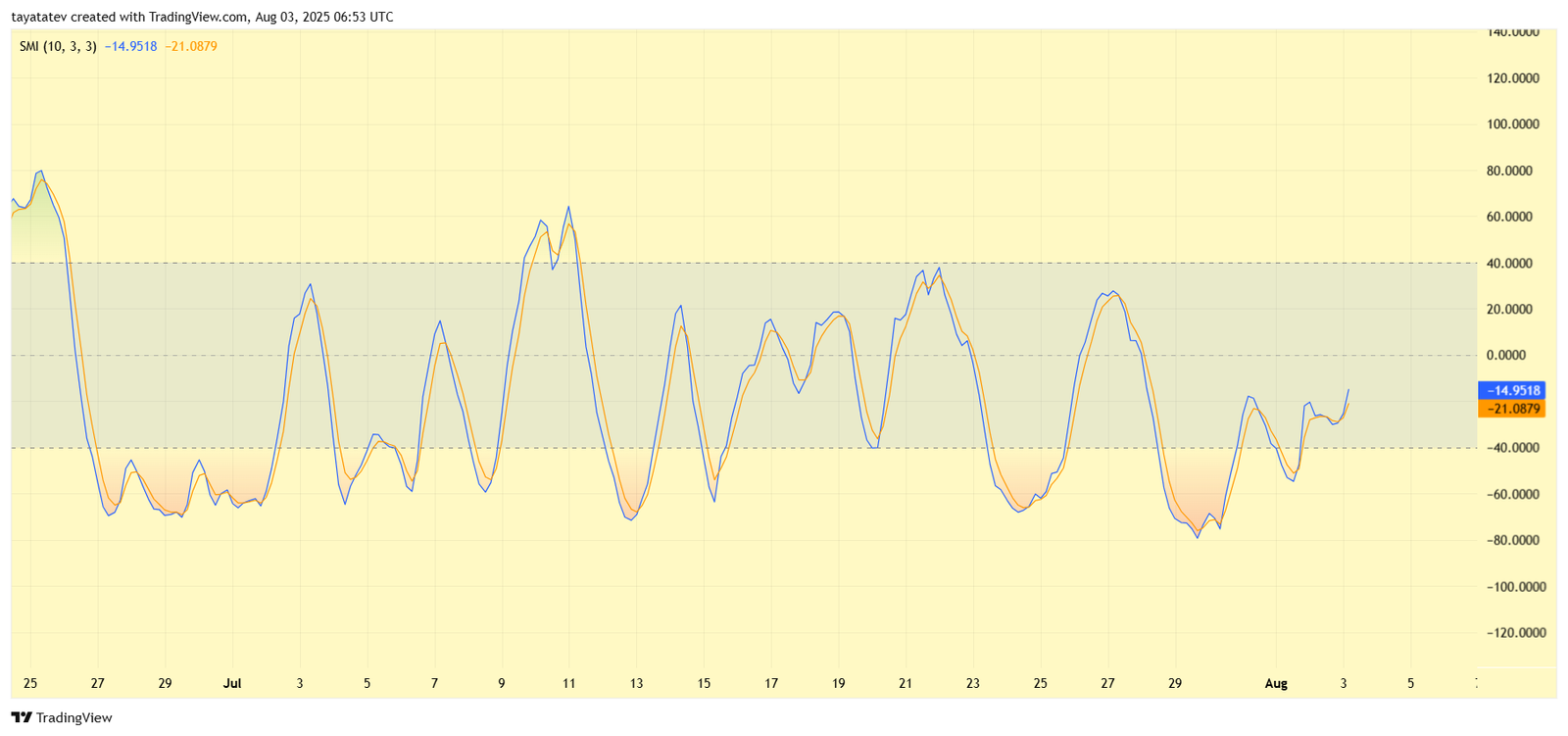
The Pi coin (PI/USDT) Stochastic Momentum Index (SMI) chart from TradingView, dated August 3, 2025, shows signs of slow recovery after a recent deep decline. The SMI value is currently at -14.95, with the signal line at -21.08, indicating that momentum remains in the negative zone but is improving slightly.

SMI Chart. Source: TradingView

During the last week of July, the SMI dropped sharply to levels near -80, reflecting strong bearish momentum. This decline coincided with Pi coin’s price fall to its recent low around $0.31. Since early August, the index has turned upward, suggesting easing downward pressure, though it has yet to cross into positive territory.

The repeated oscillations between negative and positive zones over the past month show that Pi coin experienced short-lived recoveries followed by renewed declines. The latest movement upward, while modest, suggests early signs of stabilization as selling pressure weakens. However, as of August 3, momentum remains subdued below the neutral level of zero.

Tatevik Crypto Journalist CoinChapter

Tatevik Avetisyan

Tatev Avetisyan is a Markets Writer and Analyst at CoinChapter, covering cryptocurrency markets, policy, and regulation. With over seven years of experience in business and marketing development, she has spent the past two years specializing in digital assets and has authored more than 2,000 articles on crypto markets and regulatory developments.She contributes as a guest writer to leading industry publications and is a prominent Web3 advocate in Armenia through Web3Armenia. Her work reflects a broader focus on artificial intelligence and Web3 technologies. Tatev maintains a diversified crypto portfolio, with Bitcoin as her primary holding above CoinChapter’s $1,000 disclosure threshold.