


Pi Network will face a major token unlock in the coming month. According to PiScan, 312.29 million PI tokens—worth $152 million at current prices—will enter circulation within 30 days.

This large unlock puts added pressure on the altcoin. Bullish sentiment around PI remains weak, and current market data shows low buying interest. As a result, there is little indication that demand will absorb the incoming supply.
If this demand gap continues, the unlock could increase selling pressure. More circulating tokens without matching demand would tilt the balance, likely driving PI’s price further down.
Pi2Day 2025: Pi Network Unveils Seven Major Ecosystem Updates
Meanwhile, Pi Network introduced Pi App Studio, a no-code tool that lets users build apps and chatbots using natural language. The feature targets non-developers and allows fast app creation without any coding. The tool offers two functions: a Topic-Based Chatbot Builder and an Open-Ended App Builder (in beta). Users can deploy apps inside the Pi ecosystem using the Pi Browser. They can also link their apps to the Pi Wallet, Pi ad network, and secure a .pi domain.

Alongside the studio, the team rolled out Ecosystem Directory Staking. This lets users stake PI tokens to boost apps they support. Higher staked apps appear more visibly in the directory. The feature replaces traditional ads with user-driven rankings, giving more power to the community.
Pi Network improved its backend and cleared KYC hurdles for many users. As a result, over 500,000 new users migrated to Mainnet. These fixes removed bottlenecks caused by technical checks and helped users with tentative KYC status clear final verification. The team also deployed new blockchain API servers, improving system capacity and migration speed.
The Pi desktop app—now called Pi Desktop—received a major upgrade. Version 0.5.2 brings a new design, security upgrades, window resizing, and public key display. Users can now identify their nodes more easily. The update improves support for larger screens and apps like App Studio. Meanwhile, the new Node Ranking Page lists the top 5,000 active nodes, tracking uptime, performance, and reliability.
Pi Wallet Adds Fiat On-Ramp Option
To support easier onboarding, Pi integrated Onramper, a fiat-to-crypto on-ramp tool, into the Pi Wallet. Starting in early July 2025, users will be able to buy PI directly using credit cards, Apple Pay, and local payment methods. This feature removes the need for external exchanges and simplifies crypto entry for users worldwide.
The .pi domain auction deadline has moved to Sept. 30, 2025. The Core Team said the extra time will help developers finish their apps before claiming a branded .pi address. These domains serve as app identifiers in the ecosystem’s Web3 infrastructure.
To mark Pi2Day, the Core Team launched a Pi2Day Ecosystem Challenge. Running from June 27 to July 7, the challenge walks users through new features like App Studio, staking, and domain bidding. Participants complete tasks to earn digital rewards while learning how to use the new tools.
So far, over 13 million users have moved to Mainnet. Tools like App Studio, staking, and domain auctions show real progress in building a utility-driven Web3 platform. Technical upgrades also reflect stronger decentralization.
However, many users still face KYC delays, especially in areas with limited verification access. The next phase will depend on how fast the team can solve these issues, maintain user trust, and expand beyond the test phase.
Pi Network Forms Falling Wedge, Signals 39% Potential Upside
The Pi Network to Tether (PI/USDT) chart on the 4-hour timeframe shows a falling wedge pattern that formed between June 26 and July 1, 2025. A falling wedge is a bullish reversal pattern formed by downward-sloping trendlines that converge as price moves lower.

The price broke out of this wedge on July 2, 2025, suggesting a potential bullish reversal. At the time of breakout, the price traded around $0.4923. If the pattern plays out fully, PI could rise by up to 39%, targeting a projected level near $0.6840.
The target comes from measuring the height of the wedge and adding it to the breakout point. The price currently trades below the 50-period Exponential Moving Average (EMA), which sits at $0.5263. A breakout above this EMA could confirm the trend shift and trigger stronger upward momentum.
The Relative Strength Index (RSI) reads 37.11, which suggests that the token remains in the lower range but is recovering from oversold conditions. Volume also shows a small increase near the breakout, supporting the bullish case.
If PI flips the EMA into support and maintains buying pressure, the next major resistance will likely appear near the $0.68 level. However, failure to reclaim the EMA could invalidate the breakout.
MACD Shows Weak Momentum for Pi Network
The Moving Average Convergence Divergence (MACD) chart for Pi Network (PI/USDT) on the 4-hour timeframe shows weak bullish momentum as of July 2, 2025. MACD stands for Moving Average Convergence Divergence and helps detect momentum shifts by comparing two exponential moving averages.
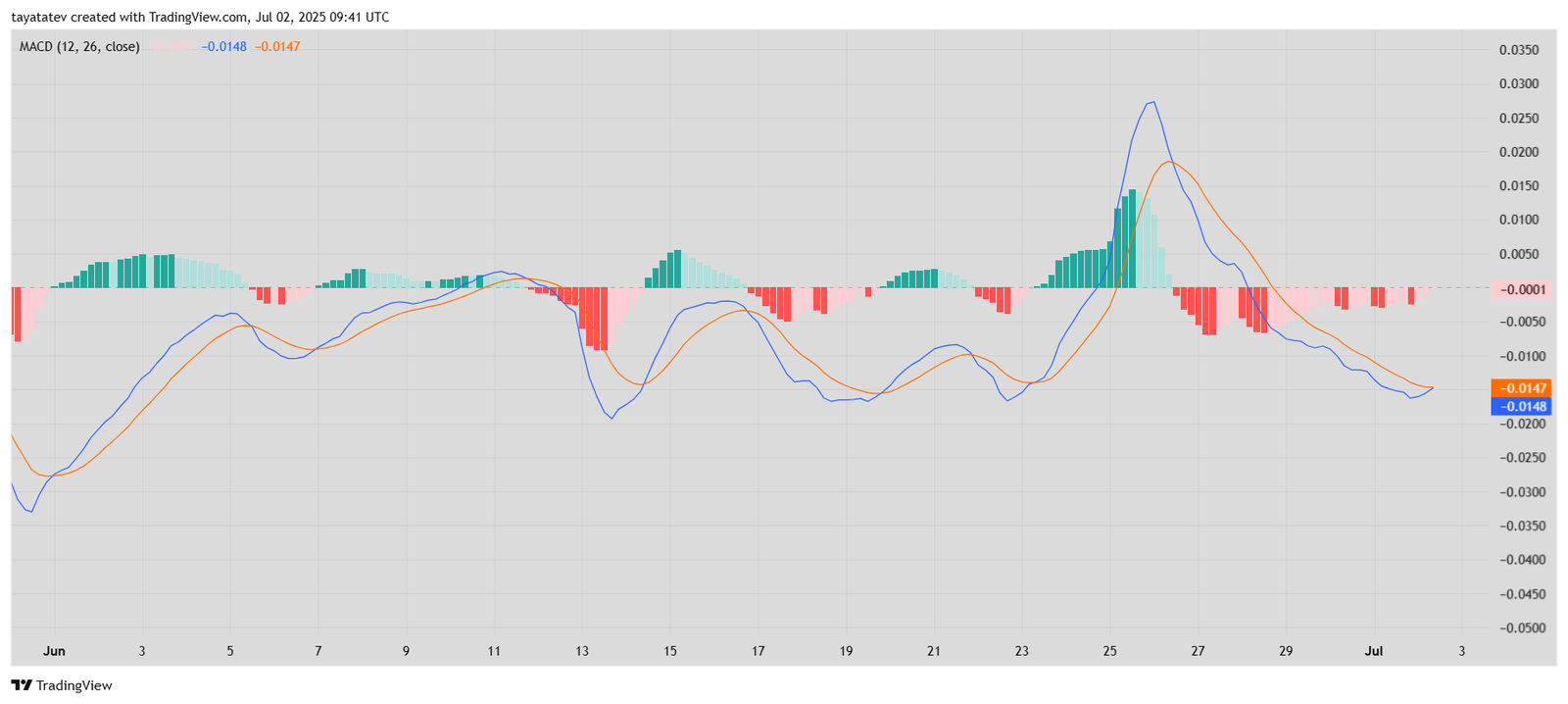
Currently, the MACD line (blue) is slightly below the signal line (orange), with both trending near –0.0148. This setup signals bearish momentum, but the gap between the lines is narrow, suggesting potential for a crossover.
The histogram bars remain negative but have started to shrink, indicating that bearish pressure is slowing down. This slowdown often happens before a trend reversal.
If the MACD line crosses above the signal line in the next few sessions, it would confirm a bullish crossover. That crossover, combined with the recent falling wedge breakout seen on the price chart, could support a move toward the $0.68 target.
Until then, the MACD confirms that momentum remains soft, and bulls have not yet fully taken control.


