



On May 14, 2025, Pi Network shut down its central node. The change came ahead of Consensus 2025 in Toronto. The core team also plans to release the Pi Network source code soon.
Pi Network VietNames confirmed the move on X, saying,
“The Pi core team has closed the central node, ready to release the source code.”

The post included a network diagram showing the central node was removed.
The shutdown follows Pi Network’s stated goal to remove central control and build a decentralized system. The blockchain uses an Improved Proof of Stake (IPoS) consensus model. This update brings attention to whether Pi Network now operates independently of its core team.
Pi Network Source Code Release to Increase Transparency
The Pi Network source code release aims to increase transparency. Users will be able to see how the Pi Network decentralization process works. Web3 researcher Tanner stated,
“Transparency Unleashed Anyone can audit the code. No more FUD about “centralized scams” or “hidden logic.” If there’s a bug or a backdoor? You’ll know. If the consensus model is secure? You’ll see it. This is credibility on the blockchain.”
However, Pi Network critics say key decisions remain in the core team’s hands. Pi Network’s referral-based mining and supernode model have raised concerns about decentralization.
As reported earlier, the Pi core team still selects supernodes. It also holds about 82.8 billion PI coins. This level of control continues to raise questions.
Pi Network Links Node Shutdown With Consensus 2025
The Pi Network central node shutdown was timed to match the start of Consensus 2025. The Toronto event began on May 14. Pi Network hinted at a major reveal in a May 8 post.
Pi UpdatesDaily shared a schedule:
“May 14: Announcement from Pi Ecosystem, May 15: Hint of something GREAT/GOOD, May 16: Dr Nicolas himself will speak.”
The post suggested multiple updates were planned.

Another message from May 13 said, “2025/5/14—Pi is about to Boom.” These posts came just before the Pi Network decentralization update was confirmed.

Pi Network representatives are attending Consensus 2025. The event includes one of the largest blockchain gatherings globally. The Pi Network Consensus 2025 appearance adds weight to its announcements.
Pi Network Features Still Blocked in Some Regions
Despite the Pi Network decentralization step, access to some features remains limited. In several regions, users report they need a virtual private network (VPN) to use functions like “lightning.”
Pi users also remain under a closed mainnet system. Coin transfers are restricted. These limits continue to raise concerns about how open the ecosystem really is.
The Pi coin has also not been listed on any major centralized exchange. This has kept many users from using or trading their tokens freely.
On May 14, both the Pi app and the Pi Browser received updates on the Google Play Store. The timing came hours before the first Pi Network Consensus 2025 announcement.

Community leaders pointed out the update, highlighting it as a possible link to the planned reveal. The Pi app now has over 100 million downloads. The Pi Browser app has more than 10 million.
The apps play key roles in the Pi ecosystem. Users mine the Pi coin using the Pi app. They access decentralized applications using the Pi Browser. Even so, activity and usage levels are not fully clear.
PIUSDT Forms Rising Wedge After Volatile Climb on May 14
On May 14, 2025, the PI/USDT trading pair on OKX was priced at $1.1956. The 1-hour candlestick chart shows the price formed a rising wedge pattern after a sharp rally between May 10 and May 12. The price surged from below $0.80 to over $1.60 before retracing and consolidating within converging trendlines.
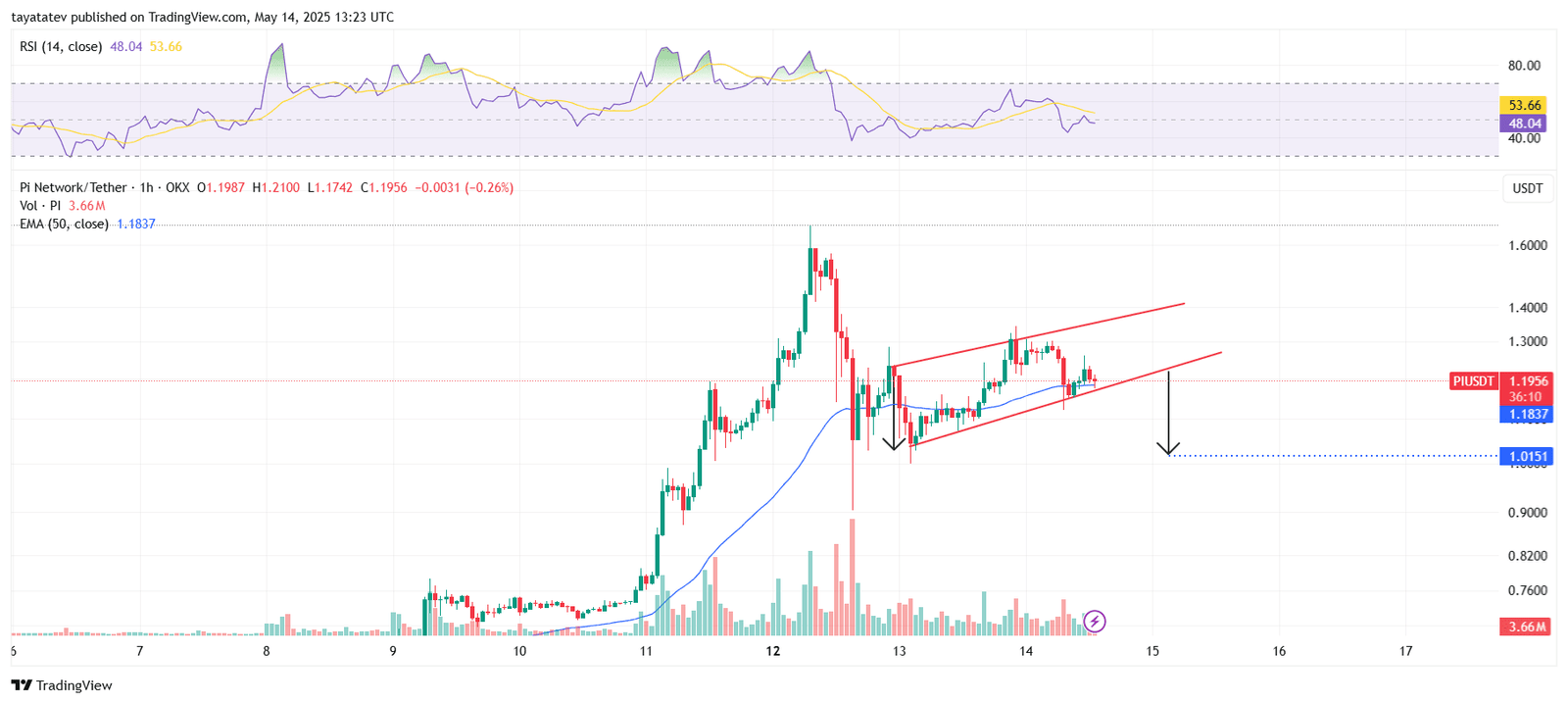
A rising wedge is a bearish chart pattern where the price climbs within two upward-sloping, narrowing lines. It usually appears during corrective moves after sharp gains and often leads to a breakdown below the lower trendline.
In this chart, the lower trendline starts near $1.02, while the upper trendline caps out near $1.40. The price has already tested the lower boundary several times and is now trading close to $1.20. If the wedge breaks to the downside, the measured move suggests a possible 15% drop from the breakout point. That would place the next key target near $1.0151, matching the dotted blue line drawn on the chart.
Meanwhile, the 50-period Exponential Moving Average (EMA), currently at $1.1837, acts as dynamic support. The price has moved sideways above this line since May 13. A firm breakdown below the EMA could confirm bearish momentum.
The Relative Strength Index (RSI), a momentum indicator, shows a current value of 48.04. This level is below the midline of 50, signaling weakening bullish strength. Earlier, the RSI crossed above 70 during the May 12 rally, indicating overbought conditions, but has since cooled off.
Volume data shows reduced trading activity following the May 12 peak. The current hourly volume stands at 3.66 million PI. Lower volume during a rising wedge often precedes a breakout, as it reflects decreasing interest during the upward correction.
The pattern becomes significant due to the timing. On May 14, Pi Network shut down its central node and prepared to reveal its source code during the Consensus 2025 event in Toronto. The price action appears to have responded to this announcement but remains within a technical structure that hints at possible downside movement.
If the pattern confirms, the PI/USDT pair could revisit $1.01, a level that previously acted as a support base during May 13’s rebound. This zone also aligns with volume clusters visible in the left part of the chart, where buyers stepped in after the earlier drop.
Until a breakout occurs, the price will likely continue oscillating between the wedge boundaries. Traders will watch closely for a move below the trendline and the 50-period Exponential Moving Average to confirm bearish momentum.


