



Pi Network has started the rollout of its V23 upgrade, modeled after Stellar Protocol 23. The deployment follows a phased approach, moving from Testnet1 to Testnet2 and then to Mainnet. The update aims to strengthen blockchain stability, improve scalability, and expand cross-chain compatibility. Developers highlight that this transition will create a more resilient network infrastructure.
While the technological step is significant, market response has remained muted. Analysts note that the upgrade shows Pi Network’s focus on infrastructure rather than speculative activity.
The project has introduced a Linux node client, expanding beyond its existing Windows and Mac options. The move opens participation to a wider base of developers and operators, reinforcing decentralization. Linux remains a preferred operating system among developers, particularly in blockchain environments where stability and open-source flexibility are valued.

The addition is expected to increase the number of active nodes, strengthening the security and reliability of the network.
PiNet Platform Brings Browser Access
Pi Network also launched PiNet, a browser-based platform accessible through Chrome and Safari. The feature allows users to connect directly to Pi applications, offering a smoother transition from Web2 to Web3 services. This expansion lowers the barrier for adoption by enabling users to engage without requiring separate installations.
The initiative underscores Pi Network’s strategy to position itself as a bridge between mainstream internet users and blockchain-based ecosystems.
The project has reduced its mining rate by 1.23%, bringing the base rate to roughly 0.0027405 Pi per hour. This change aligns with Pi Network’s gradual supply control strategy, which aims to balance token issuance with long-term sustainability. At current settings, users mining without bonuses generate about 24 Pi annually.
At the same time, the network resolved a widespread issue affecting wallet access, where users faced “Failed to Load Mainnet Wallet” errors. The fix involved cache clearing and DNS adjustments, restoring access and improving reliability for account holders.
Pi Network Faces Prolonged Downtrend With Key Resistance in Focus
Pi Network’s price action on thePI/USD 4-hour chart shows a persistent decline under a descending resistance line. Since late July, every rebound attempt has failed to break above this trendline, reinforcing bearish control. The most recent move saw Pi touch resistance near $0.38 before sellers regained momentum, driving the price back toward the $0.34 zone.

The 50-period exponential moving average at $0.3529 currently caps upside attempts, acting as an additional resistance layer. Price action continues to trade slightly below this level, indicating weak buying pressure. At the same time, trading volume has thinned compared to earlier spikes, showing reduced conviction among market participants.
Momentum signals reinforce this picture. The Balance of Power indicator sits near 0.35, reflecting sellers’ dominance despite short bursts of recovery. Unless Pi Network breaks decisively above the descending resistance and the EMA, downward momentum is likely to persist. If the rejection continues, price could drift back toward the $0.32 support area, while only a breakout above $0.38 would shift the short-term outlook toward recovery.
Pi Network RSI Signals Weak Momentum but No Clear Breakout
Pi Network’s 4-hour RSI chart shows the indicator sitting around 43.32, with its signal line at 44.05. This level keeps RSI below the neutral 50 mark, reflecting weak bullish momentum after the recent drop from overbought conditions near 70. The decline in RSI during early September confirms that sellers regained control, pushing the token into a consolidation phase.

Throughout July and August, RSI frequently spiked into overbought and oversold zones, showing sharp volatility in short cycles. Each push above 70 quickly reversed, while moves under 30 sparked brief recoveries. At the current reading near the mid-40s, the market stands in a neutral-to-bearish zone, suggesting buyers lack the strength to reclaim dominance.
If RSI continues to hover under 50, downward pressure may persist, aligning with the broader trend capped by the descending resistance line seen on the price chart. A rebound would require RSI to cross above 50 with follow-through, which could open space for a retest of resistance levels. Until then, momentum remains fragile, and Pi Network’s market is leaning toward caution rather than a decisive rally.
Pi Network MACD Shows Weak Recovery Momentum
Pi Network’s MACD on the 4-hour chart signals fragile recovery attempts after a recent bearish phase. The blue MACD line sits at -0.0024, while the orange signal line stands at -0.0029, with the histogram barely positive at 0.0005. This setup reflects an early bullish crossover, but the strength of momentum remains limited.
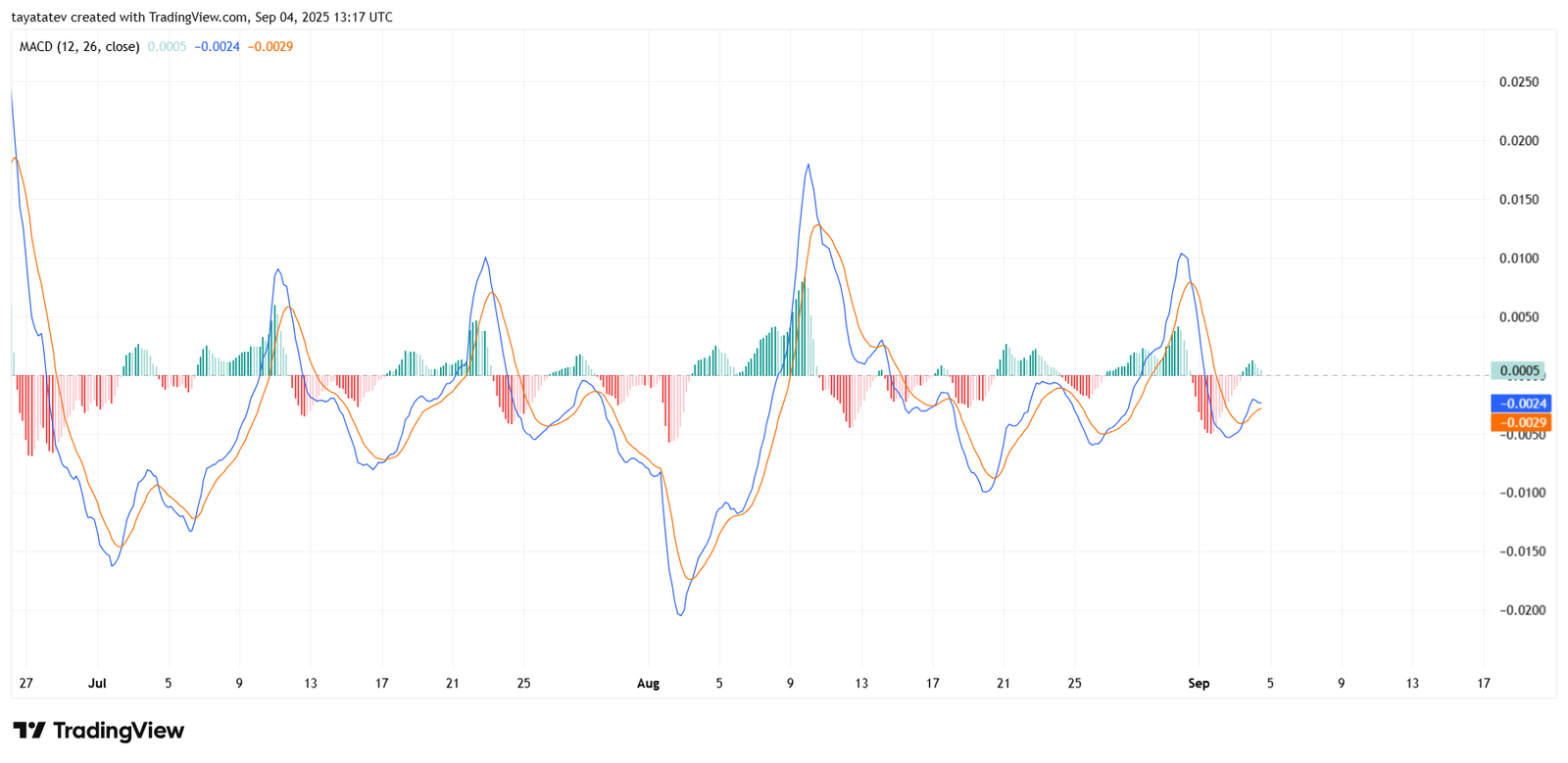
Earlier in August, strong bullish crossovers produced sharp spikes in the histogram, followed by equally rapid declines. Each time, buyers failed to sustain pressure, leading to renewed downside. The current crossover is modest compared to those peaks, which indicates that the market is testing for direction rather than building a strong trend.
As long as the MACD remains close to the zero line, Pi Network’s price is likely to consolidate without a decisive move. If the histogram expands further into positive territory, it could confirm stronger bullish momentum toward a resistance retest. However, a quick fade back below zero would reinforce bearish pressure and extend the consolidation phase.


