



Pi Network’s upgrade track to protocol version 23 moved through the final Testnet1 stage, according to multiple industry reports published today and yesterday. The outlets describe v23 as the last Testnet1 step before Testnet2 and then Mainnet, aligning with the Core Team’s previously published roadmap.

The project’s documentation frames v23 as a Pi-customized stack drawing from Stellar protocol 23, designed to add control layers and new functionality. The team also warned that phased rollouts could require short, planned service interruptions as partners apply changes.
While today’s coverage points to progress, Pi’s official channels have emphasized staged transitions rather than a single switch. The path remains Testnet1, then Testnet2, then Mainnet, with coordination across nodes and ecosystem apps.
Linux Node release broadens support
Pi released an official Linux Node build, extending support beyond Mac and Windows to common server environments. The team highlights standardized packages, auto-update options, and documented installation steps to replace bespoke community builds.
The PiCoreTeam reiterated the release on social channels, noting developer demand and immediate relevance for partners running Linux infrastructure. The move reduces friction for validators and services that prefer containerized or bare-metal deployments.
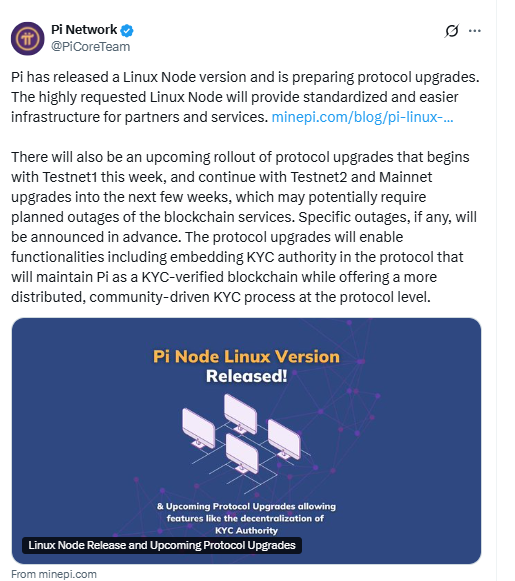
In earlier notes, the Core Team linked the Linux availability with the v23 series, positioning the operating-system expansion as part of broader readiness work for the Open Network era.
Hackathon 2025 targets Mainnet-ready apps
Pi opened Hackathon 2025 on August 21 and set the window through mid-October, with total rewards of 160,000 Pi. The program asks teams to ship utility-focused apps that work in the Open Network context and demonstrate real-world use.
Program materials detail prize tiers and selection criteria, signaling an emphasis on on-chain functionality, user experience, and compliance with platform standards. Community channels and exchanges echoed the kickoff and prize pool.
The hackathon sits alongside the protocol upgrades, giving developers time to build against evolving nodes and SDKs while the network completes staged transitions. That cadence keeps app delivery in step with infrastructure rollout.
.pi domains auction sustains ecosystem identity
Pi continues its .pi domains auction, a platform-level utility meant to anchor app and business identities inside the ecosystem. Official posts describe the auction as a way to standardize naming for stores, apps, and content as the network opens.
The team positions domains as part of a broader utility strategy, combining community participation with external connectivity during Open Network. Developers can align brand assets and user-facing endpoints with their on-chain services.
Timing overlaps with the hackathon window, which gives builders additional weeks to secure names while they finalize submissions. That sequencing supports app discoverability and long-term maintenance.
Founder to speak at TOKEN2049
Pi cofounder Chengdiao Fan will speak at TOKEN2049 in Singapore on October 1–2. The Core Team says her session will focus on real-world utility, Web3 frictions, and paths to broader adoption.
Regional media underscored that the appearance marks Fan’s first public talk since the project’s launch, adding context to Pi’s presence on a major industry stage this fall. Coverage ties the talk to the network’s open-phase messaging.
Together, the speaking slot, Linux Node release, hackathon timeline, and domains program outline a coordinated push on developer readiness and identity as protocol v23 progresses through Testnet.
PIUSDT 4 hour chart tests descending trendline
September 16, 2025. PIUSDT traded near 0.355 on OKX after slipping about one half percent intraday. Price briefly reclaimed the 50 period exponential moving average around 0.354, then stalled beneath a multi week descending trendline that has capped rallies since July. The recovery from last week’s spike toward 0.38 lost momentum as sellers appeared at the trendline.
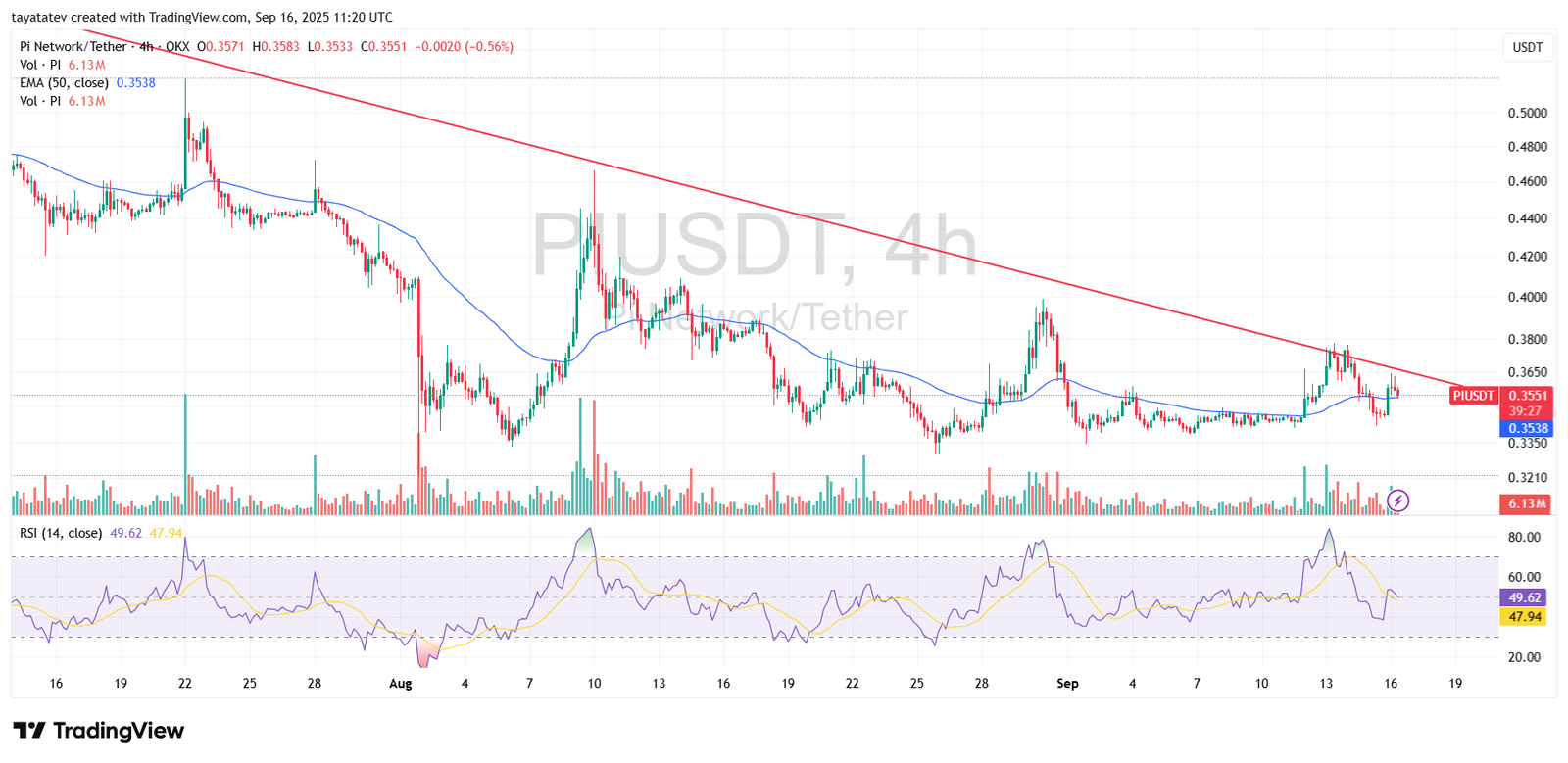
Momentum signals stayed neutral. The relative strength index hovered near 50 after easing from earlier overbought readings, which indicates neither side holds a clear edge. Volume looked moderate compared with prior impulsive moves, and the flattening 50 period average showed balance while the broader structure still pointed lower.
Into the next sessions, the trendline near 0.36 to 0.37 remains the pivot. Rejection there keeps risk skewed toward support around 0.335, with a secondary shelf near 0.321 if pressure builds. However, a firm four hour close above the trendline and follow through over 0.370 would shift the bias to the upside, opening room to retest 0.38 and then the round number at 0.40.
PIUSDT 4h MACD slips below signal
The four hour Moving Average Convergence Divergence shows momentum cooling. The MACD line edged under the signal line near the zero axis, and the histogram flipped slightly negative. That shift follows a short bullish burst over the weekend and signals fading upside pressure in the very near term.
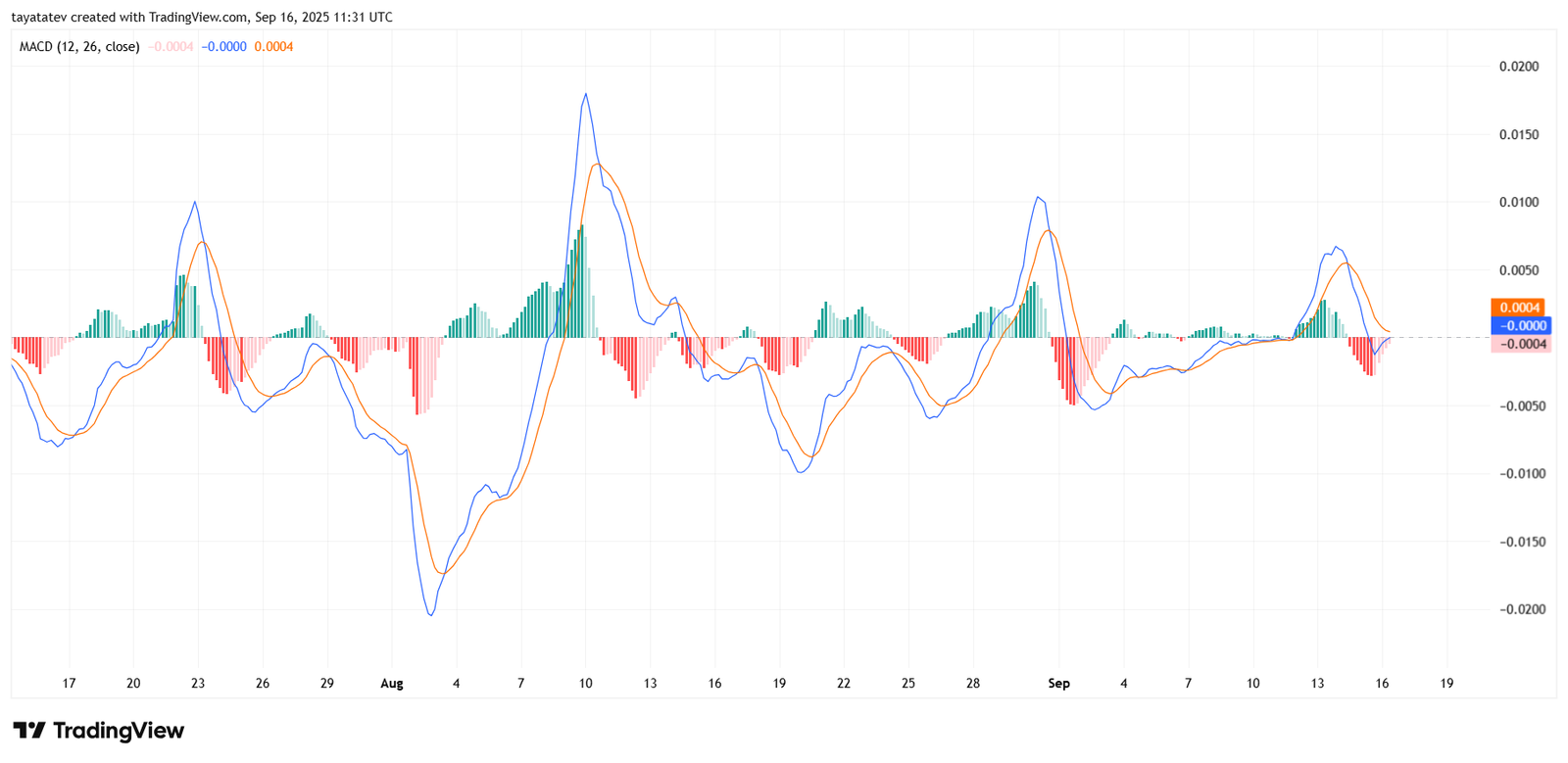
Through the past month, each strong green histogram build faded within a few sessions. The latest cycle peaked around September 14–15, then bars contracted toward zero before today’s slip. Because the crossover happened at the zero line, the market sits at an inflection point where small price moves can quickly flip momentum again.
If price remains capped under nearby resistance, a stay below the signal line would keep bias neutral to soft until the histogram expands again. However, a quick recapture of the signal line with rising positive bars would restore short term momentum and validate another attempt to push higher.


