



Shibarium’s bridge remains in containment while developers push decentralization fixes. In a late-September update, core developer Kaal Dhairya said attackers used unauthorized validator signing power on September 12 to push a malicious exit through the PoS bridge. The team froze bridge operations, began outside reviews, and outlined steps to harden validator controls before any phased reopening. The blog labels the current state as “containment holding,” with investigations active and timelines communicated only through official posts.
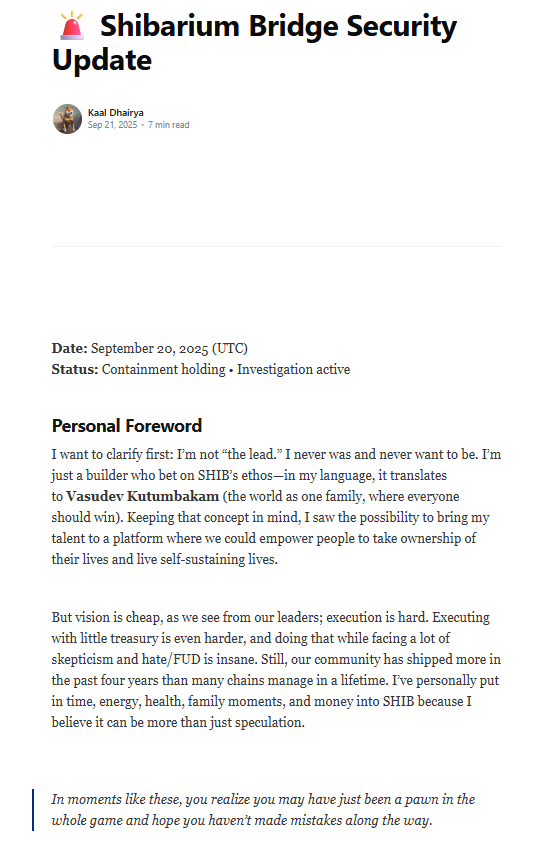
Bridge security: what happened and what changes next
Developers described the exploit method in detail: short-lived stake amplification combined with forged checkpoint and exit proofs enabled withdrawals, indicating problems in validator key protection rather than a single contract bug. They said emergency actions limited losses and revoked attacker permissions while auditors review the flow. Today’s status remains unchanged: the bridge stays paused until the audits conclude and new operational policies go live.
The next phase centers on decentralization. The team committed to stronger key management and a broader validator set to cut single-point risks. They framed these controls as prerequisites for reactivating normal bridging, with restoration staged and monitored. The update stresses that only the project’s blog will post the green light; no alternate channel has published a reopening date.
Independent summaries align on the incident’s contours. Security write-ups and exchange briefings point to a validator governance capture aided by flash loans, with loss estimates in the low-to-mid single-digit millions. Those reports track subsequent on-chain movement and reiterate that Shibarium’s base chain continues operating while the bridge is isolated for review.
Governance today: Doggy DAO adds flexible voting models
Away from the bridge, Shiba Inu’s governance arm widened participation tools. In August, the Doggy DAO introduced multiple voting methods, allowing proposals to use staking-based votes, direct ERC-20 token voting, or quadratic voting. The change aims to broaden turnout and reduce the outsized sway of large holders. Today’s ecosystem notes still reference this shift because it governs how new proposals will advance while security work continues.
Project channels framed the update as part of a longer decentralization push. Posts around LEASH v2 and DAO outreach emphasized bringing more holders into formal decision-making while the core team implements technical hardening on Shibarium. That positioning keeps governance active without relying on bridge throughput.
Aggregators and explainers echo the same architecture: community voting now spans several strategies, with identity-based options under discussion. That context matters today because any parameter change tied to bridge relaunch—like validator policies—will route through these DAO processes and their newer voting rails.
Ecosystem signals: burns and community activity
On supply activity, third-party trackers provide a running ledger of burn transactions. The live dashboards offer raw transaction links and totals rather than commentary, letting observers separate daily noise from multi-day trends. Today’s community chatter cites those ledgers to gauge whether post-incident activity is normalizing.
Some news roundups noted flat or low 24-hour burns at points this week, which underscores the value of checking the primary ledger rather than relying on snapshots. The tracker’s methodology clarifies that burns count only transfers to dead wallets and the Genesis address, which reduces supply. That definition keeps daily comparisons consistent as community projects resume routines.
For operational news, the project’s announcements blog remains the authoritative source. Today, no new post adds a bridge reopening date or changes the security posture. Coverage continues to reference the September 20 update as the latest official note, with developers reiterating that audits and decentralization steps must complete first.
Shiba Inu nears key support as traders eye a possible rebound zone
Shiba Inu is pressing a long-watched horizontal level around $0.00001150. TheCryptoBasic highlighted an X thread noting analyst “Coinvo” sees SHIB approaching a “critical” area. Although the post mentioned “resistance,” the attached TradingView chart marks the line as support, with prior bounces clustered along the same band. The setup puts SHIB at a decision point where market structure either holds or breaks.
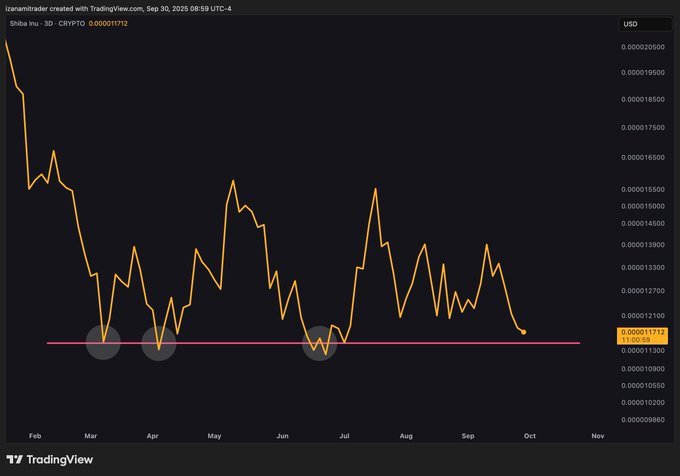
SHIB is revisiting the same horizontal level that the chart shows as a base through multiple earlier swings. Each touch previously produced rebounds, which is why technicians track the line as a “rebound zone.” The current move brings price back to that band, compressing volatility against a flat support.
Moreover, the highlighted circles on the chart mark several contacts with this line across spring and early summer. Those reactions built a case that buyers defend this area. Consequently, a fresh test draws attention because repeated interactions can either strengthen a level through acceptance or weaken it through attrition.
At the same time, the broader context matters. The three-day view in the image shows a sequence of lower highs since late summer. That pattern keeps near-term momentum soft even as price meets support. Therefore, traders will focus on whether this level holds long enough to reverse that series.
How earlier reactions frame today’s setup
Earlier in the year, the same support repelled declines and launched counter-trend rallies. Those moves did not create a new uptrend, yet they restored range equilibrium. Thus, the market treated the band as fair value after sharp sells.
Additionally, liquidity tends to pool near obvious levels. As price returns to the line, stop orders and resting bids can accelerate the next move. A clean rebound often starts with a swift wick through the level followed by a close back above it; a failure usually shows the opposite: a firm close below and a weak retest from underneath.
However, the posted chart does not include volume or momentum overlays. Because of that, analysts will usually pair this structure with confirmation tools—like a momentum divergence or an expansion in traded volume—to separate routine “tags” from higher-quality reversals.
Momentum, range, and risk factors
Structurally, SHIB has carved a broad range this year, with the $0.00001150 area acting as the lower boundary on the displayed timeframe. Lower highs into support describe a compression that often resolves with an impulsive move. Direction depends on whether buyers can print a higher low after contact.
Yet, near-term bias remains cautious while the series of lower highs persists. A rebound needs follow-through—strong bodies on candles and acceptance back into the mid-range—to shift momentum. Without that, bounces can fade into another test of the base.
External catalysts still influence the tape. Headlines around Shibarium’s security hardening, bridge status, burn-rate chatter, or broader “altseason” narratives can change risk appetite quickly. Therefore, structure provides the map, while catalysts decide timing.
October seasonality claims and why they’re only context
Community commentator “Shib Spain,” cited by TheCryptoBasic, floated that altseason could begin in October. The same thread listed SHIB’s October gains in prior years: roughly 833% in 2021, 10.4% in 2022, 6.04% in 2023, and 2.46% in 2024. Those figures explain why some traders watch this month.
Even so, seasonality is context, not a catalyst. Market regimes differ. The explosive 2021 move occurred during a broad speculative cycle, while subsequent Octobers delivered far smaller advances. Present structure and liquidity conditions outweigh calendar effects.
Therefore, today’s focus returns to the charted level. If the market treats $0.00001150 as fair value again, seasonality may amplify a bounce. If not, historical returns will matter less than the immediate breakdown mechanics.
What would typically confirm a bounce or a breakdown
Technicians usually look for a forceful close back above support, followed by a higher low on the next pullback, to validate a rebound. That sequence shows buyers doing more than defending an intraday wick; it shows control transferring back to demand.
Conversely, a decisive close below the band, then a retest that fails to reclaim it, often confirms a breakdown. In that case, the former support can act as resistance, opening a lower range until new demand emerges.
In parallel, observers monitor correlated signals: risk appetite across large-cap alts, BTC dominance shifts, and any project-specific updates that alter flows. These elements help explain whether the move is idiosyncratic to SHIB or part of a wider market rotation.


