



Solana moved into Korea’s regulated finance lane today. The Solana Foundation signed a memorandum of understanding with Wavebridge, a Seoul-based infrastructure firm, to explore a Korean won-pegged stablecoin and institutional tokenization products. Korean outlet Maeil Business Newspaper and multiple crypto media confirmed the agreement on Oct. 14.
The scope goes beyond a single token. Materials describe parallel work on a verification engine and money-market fund tokenization, with education tracks for banks. That framing places Solana’s push inside existing compliance rails rather than only consumer apps. It also aligns with ongoing efforts to build regional liquidity hubs that speak the language of local regulators.
This Korea move matters because domestic payments and savings products typically require clear settlement and reporting paths. A KRW stablecoin, if executed with bank-grade partners, gives institutions a way to test tokenized cash and funds without FX friction. As a result, Solana positions itself where banks already operate: deposit-like instruments, fund shares, and auditability.
CME highlights record interest in regulated SOL exposure
On the same news day, CME Group’s October crypto insights flagged all-time highs for demand in Solana futures during Q3. The note, published today, situates SOL alongside XRP as the contracts drawing increased institutional use on a regulated venue. That emphasis keeps the story squarely on market structure, not spot price.
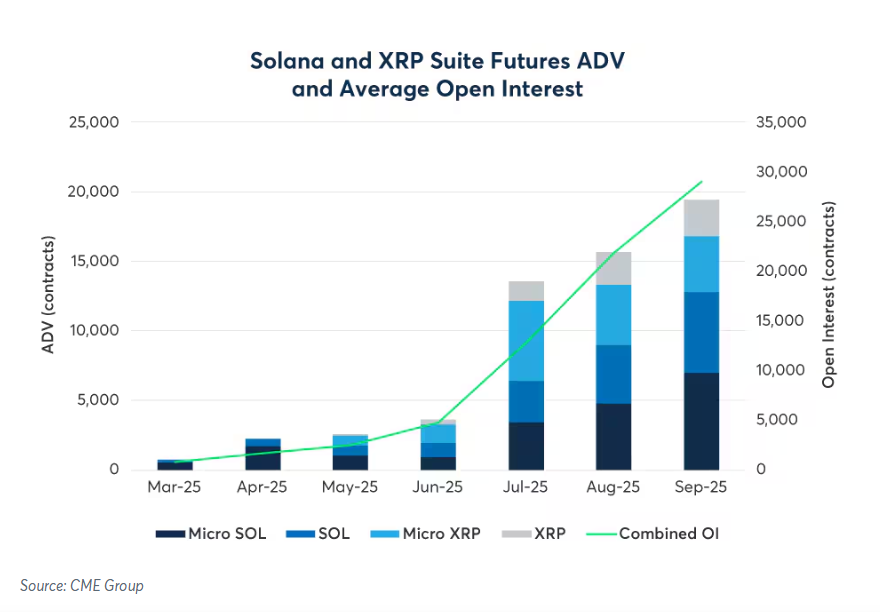
Regulated derivatives matter for desks that must route through compliant venues. With deeper futures activity, risk teams can hedge or express views using tools their mandates allow. Therefore, any growth in open interest or volumes on CME typically precedes broader adoption inside banks and asset managers.
This institutional lens also ties back to the Korea development. If local firms pilot KRW-based stable instruments on Solana while global desks manage exposure via CME futures, the network gains a two-sided on-ramp: regional settlement rails plus offshore hedging capacity. That is how tokenized finance scales without forcing policy changes first.
ARK’s Q3 read: Solana leads in “real economic value”
Adding context, ARK Invest’s DeFi Quarterly: Q3 2025—covered today by industry press—estimated Solana’s “real economic value” at $223 million for the quarter, leading major chains on that metric. While the methodology focuses on on-chain revenue drivers rather than market cap, it captures activity that institutions watch: fees paid, user behaviors, and protocol cash flows.
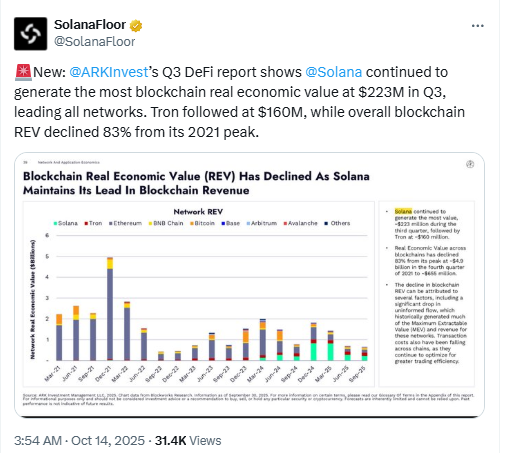
Because the figure aggregates value generated on the network, it supports the view that developers and end-users are transacting in ways that produce measurable revenues. That strengthens the case for banks and fintechs to run pilots where cost and throughput matter. It also complements today’s Korea news by showing a base of usage that a KRW stablecoin or tokenized fund could plug into.
In summary, today’s Solana headlines point in one direction: regulated rails. A KRW stablecoin initiative with Wavebridge, record CME futures interest, and ARK’s Q3 activity snapshot all signal the same theme—build for institutions first, then widen the circle.
Analyst projects Solana path to $300 this week
A trader posting as QuantumFox said Solana could reach $300 this week. The chart shows price rebounding from a falling channel and approaching the upper trendline. The projection sketches a brief pullback near the breakout level and then a sharp extension toward the $300 area.
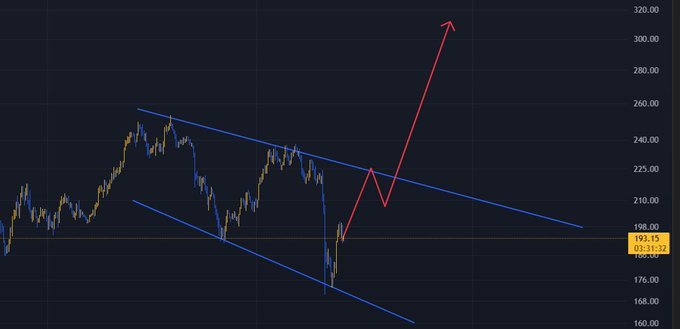
The setup relies on a clean break above the descending resistance. In the image, price hovers around $193 while the channel cap sits slightly higher. Therefore, the idea assumes momentum holds, volume expands, and resistance turns into support after the first retest.
However, timing remains the key uncertainty. The forecast compresses a multi-leg move into a few sessions. As a result, any failure to reclaim and hold above the upper boundary would delay or invalidate the path. The post frames it as a scenario, not a confirmation.
Solana tests support after breakout — what the pullback means
Solana is retesting the first resistance pivot (R1) at $196 after a clean breakout. In pivot terms, R1 often flips from resistance into support once price closes above it. Therefore, today’s dip toward $196 functions as a role-reversal check: if buyers absorb supply here and print higher lows, the breakout remains valid. On the posted chart, price hovers near $199, so the market is probing but not violating that level.
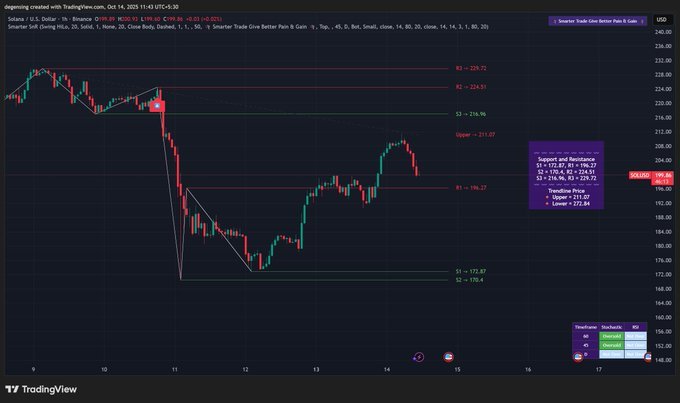
The mechanics are straightforward. Breakouts that stick usually show three things in sequence: a push through resistance, a retest of that same line from above, and then continuation. The retest lets late buyers enter at defined risk while forcing weak hands to exit. As a result, the $196 area matters less as a single tick and more as a zone. Intraday wicks below are common, but sustained closes back above keep the structure intact. Volume helps confirm the defense; rising buy-side activity on the retest signals committed demand rather than a reflex bounce.
If $196 holds, the chart maps a measured path higher. The next reference levels sit near $211, $224, and $230, which align with prior congestion and pivot bands on the screenshot. Each zone is a checkpoint for trend strength: acceptance above $211 often invites tests of the higher bands, while rejection there implies more time inside a range. Conversely, a decisive close below $196 would shift attention to $172, the next visible support shelf from recent lows. Importantly, even a move to $172 does not break the broader recovery as long as the market preserves higher lows versus the capitulation spike; it simply stretches the retest.


