


SwissBorg said an unauthorized party accessed a wallet used for its Solana staking operations on September 8 and removed funds. The firm paused SOL staking and began an incident response with security partners. It also said it would work on reimbursements while the investigation continues.
Kiln, SwissBorg’s staking partner, was named in external reports describing an API compromise that enabled the withdrawal of roughly 193,000 SOL, worth about 41 million dollars at the time. SwissBorg stated that the event was confined to the staking wallet and did not affect other products. The companies have not disclosed the precise technical indicators that triggered the alert.
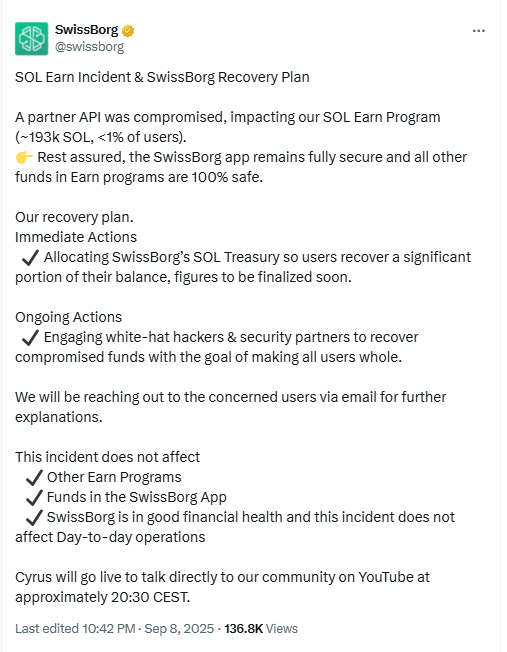
SwissBorg has not reported service-wide downtime. However, it reiterated that staking remains paused while the teams trace transactions and coordinate with law enforcement. The firm has continued communication via status posts and a joint statement with Kiln as it works through recovery steps. SwissBorg
Forward Industries closes 1.65 billion dollar placement to build a Solana treasury
Forward Industries said it closed a 1.65 billion dollar private placement in cash and stablecoin commitments to fund a Solana-focused corporate treasury strategy. The company framed the plan around acquiring SOL and increasing SOL-per-share over time through active treasury management. The announcement followed earlier disclosures about a pivot toward digital assets anchored in Solana.
Coverage noted participation from Galaxy Digital, Jump Crypto, and Multicoin Capital and flagged initial share-price moves in pre-market trading after the update. The firm also outlined governance changes aligned with the new strategy. The transaction ranks among the largest capital raises tied to a public company’s single-chain treasury plan.
Additional market reports this week repeated the size of the placement and the Solana-first positioning. They also placed the news in the context of other corporate digital-asset treasuries. Forward Industries did not provide a day-by-day purchase schedule for SOL, and the company said it would manage exposure under its treasury program.
Galaxy Digital tokenizes public shares on Solana via Superstate’s Opening Bell
Galaxy Digital said its Class A common stock is now available as SEC-registered tokenized shares on Solana through Superstate’s Opening Bell platform. The arrangement keeps shareholder rights intact while enabling on-chain transfer and record-keeping. Galaxy characterized the step as part of a broader push to migrate capital-markets infrastructure onto public blockchains.
Independent coverage said tokenized shares had begun to circulate on Solana and described the move as a first for a U.S.-registered company. Reports also highlighted the longer-term aim of enabling 24/7 transferability and faster settlement, subject to regulatory constraints.
Legal advisers also outlined the platform’s compliance posture and described Opening Bell’s role within Superstate’s product suite. Those notes placed the listing in the context of tokenized funds and stable instruments that interact with traditional custodians and transfer agents.
R3 launches Labs division to extend tokenized assets to Solana
R3 unveiled “R3 Labs,” a unit focused on bringing real-world assets to public chains, starting with Solana. The company saidit would leverage privacy and control features developed for regulated markets and adapt them for distribution on a high-throughput public network. It cited about 17 billion dollars in already tokenized assets across existing platforms as the base it plans to build on.
Industry analysis framed the launch as part of a longer shift by R3 clients toward public infrastructure while retaining safeguards expected by banks and market operators. The unit aims to make issuance and lifecycle operations usable by institutions that need auditability and rule-set enforcement. It also targets distribution channels that can handle higher retail and cross-border flows.
Earlier reporting tied R3 and major financial institutions to broader Solana adoption plans. That work included integrations and governance links designed to align public-chain performance with enterprise controls. The Labs announcement signals the next step from pilots to production pathways on public rails.
“Alpenglow” governance vote clears; engineering phase next
The Solana community approved the “Alpenglow” upgrade through a governance vote last week. Tallies published by community trackers showed over 98 percent voting “yes,” with stake participation near 52 percent. Organizers described the change as a major step toward faster finality and improved validator efficiency.
Technical briefs said Alpenglow introduces new components, including “Votor” and “Rotor,” to streamline consensus. Analysts said the design targets lower latency and reduced inter-validator data transfer while preserving Solana’s throughput profile. Implementation now moves to client engineering and rollout planning.
Public explainers described ambitions to push typical finality into the sub-second range, though production performance will depend on deployment and operator settings. Networks often stage upgrades in test environments before mainnet activation to validate behavior under load. The Solana team has not published a firm mainnet date for Alpenglow in these reports.
Solana rising wedge points to ~$282 target — September 11, 2025
The 4-hour SOL/USD chart dated September 11, 2025, 12:05 UTC shows Solana trading near $225.42 with the 50-EMA at $212.91. The structure draws two upward-sloping, converging trendlines from early August, which creates a rising wedge rather than an ascending triangle. Price hugs the wedge ceiling around $226–$228 and presses higher with a modest pickup in volume, while the lower boundary rises through the low $210s. The chart also marks a horizontal objective near $282.03, which aligns with a 25% extension from the current level.
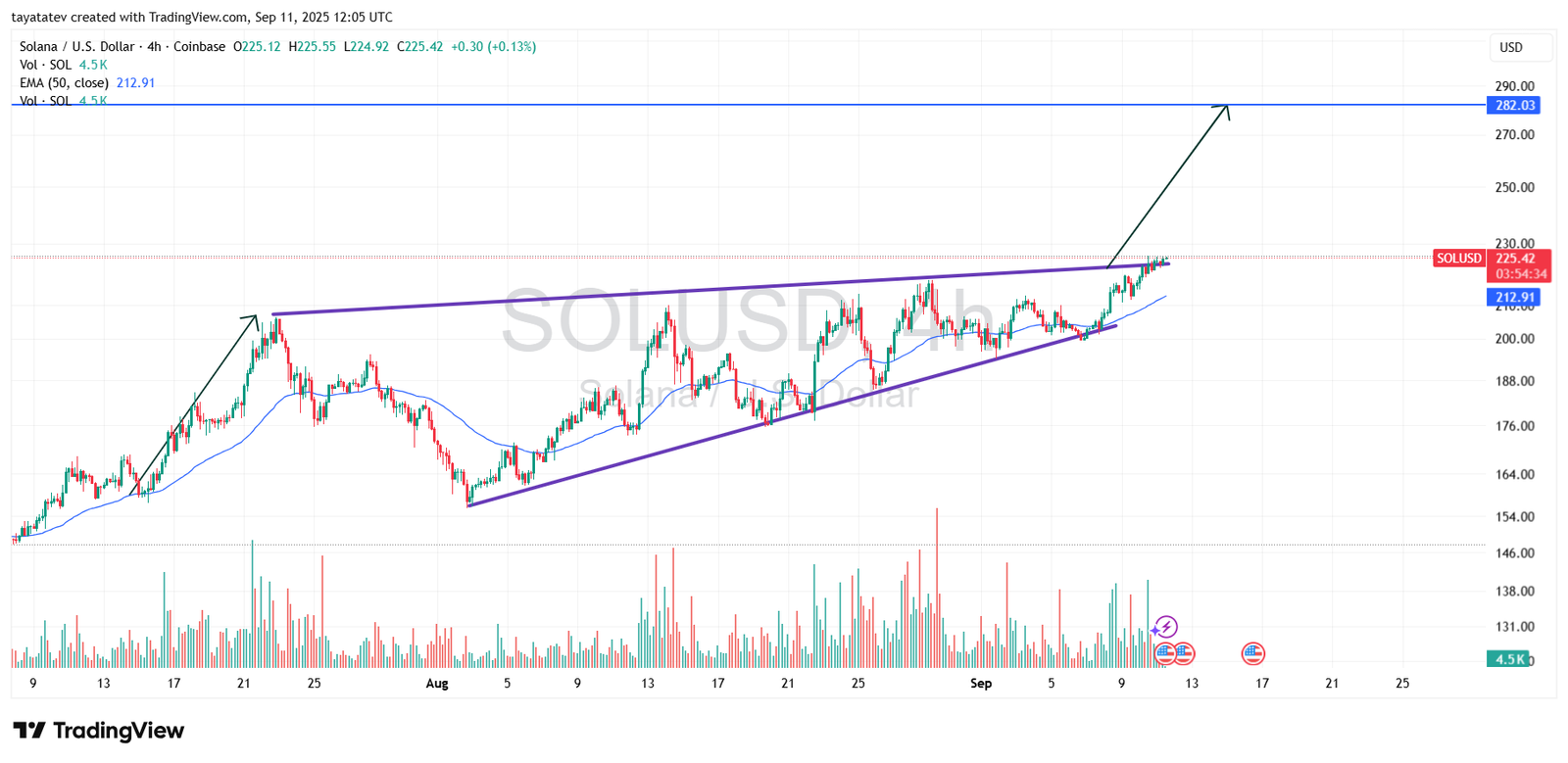
A rising wedge is a compression pattern where price makes higher highs and higher lows, yet the highs rise more slowly than the lows. The range narrows, momentum cools, and pressure builds toward a break. In many textbooks a rising wedge carries bearish bias; however, in strong trends it can resolve upward when buyers absorb supply along the upper rail. Here, Solana advances inside the wedge and repeatedly reclaims the 50-EMA, which keeps bullish continuation on the table as long as price holds above the rising support.
If Solana confirms an upside break with a sustained 4-hour close above the wedge’s upper rail near $227–$230 and follows through with rising volume, the measured path points about 25% higher from the current $225.42. That projection implies approximately $281.78, broadly matching the marked $282 area on the chart. Should price break and then successfully retest the former ceiling as support, momentum could carry toward that zone into the next liquidity pocket. Conversely, if Solana slips back inside the pattern and loses the 50-EMA near $212.91, the bullish case weakens and risk shifts toward the wedge base in the high $190s to low $200s. For now, the setup remains constructive while price persists above ascending support and probes resistance with improving participation.
SOL 4h MACD backs the bullish setup — September 11, 2025
The SOL/USD 4-hour MACD (12,26,9) turns firmly positive on the latest print at 12:12 UTC. The MACD line sits at 4.57, above the signal at 4.13, while the histogram reads +0.45. That alignment signals bullish momentum and confirms the upside impulse that started after this week’s bullish crossover. Momentum now pushes through the zero line, which usually supports trend continuation when price already presses resistance.
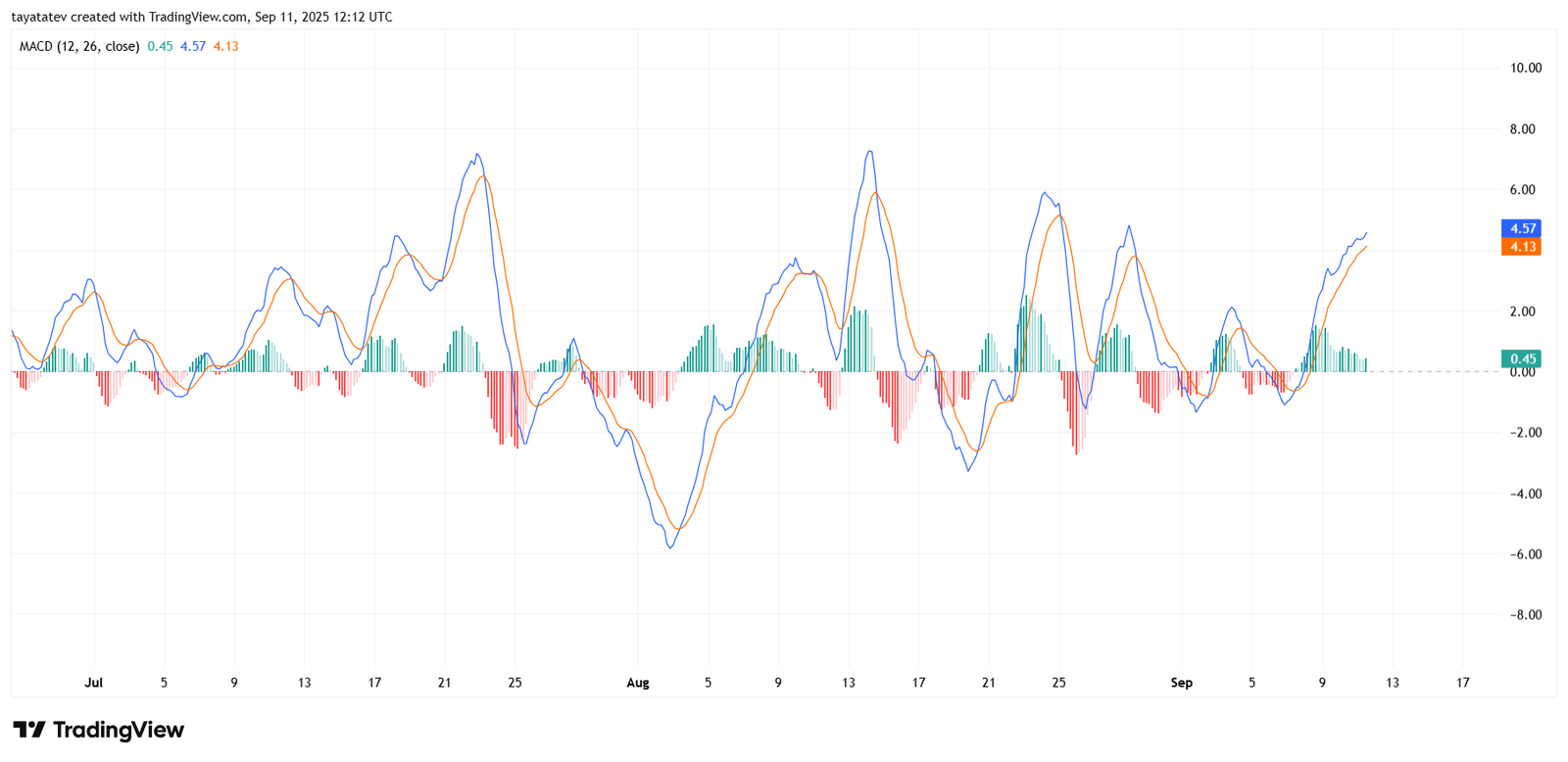
Recent swings show rising MACD peaks since early September, and the histogram bars lengthen, which implies acceleration. Price action in your wedge chart leans on the upper rail; this MACD posture adds confirmation. As long as the MACD stays above the signal and the histogram holds green, buyers keep the initiative. A brief pullback can occur without breaking the structure, but the bias stays constructive while the oscillator remains north of zero.
However, the oscillator approaches areas that capped previous rallies in late August and mid-July. If the histogram starts to contract while price grinds higher, that would warn of fading momentum. A bearish cross (MACD dropping below the signal) would be the first clear weakness. A subsequent slide back below zero would further undermine the bullish case and shift attention to support levels on price.
SOL 4h RSI tests overbought zone — September 11, 2025, 12:26 UTC
Solana’s 14-period RSI prints 69.83, while its signal average sits at 65.10. The oscillator trends higher and holds above its own average, which shows bullish momentum. Moreover, RSI operates in the 60–70 regime, a zone that typically accompanies trending advances rather than short squeezes. With price already leaning on resistance in your wedge chart, this RSI posture supports continuation as long as the indicator stays elevated.
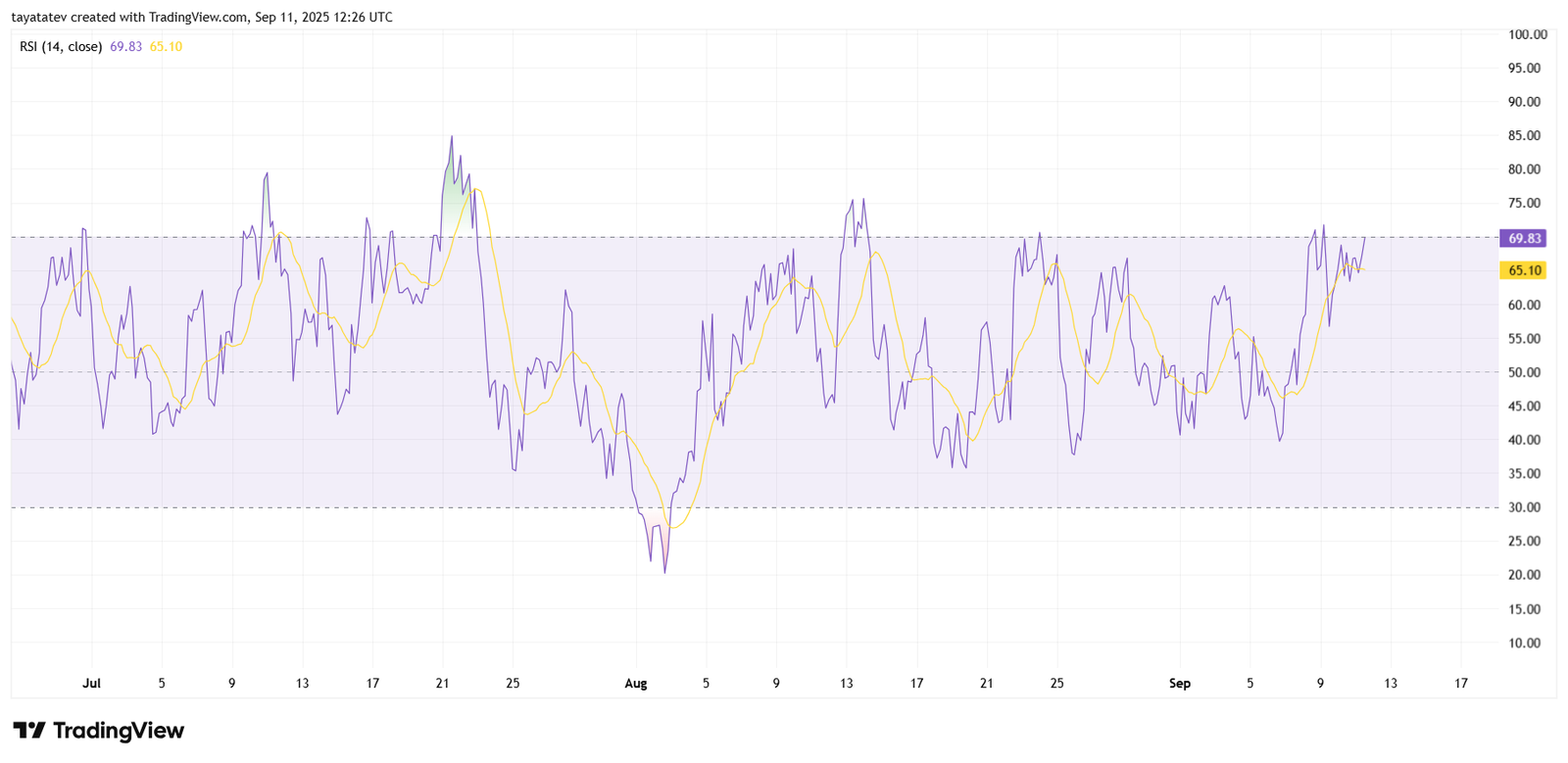
However, the next inflection sits directly ahead. RSI approaches the classic 70 threshold, where rallies often pause or rotate. If RSI pushes through 70 and holds while its average keeps rising, momentum usually persists and breakouts gain follow-through. If instead RSI stalls below 70 and rolls over through its average, momentum cools and price often reverts toward nearby moving averages.
I do not see a clean bearish divergence at this print; the oscillator’s recent peaks track price fairly well. At most, a shallow negative skew appears versus the early-September spike, which alone does not negate the trend. Therefore, I treat 65–66 (the signal average) as the first momentum line. A drop back below 60 would further weaken the impulse and shift focus to support. Until then, the RSI backdrop remains constructive and aligns with the bullish read from MACD and the rising-wedge pressure on price.


