


June 23, 2025 — Bittensor’s TAO token dropped into a key support zone between $261 and $300 before recovering near the $300 mark. As of early morning UTC, the token trades at $297.81 after falling over 7% in 24 hours. The sell-off followed a multi-week decline from early June highs near $440.
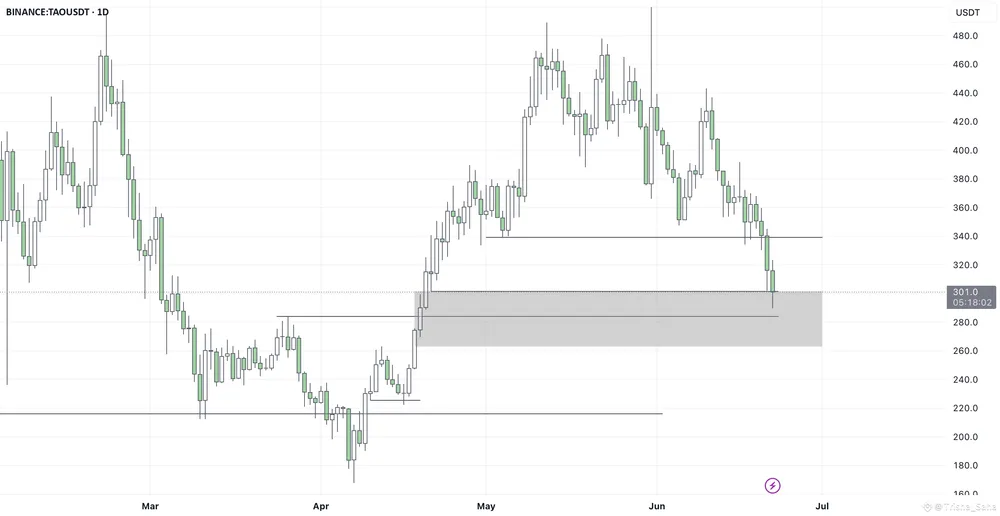
On the daily chart, TAO bounced from the lower end of the highlighted accumulation zone, which previously triggered April’s breakout. The candle shows a long lower wick, suggesting strong buyer reaction near the $280 level. This area matches past consolidation and may act as a springboard again.
If TAO holds above $300, short-term momentum could push the price toward the $340 resistance. This level capped the last attempt to recover before the June decline accelerated. A successful break above it may clear the path to $380. However, if TAO fails to reclaim $300 convincingly, further downside toward $260 or even $240 could follow.
The market cap stands at $2.65 billion. One-hour losses reached 1.49%, while the broader 24-hour loss remains above 7%. Traders are watching this zone closely for potential spot buys and leveraged entries, with weekly chart signals offering confirmation for mid-term setups.
TAO RSI Drops Near Oversold, Signals Possible Reversal Zone
The Relative Strength Index (RSI) for TAO/USDT is nearing oversold territory, with a value of 32.96 on the daily timeframe as of June 23, 2025. The 14-day RSI curve has dipped below its moving average (42.04), confirming strong bearish momentum over recent weeks.

TAO’s RSI last touched similar levels in mid-April and mid-November 2024. Both cases were followed by short-term rebounds. A value below 30 would confirm oversold conditions, but traders often begin watching for price reactions when the RSI nears 33–35, especially if support holds on the price chart.
Momentum has weakened since mid-May, with RSI trending downward in parallel with the token’s price. However, the current reading suggests that TAO may be approaching exhaustion on the sell side, especially as it bounces from the $280–300 buy zone.
The RSI divergence is not yet visible, but if TAO forms a higher low while RSI turns up from current levels, it could signal a bullish reversal setup.
TAO Balance of Power Turns Slightly Positive After Volatile Sessions
On June 23, 2025, the Balance of Power (BoP) indicator for TAO/USDT shows a reading of 0.19. This value sits in the positive range, suggesting that buyers held a marginal advantage by the close of the most recent session.

Over the past several months, the BoP chart has shown persistent high volatility, with sharp shifts between positive and negative territory. The current reading remains far from the highs seen earlier in the year and lacks a sustained upward slope, indicating that market strength is still mixed.
Despite strong downward pressure on price, this slight recovery in the BoP could point to buyers stepping in near key support. However, confirmation from price action and other indicators would be needed before signaling a trend reversal.
What Is Bittensor (TAO)? A Deep Dive Into the Decentralized AI Network
Bittensor (TAO) is a decentralized blockchain protocol designed to reshape how artificial intelligence (AI) and machine learning (ML) models develop, interact, and improve. Unlike centralized systems dominated by large tech companies, Bittensor builds an open peer-to-peer network where AI models collaborate globally and evolve collectively.
Bittensor runs on a decentralized structure that lets machine learning models operate together in a shared environment. It enables developers around the world to contribute models, share data, and improve collective intelligence through a secure, reward-based system.
Instead of isolating AI development within private labs, Bittensor encourages open knowledge exchange. This approach forms what the network calls a “digital hive mind” — a global neural framework where each model adds to the system’s intelligence.
The network treats machine intelligence as a tradeable asset. Developers build and train models, then offer their outputs and services to others on the blockchain. This exchange model drives collaboration and ensures constant refinement of AI capabilities.
How the Bittensor Protocol Works
At its core, Bittensor functions like a decentralized machine, using multiple layers to process, evaluate, and improve AI models. Here’s how the structure operates:
Proof of Intelligence (PoI)Bittensor uses a custom consensus mechanism called Proof of Intelligence. This system rewards contributors based on the value of their AI outputs. Instead of mining tokens, participants earn TAO by producing accurate, useful predictions. The network evaluates these contributions using game theory principles and the Shapley value framework to ensure fairness and relevance.
Miners and Validators
Miners host machine learning models and provide services when users submit queries. Validators oversee this process, selecting the best-performing miners and verifying the quality of their predictions. This structure keeps the network secure and efficient.
Subnets and Registration
Participants register by solving a Proof of Work challenge or paying a fee. Once verified, they join specific subnets based on their area of expertise—like natural language processing or image recognition. This specialisation improves the network’s performance and keeps models organized by function.
Incentives Through the TAO Token
TAO is the utility, staking, and governance token of Bittensor. It powers every interaction across the ecosystem. Participants use TAO to access AI services, stake for network roles, and vote on future protocol changes.
The token has a fixed supply of 21 million, similar to Bitcoin. This capped issuance supports long-term value and controls inflation. A wrapped version, wTAO, also exists on Ethereum to provide cross-chain interoperability.
The network uses TAO rewards to encourage high-quality performance. Efficient miners and validators receive more emissions, while underperforming nodes get reduced rewards or risk removal from the network.
Challenges Bittensor Solves
Bittensor tackles two major barriers in AI development: limited access to compute power and duplication of effort across siloed teams. By decentralizing the process and enabling models to learn from each other, the network reduces resource waste and speeds up innovation.
Its system mimics the human brain, where neurons process tasks locally but also interact constantly. Each node in Bittensor shares insights with others, resulting in a living, evolving AI system.
This architecture gives smaller teams access to the same resources and collaboration opportunities that were previously exclusive to tech giants. It also supports continual learning, which allows the network to self-improve over time.
Game Theory and Network Design
Bittensor applies game theory to ensure constant progress. The protocol sets up competitive dynamics between subnets, validators, and miners. Only the most reliable and productive actors receive top rewards.
This system filters out weak models and promotes innovation. By structuring incentives around performance, the network stays lean and focused while adapting to new AI developments.
Bittensor does not provide its own wallet. However, TAO is compatible with several third-party solutions, including the Crypto.com App. Users can store, send, and receive TAO through supported platforms. Wrapped TAO (wTAO) also makes it easier to interact with Ethereum-based applications.
TAO is available on major exchanges. Buyers can access it through the Crypto.com App by registering, funding their account, and completing a trade. Payment methods include bank transfers, debit cards, and services like Apple Pay or PayPal.


