


YEREVAN (CoinChapter.com) — On Thursday, over $20 million in cryptocurrency was transferred from a U.S. government wallet. Notably, this wallet is tied to funds seized in the 2016 Bitfinex hack. Additionally, the transfer included both stablecoins and Ethereum. As a result, blockchain analysis firms quickly took notice. Experts now suspect the transfer was unauthorized. Furthermore, the funds moved to an address that was created just five days ago. Consequently, this has sparked concerns about a possible security breach or theft. Previously, the wallet had been inactive for the past eight months.
After the initial transaction, part of the funds went to instant crypto exchanges. One of these exchanges uses Binance for liquidity. Just minutes before this, Arkham Intelligence reported large withdrawals from Aave, a lending platform. These withdrawals raised suspicion about the wallet’s activity.
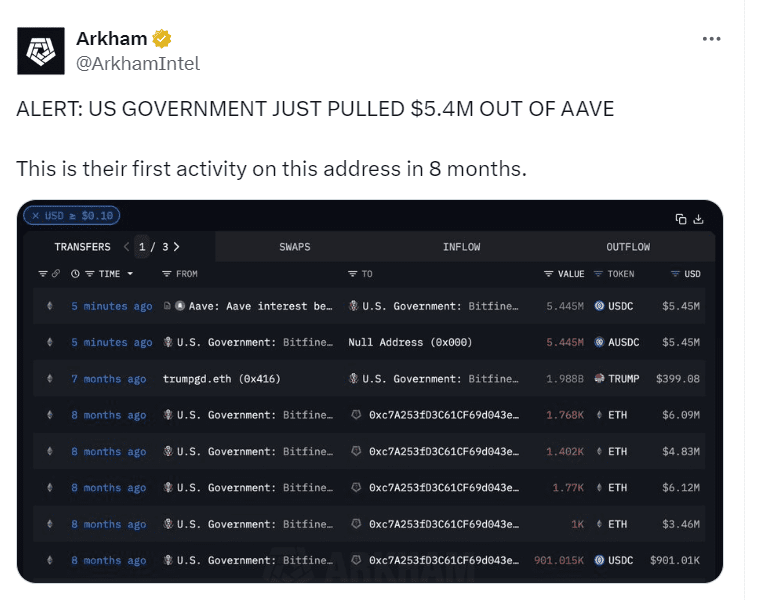
Withdrawals From U.S. Government Crypto Wallet in Series of Transactions
Arkham Intelligence reported that $1.25 million in Tether (USDT) and $5.5 million in USD Coin (USDC) were withdrawn from Aave. This happened just before the main transfer. The funds were sent to a wallet starting with “0x348.” They included $446,000 in Ethereum and about $13.7 million in aUSDC, an interest-bearing token from Aave. Two years ago, this government wallet had received large amounts of aUSDC and Aave-based Tether tokens.
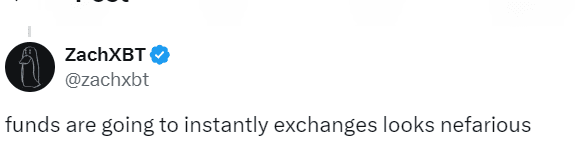
Requests for comment from the Department of Justice (DOJ) regarding whether these transfers were related to law enforcement activity have remained unanswered. On-chain analyst ZachXBT noted the transfer activity as “nefarious” on social media, indicating possible unauthorized movement. This viewpoint further emphasizes the suspicion surrounding the transfer of cryptocurrency assets from this DOJ-linked wallet.
Transfers to Exchange Aggregators Raise Further Questions
After receiving the transferred funds, the “0x348” wallet began using the exchange aggregator 1inch to convert stablecoins into Ethereum. It then sent $40,000 batches of Ethereum to a wallet associated with a nested exchange connected to Binance, according to blockchain analysis. In total, it directed $320,000 of Ethereum to the exchange wallet and split an additional $80,000 into smaller wallets.
A nested exchange likely received some assets linked to Binance’s liquidity. Moreover, blockchain analysts believe this separate platform uses Binance’s liquidity without any direct affiliation to Binance itself.

Wallet’s Source Traced to Australia-Based CoinSpot
Blockchain analysis shows that the “0x348” wallet, which received funds from the US Government crypto wallet, was created recently but links to CoinSpot, an Australian exchange. Records confirm CoinSpot funded the wallet two years ago. CoinSpot operates exclusively within Australia, limiting its transactions outside the jurisdiction.
This same DOJ wallet previously contained funds seized from individuals associated with the Bitfinex hack. In 2016, authorities charged New York residents Ilya Lichtenstein and Heather Morgan for their involvement in the breach, which caused the loss of $3.6 billion in digital assets.
At present, the US government crypto wallet is empty, with only a negligible balance of $127 in a Donald Trump-themed meme coin remaining. Blockchain analysts continue to monitor the case, with several questions still surrounding the movement of these seized assets and whether additional funds will emerge on public blockchains in the days ahead.



… [Trackback]
[…] Info on that Topic: coinchapter.com/us-government-crypto-wallet-withdrawal/ […]
… [Trackback]
[…] Find More on to that Topic: coinchapter.com/us-government-crypto-wallet-withdrawal/ […]
… [Trackback]
[…] Find More here to that Topic: coinchapter.com/us-government-crypto-wallet-withdrawal/ […]