


WazirX users approved a fresh restructuring plan following the $234 million hack of July 2024. The new plan gained support from 95% of creditors, marking the second time WazirX users voted in favor of restructuring after the Singapore High Court rejected the earlier scheme.
The hack targeted a Safe Multisig wallet and was attributed to North Korean hackers. In response, WazirX suspended all crypto withdrawals and Indian rupee withdrawals, leaving customers without access to their balances.
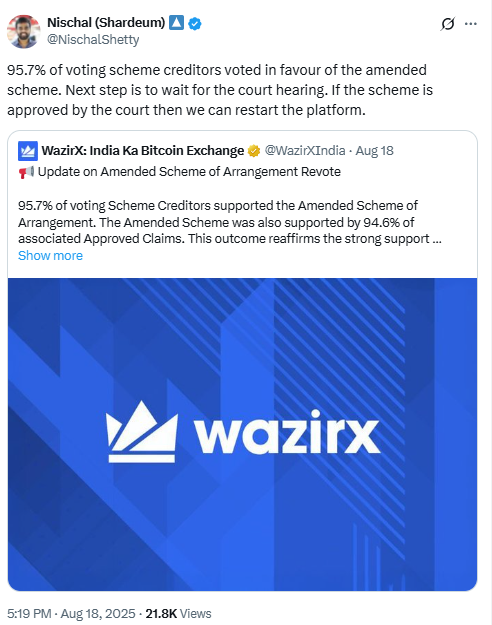
On Monday, Nischal Shetty, founder of WazirX, said the exchange would restart services and begin repayments within 10 days of the court approving the new plan. His timeline differed from George Gwee, director at Kroll, who estimated a wait of two to three months after approval.
Why WazirX Restructuring Faced Court Rebuff
Between July 30 and August 6, nearly 150,000 creditors cast votes, representing claims of over $206 million. WazirX users had already approved a restructuring plan in April, but the Singapore High Court rejected it. The court raised concerns about how the proposed recovery tokens would operate under regulations for digital token service providers.
The recovery tokens are designed to track user claims not covered by the first distribution. Token holders are expected to receive additional payouts funded by WazirX profits and recovered assets.
The issue gained urgency after Singapore’s central bank set a deadline of June 30, 2025, requiring crypto service providers to halt overseas services. This deadline forced WazirX to amend its structure and shift responsibility for compensation.
Compensation Shifts to Zanmai India
Under the new restructuring plan, WazirX users will still receive recovery tokens repurchased with the exchange’s net profits. However, compensation will now be managed by Zanmai India, which operates under the Financial Intelligence Unit of India.
Previously, Zettai, the parent company of WazirX, was based in Singapore. After the court decision, Zettai established Zensui Corporation in Panama in June and transferred cryptocurrency-related services to the new subsidiary. The restructuring plan therefore keeps token distribution in India while shifting operations abroad.
Users Divided Over WazirX Delays
WazirX users have been warned that without a restructuring plan, repayments could be delayed until 2030 because liquidation would take longer. Many creditors on X and Reddit voted in favor, saying the plan at least allowed progress toward recovering funds.
Others raised concerns about delays, the regulatory questions highlighted by the High Court, and the relocation of company operations. Some WazirX users also noted that holders of unhacked coins lost out because their tokens rose in value after the breach.
A separate legal effort also failed. On April 16, the Supreme Court of India dismissed a petition from 54 victims, stating it could not rule on cryptocurrency policy matters.
WazirX has not provided any additional comment on the restructuring process.


