


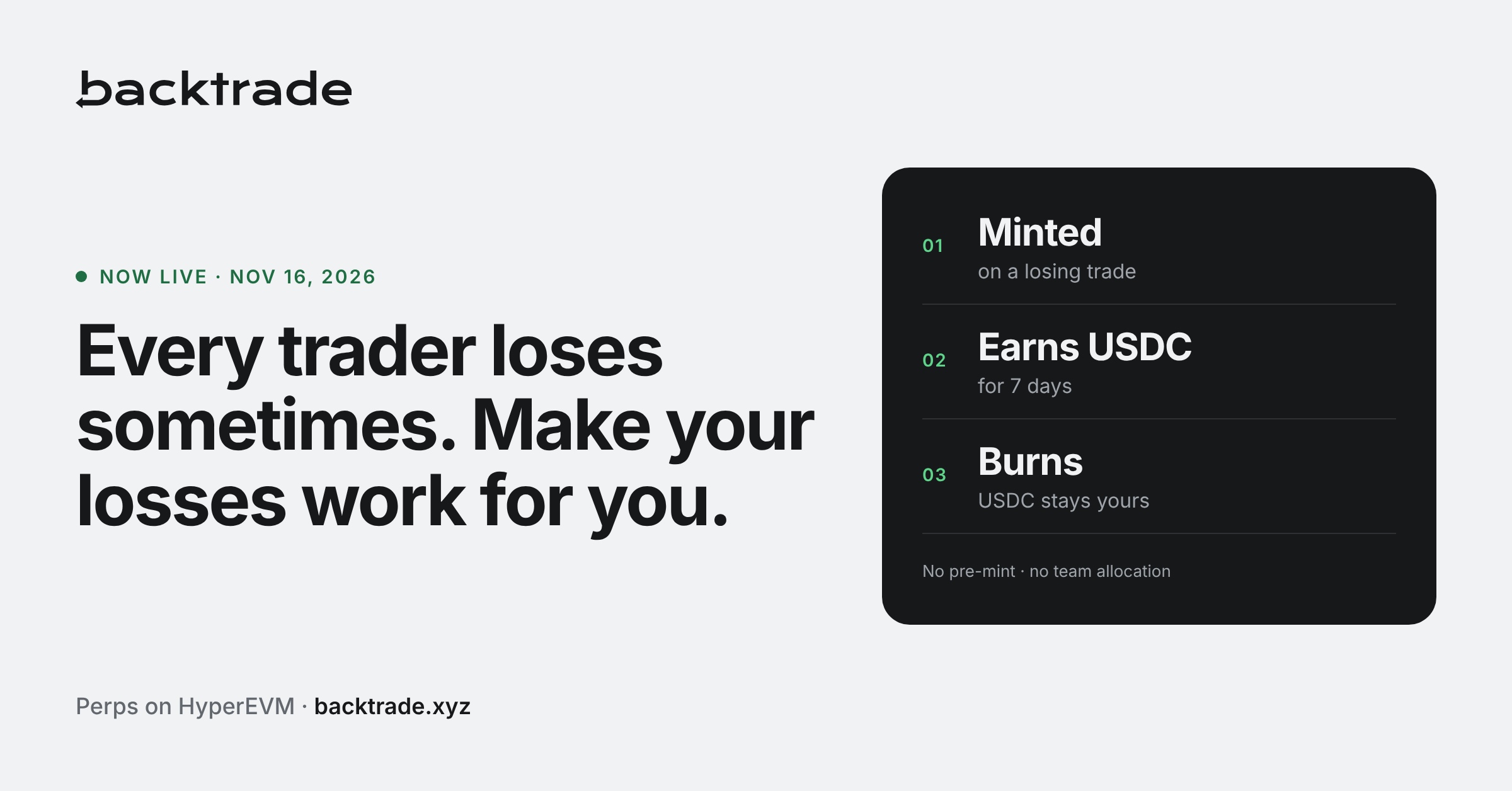
A worked example of Backtrade’s loss-to-mint model, where a losing trade converts into BACK, a token that earns a share of exchange fees.
November 16, 2026. Million-dollar liquidations no longer make headlines in crypto. On November 13, the day’s largest single liquidation hit a $31.09 million bitcoin long on Hyperliquid, closed at $72,250, according to CoinGlass data cited by BeInCrypto. More than 170,000 traders lost positions in the same 24 hours.
Backtrade, a perpetuals exchange that opened to all traders today on Hyperliquid’s HyperEVM, changes what a trader keeps after a loss. A hypothetical case shows how.
Backtrade is live. Start trading at app.backtrade.xyz: connect a wallet and deposit from 10 USDC.
The setup
Imagine you open a leveraged bitcoin long with $1,000,000 of margin. The market drops, your position hits its liquidation price, and the margin is gone.
| Typical exchange | Backtrade | |
| Margin lost | $1,000,000 | $1,000,000 |
| Where it goes | Counterparties, insurance fund, the exchange | The house, a USDC pool with no team or investor stake |
| What you receive | Nothing | 100,000,000 BACK, staked at once |
| What it earns | Nothing | A pro-rata share of USDC payouts |
What 100 million BACK does
Backtrade mints 100 BACK for each dollar of margin lost in a liquidation. Your $1,000,000 mints 100 million tokens, and they start earning at the next distribution.
The payouts come from two sources. BACK holders split half of every win, loss and liquidation fee on the exchange. Once the house has paid winning traders, holders also receive anything it holds above $500,000. Your share of each payout matches your share of all live BACK.
Seven days after minting, your tokens burn. The USDC they earned stays in your account to claim whenever you want.
“A liquidation hurts on any exchange. We asked what a trader should walk away with afterwards, and our answer is a share of what the exchange earns,” said Lucas, founder of Backtrade.
What BACK is not
BACK has no market price. You cannot sell it, send it or trade it, and Backtrade states that the project promises the token no value. A loss on Backtrade costs you the same margin as a loss anywhere else. The difference shows up afterwards: you hold a claim on what the exchange earns for the next seven days.
A real-world precedent
The loss-to-mint model already has a public example. Papertrade, a Hyperliquid exchange with a similar design, launched in October. Taiwanese entrepreneur Machi Big Brother traded $1.41 billion in volume there and lost $416,000 on his positions. Staking the tokens those losses minted earned him 341,000 USDC, which cut his net loss to about $75,000, according to on-chain data reported by Tokenpost. Results depend on how much the whole exchange earns, so a new venue like Backtrade will not repeat those numbers one for one.
Timing
The seven-day countdown starts only after the house first reaches $500,000. If your loss lands before then, your BACK keeps earning until the pool fills, and for seven days after.
The exchange behind the example
Backtrade fills orders at the midpoint of Hyperliquid’s best bid and offer, charges no funding and takes no fee or gas to open. You can trade BTC and ETH at up to 1000x from $10 margin. The exchange earns on winning closes: a 2% win fee and a 1.2% referral fee, or 1% with an invite link. Backtrade raises position limits in stages as it grows, so very large single orders may hit caps in the first weeks.
The contracts have no external audit yet. If the house runs short, winning traders wait in a first-in, first-out queue. At 1000x on BTC, a 0.05% move liquidates the full margin.
Open Backtrade and follow @backtrade_xyz on X.
About Backtrade
Backtrade is a perpetual futures exchange running in smart contracts on Hyperliquid’s HyperEVM. Traders go long or short on BTC and ETH with up to 1000x leverage, fills at the Hyperliquid mid and no funding payments. Every losing trade mints BACK, a token that earns a share of exchange fees in USDC.
Website: backtrade.xyz · Docs: docs.backtrade.xyz · X: @backtrade_xyz
The $1 million case is hypothetical. Liquidation data: CoinGlass, as reported by BeInCrypto and The Crypto Times. Papertrade case: Tokenpost. This article is for information only and is not financial advice. Leveraged trading carries a high risk of loss.
Note:The content provided on this website is for informational purposes only and does not constitute financial, investment, or trading advice. Always conduct your own research (DYOR) and consult a qualified financial advisor before making any investment decisions. CoinChapter.com is not responsible for your losses.


