


The XDC Network is strengthening its role in cross-border payments and trade finance. The blockchain’s hybrid model, designed for institutional use, continues to attract interest from banks and asset managers. Recent developments highlight XDC’s alignment with regulatory frameworks such as Europe’s MiCA rules and its integration with LayerZero’s Omnichain Transfer Standard. These moves position the network as a practical option for enterprises requiring fast settlement and interoperability across chains.
The network’s upgrade, XDC 2.0, has already introduced three-second transaction finality and enhanced compliance features. These changes directly address the needs of financial institutions managing tokenized assets and real-world financial instruments. The design underscores the platform’s strategy of meeting regulatory standards while retaining efficiency in settlement.
Institutional Partnerships Signal Market Expansion
Institutional adoption is advancing through partnerships with SBI Holdings, VERT Capital, and SIX Swiss Exchange. VERT Capital confirmed plans to tokenize $1 billion in assets on the XDC blockchain, underscoring the network’s growing role in real-world asset (RWA) tokenization. At the same time, SIX Swiss Exchange listed the XDC Network ETP (XDCN) through 21Shares, opening European investor access to the blockchain.
These collaborations extend beyond announcements. SBI Holdings continues to explore blockchain infrastructure for trade finance, and the integration of XDC reflects the push toward blockchain-based settlement systems. The presence of a regulated ETP on a major European exchange also signals an effort to provide traditional investors with exposure to blockchain assets through established financial structures.
Building Infrastructure for Developer Growth
XDC is not limiting its expansion to Europe and Asia. The network has also rolled out initiatives for developers in Africa, creating a regional ecosystem designed to encourage innovation on the blockchain. The initiative aims to supply tools and resources for developers seeking to build payment and trade applications in emerging markets.
This effort aligns with the network’s strategy of extending its reach beyond institutional corridors. By investing in developer communities, XDC increases its chances of being used in local financial applications while broadening the pipeline of blockchain use cases. The program also provides a foundation for future partnerships with governments and businesses in markets that often face limited access to global financial infrastructure.
Risks Amid Expanding Opportunities
Despite momentum, XDC faces clear risks. Competition from other blockchain networks such as Ripple and Stellar remains strong in the payments and trade finance sector. These rivals already have established corridors and bank relationships that XDC must match or surpass.
Execution also remains a concern. While partnerships and tokenization plans generate interest, the success of these projects depends on delivery timelines and integration with financial systems. Regulatory uncertainty in certain jurisdictions could delay adoption, even as the network works to maintain compliance with European standards.
The XDC Network’s trajectory shows a dual focus: building institutional trust while expanding developer participation in emerging markets. The combination of regulatory alignment, fast settlement, and tokenization use cases underscores its ambition to serve as a backbone for global trade finance.
Institutions exploring tokenized securities and cross-border payment systems are watching how XDC executes on these initiatives. With billions in assets earmarked for tokenization and regulated products now listed in Europe, the network is steadily embedding itself in the broader financial ecosystem.
XDC Technical Analysis: Falling Wedge Breakout Suggests Major Upside
The XDC/USD chart dated September 5, 2025, shows the coin breaking out of a falling wedge pattern after weeks of consolidation. A falling wedge is a bullish reversal formation where price moves within converging downward-sloping trendlines, usually signaling an upcoming breakout to the upside.
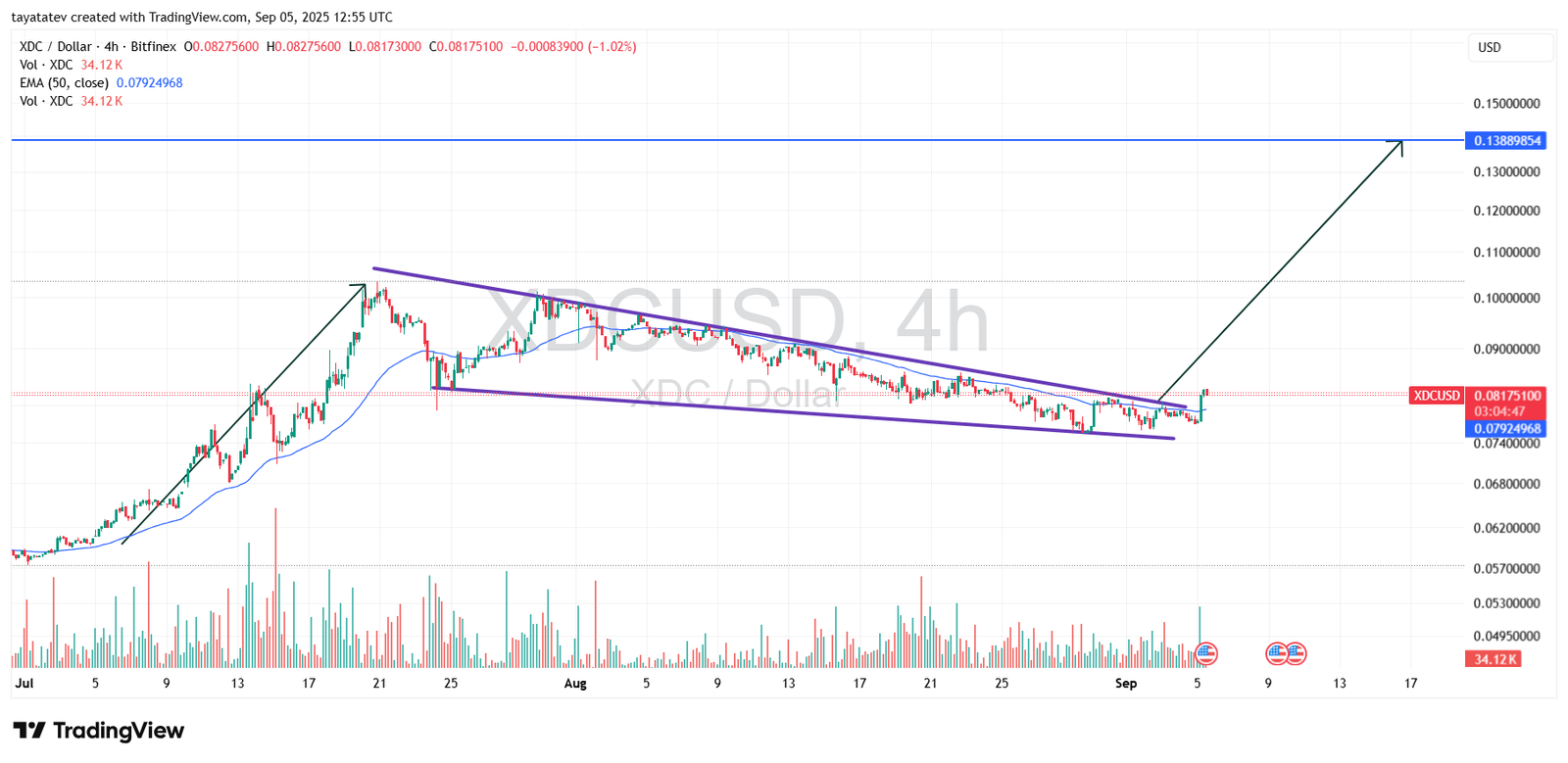
The price action confirms this breakout as XDC climbed above the wedge’s resistance line with strong buying momentum. The 50-period EMA at $0.0792 provided support during the move, underlining renewed bullish pressure. Trading volume also increased during the breakout, validating the pattern.
From the current level of $0.0817, the measured move of the wedge projects a target near $0.1389, which represents a 69 percent upside. This target comes from the height of the wedge applied to the breakout point. The breakout suggests a shift in market sentiment, with bulls regaining control after a prolonged downtrend.
If momentum holds, the breakout could push XDC toward the projected level over the coming sessions. However, the price must sustain above the breakout zone to keep the bullish structure intact. The wedge breakout adds weight to XDC’s technical outlook, positioning it for a strong recovery phase in the near term.
XDC RSI Analysis: Momentum Builds After Breakout
The Relative Strength Index (RSI) chart dated September 5, 2025, shows XDC trading at an RSI value of 61.83 on the 14-period timeframe. The indicator recently climbed out of neutral territory, moving above its midline of 50 and approaching the 70 threshold that signals overbought conditions.
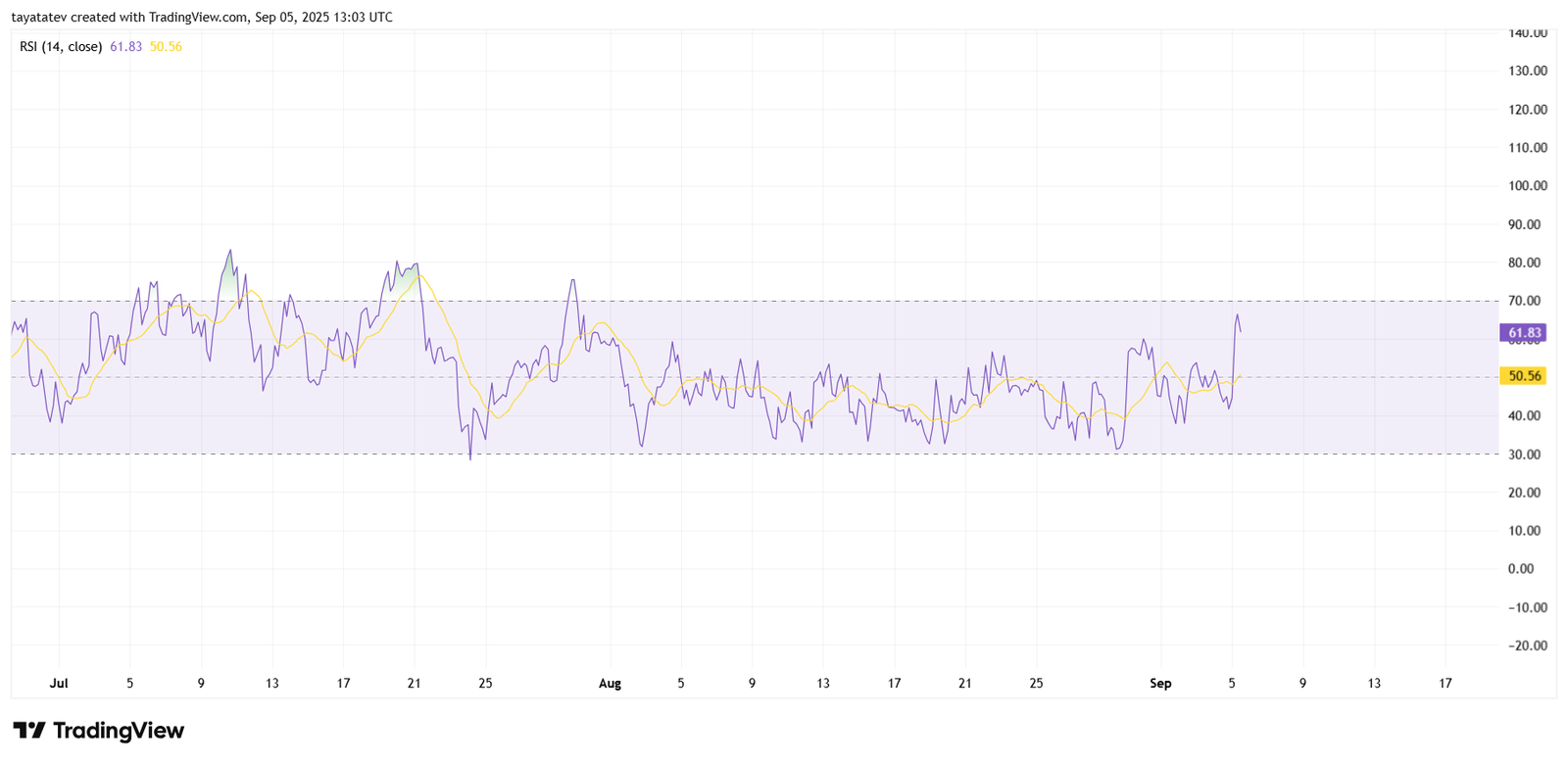
This upward shift reflects renewed buying momentum after XDC broke out of its falling wedge pattern earlier in the day. The RSI’s move above its moving average line at 50.56 confirms the change in trend direction, with bulls showing stronger control over price action. Sustained RSI levels above 60 often precede extended rallies, especially when aligned with a technical breakout.
While the indicator is not yet in overbought territory, the sharp rise suggests increased demand that could push momentum higher in the coming sessions. The RSI supports the broader bullish setup seen on the price chart, reinforcing expectations of continued upside potential if buying pressure holds.


