



XRP is coiling inside a classic bull flag while a new US ETF product prepares to launch, two signals that could lift prices toward the $1.80 zone.
XRP Bull Flag Points to $1.80
XRP appears to be consolidating within a bull flag pattern on the daily chart following its sharp rebound from the February capitulation wick near $1.10.
The structure shows a downward-sloping channel forming between roughly $1.25 support and $1.45 resistance, indicating a controlled pullback after the token’s impulsive recovery move.
Bull flags often emerge during strong trends when the market pauses before continuing higher. In XRP’s case, the flag formed after a vertical bounce, suggesting that traders may simply be digesting gains rather than reversing the trend.
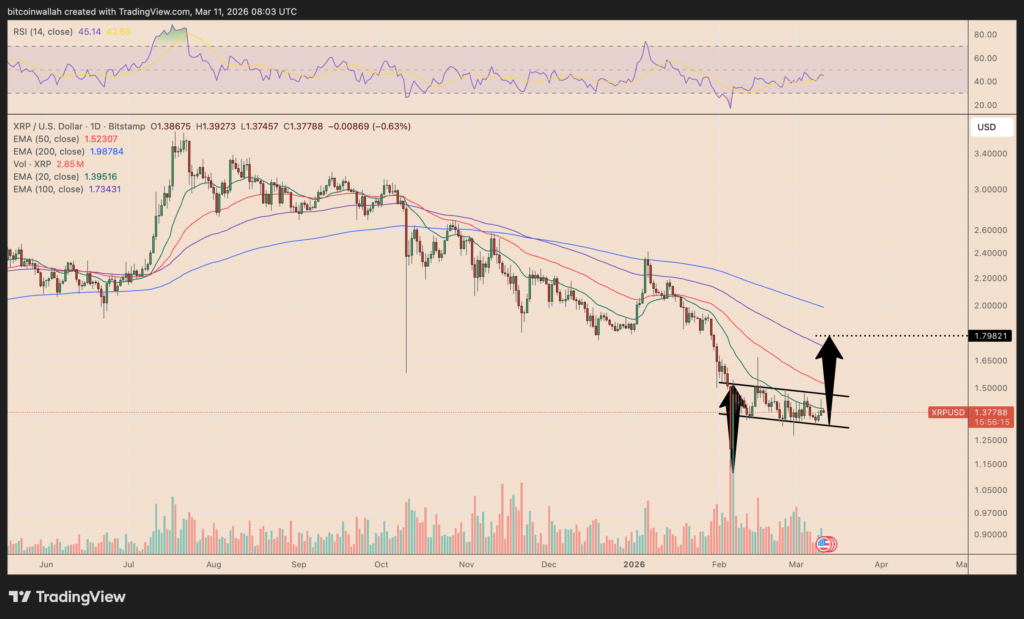
A break above the flag’s upper trendline near $1.45 would confirm the bullish continuation setup. The measured move—calculated by adding the height of the preceding rally to the breakout point—places the upside target around $1.75–$1.80, roughly 30% above current levels.
Momentum indicators support the consolidation thesis. The relative strength index (RSI) is stabilizing near the mid-40s, indicating that selling pressure has cooled while buyers slowly rebuild momentum.
Still, the setup remains conditional. A break below the flag’s lower boundary near $1.25 would invalidate the bullish pattern and expose XRP to deeper downside risks.
New XRP ETF Expands Investor Access
At the same time, a new investment product may soon broaden institutional and brokerage exposure to XRP.
The Kurv XRP Enhanced Income ETF is nearing launch after filing an updated prospectus with the U.S. Securities and Exchange Commission earlier this month. Unlike traditional crypto ETFs that simply track spot prices, Kurv’s fund aims to generate income while maintaining XRP exposure.
Instead of holding large amounts of spot XRP directly, the ETF plans to gain exposure through derivatives and XRP-linked exchange-traded products. The strategy may include synthetic long positions combined with options trades such as covered calls, puts, spreads, and collars.
These option-income strategies allow the fund to collect premiums while still participating in XRP price moves. The ETF may also route part of its exposure through a wholly owned Cayman Islands subsidiary, a structure commonly used to manage tax and derivatives exposure.
If the ETF launches as expected, it would introduce another regulated XRP investment vehicle in the United States, potentially improving access for traditional brokerage investors.
However, income-focused option strategies can sometimes cap upside during strong rallies, meaning the fund may not fully track XRP’s gains compared with a pure spot ETF.
For now, XRP’s technical setup remains the dominant catalyst. If the bull flag resolves upward, the ETF narrative could simply add fuel to a move toward the $1.80 region.


