


Unlike Bitcoin or Ethereum, XRP was pre-mined. At launch, Ripple created 100 billion tokens—none will ever be minted again. Ripple Labs initially held 80% of the supply. As of mid-2025, the company still controls around 42%.
About 35% of Ripple’s XRP holdings remain locked in monthly escrow. Another 7% sits in company wallets. Each month, Ripple can release up to 1 billion XRP from escrow. This gives the company major control over XRP’s circulating supply and, in turn, price behavior.
Market Participants Question Decentralization
This level of control has fueled skepticism over XRP’s decentralized status. Critics argue that XRP’s price no longer reflects organic demand and supply trends.
“Only one hand can perfectly determine XRP’s price direction—and I don’t like that,”
said Cava, a market participant.
“I’m not speaking as a technical analyst, but as a trader.”
Despite its design for fast and cheap cross-border payments, XRP has not attracted strong institutional interest. Unlike Bitcoin and Ethereum, which have seen growing traction among banks and funds, XRP adoption remains limited.
Ripple’s central bank partnerships also remain unclear. The company has announced deals but has shared few details about active integrations. This lack of transparency may be holding back institutional capital.
“Look at XRP’s chart. It jumped in November 2024, then just moved sideways. That’s not a healthy trend,”
Cava said. He compared the asset’s flat movement to Bitcoin’s continued price growth.
Concerns Over XRP’s Dual-Ledger System
Another issue is Ripple’s use of two separate ledgers. The public XRP Ledger handles retail and open market transactions. At the same time, Ripple has built a private, permissioned ledger for central banks exploring CBDCs.
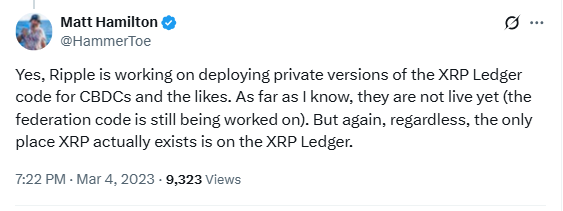
Both ledgers use similar technology. However, the private version is not publicly auditable and functions independently of the public network.
So far, Ripple has not confirmed any plans to merge the two ledgers. The lack of transparency around this private system has raised concerns among crypto investors.
In an industry built on decentralization and openness, XRP’s closed infrastructure continues to raise red flags.
XRP Forms Falling Wedge Pattern, Signals Possible 357% Rally
XRP/USDT formed a falling wedge pattern on its daily chart, published on July 9, 2025, with the price at $2.32. The setup appeared on Bitstamp and includes a 50-day Exponential Moving Average (EMA), showing XRP trading slightly above it at $2.22.

A falling wedge is a bullish chart formation where both resistance and support lines slope downward, creating a narrowing range. It often signals a trend reversal or strong upward breakout once the price breaks above the resistance line.
The current XRP pattern stretches back to early 2025. If the breakout confirms, the price may rise as much as 357% from its current level, targeting $10.45. That projection follows the wedge’s height from the prior upward move.
Volume on the chart remains under 1 million, but a breakout would likely require strong buying pressure. A valid breakout would need XRP to close above the wedge resistance and stay above the 50-day EMA. Until then, the move remains unconfirmed.
XRP RSI Crosses 60, Strengthens Bullish Outlook
XRP’s Relative Strength Index (RSI) reached 61.04 on July 9, 2025, according to the daily chart. The RSI moved above its 14-day average, which stood at 53.08, confirming growing buying momentum.

The RSI is a technical indicator that measures the speed and change of price movements on a scale from 0 to 100. Values above 70 indicate overbought conditions, while values below 30 suggest oversold levels. Readings between 50 and 70 point to rising bullish strength.
Since late June, the RSI has steadily climbed, reflecting increased demand for XRP. The current level places the indicator in a zone of sustained upward momentum but still below the overbought threshold.
With the RSI line trending above its moving average, market momentum appears to support a bullish continuation. This aligns with the falling wedge breakout pattern observed on XRP’s main price chart.
XRP Balance of Power Turns Positive, Shows Buyer Dominance
The Balance of Power (BOP) indicator for XRP rose to 0.54 on July 9, 2025, signaling stronger buying control in the market. The reading is clearly in positive territory, which shows that bulls currently dominate the price action.

The Balance of Power indicator compares buying and selling pressure during a trading period. Values above 0.00 suggest buyers are in control, while values below zero indicate seller strength.
XRP’s BOP has remained mostly volatile throughout 2025, frequently swinging between positive and negative. However, the current position near 0.54 shows one of the highest levels of buyer strength in recent weeks.
This reading aligns with other bullish signals, such as XRP’s breakout setup on the price chart and the rising Relative Strength Index (RSI). Together, these indicators suggest that bullish momentum is building.
If the BOP holds or rises further, it may support a continuation of the upward trend in XRP’s price.
XRP Stochastic Momentum Index Crosses 48, Points to Bullish Continuation
XRP’s Stochastic Momentum Index (SMI) reached 48.51, while the signal line followed at 43.28, based on the daily chart. This marks a clear bullish crossover, with the main SMI line moving above its signal counterpart.

The SMI is a momentum indicator that helps identify market strength and potential reversals. It ranges from -100 to +100:
When values rise above +40, it often signals buying pressure
A crossover above the signal line confirms positive momentum
Readings between 40 and 80 suggest building strength without being overbought
Over the past few days, the SMI climbed steadily from negative territory and now sits comfortably above the neutral zone. This upward movement shows that buyers are gaining control and that market momentum is accelerating.
The SMI crossover and current values support the ongoing bullish signals from other indicators like the Relative Strength Index (RSI) and Balance of Power. Together, they suggest that XRP has entered a phase of growing strength, with room to continue upward before reaching overheated conditions.


