



One stablecoin, two new rails, and a hard deadline: RLUSD gained a top-tier listing, tokenized Treasury holders got a direct redemption path, and XRPL node operators face a configuration switch within days.
RLUSD lands on Bybit’s spot board
Bybit listed Ripple USD (RLUSD) for spot trading, adding pairs against USDT, BTC, ETH, XRP, and MNT. The exchange placed the asset in its main trading zone, signaling immediate production access rather than a trial phase.
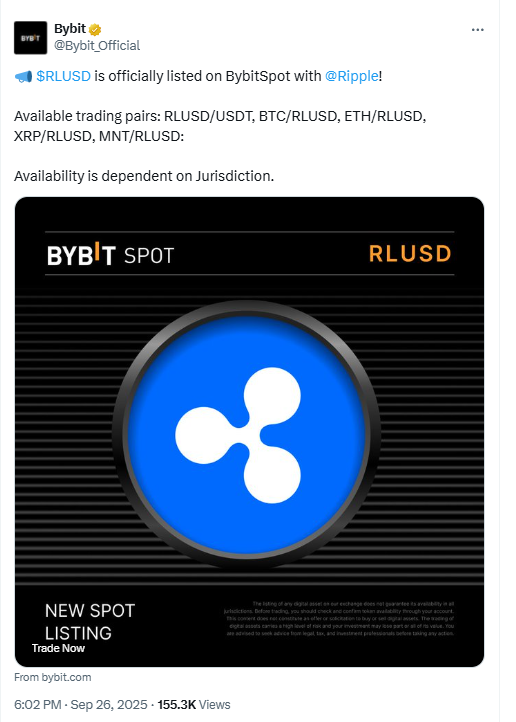
The listing expands RLUSD’s exchange footprint at the same time institutions connect fresh redemption flows. As a result, the asset now sits at the center of both retail-style exchange access and institutional settlement rails.
Coverage from industry outlets corroborated the new pairs and timing, framing the move as a broadening of RLUSD venues. However, Bybit’s own notice remains the primary source for symbols and the listing schedule.
Tokenized Treasuries can redeem straight into RLUSD
Ripple and Securitize enabled a smart-contract flow that lets qualified holders of BlackRock’s BUIDL and VanEck’s VBILL redeem fund shares directly into RLUSD. The feature runs on Securitize and targets 24-7 settlement without exchange order books.
This rail plugs tokenized funds into a cash-like stablecoin and shortens the path from fund shares to on-chain dollars. Consequently, institutions can move proceeds into RLUSD and then route across XRPL or Ethereum, depending on operations needs.
Reports add that initial redemptions execute via Securitize’s contracts, with XRPL venues in scope alongside Ethereum for settlement. That keeps the focus on standardized fund plumbing rather than speculative trading.
XRPL validator-list migration hits Sept. 30
XRPL’s default Unique Node List (dUNL) moved to a new publisher under the XRPL Foundation. Operators who still point to the old list must update configs by Monday, Sept. 30, 2025, or risk nodes failing to load the trusted validators. Fresh rippled installs on 2.4.0+ already use the new URL and keys.
Community notices also flag a full deprecation date in January 2026. Thus, lagging nodes could experience issues even sooner as the old endpoint winds down. Migration guides and the new publisher details are in the XRPL docs.
The change does not alter consensus rules; it updates the source of the recommended validator set. Still, production operators should finalize the switch before the cutoff to avoid unnecessary downtime.
Context: compliance credentials live; firewall amendment in development
XRPL activated “Credentials” on September 4, enabling on-chain attestations such as KYC or accreditation via decentralized identifiers. The feature targets institutional compliance needs across settlement and permissions.
Separately, the community is discussing XLS-86 “Firewall,” an amendment designed to add post-compromise protections at the account level. It remains in development; operators and users can track its status in the XRPL standards forum and amendment registry.
Taken together, today’s listing, live redemptions, and the validator deadline point to a single theme: XRP Ledger infrastructure is aligning exchange access, institutional rails, and operator hygiene on a tight timetable.
XRP on-chain chart flags a thin supply zone between 2.51 and 2.73 dollars
Glassnode’s realized price distribution shows a clear gap where little XRP last moved on-chain between 2.51 and 2.73 dollars. The bars thin out in that band, while activity clusters below and above it. The image was shared by analyst Ali, who highlighted the same range.
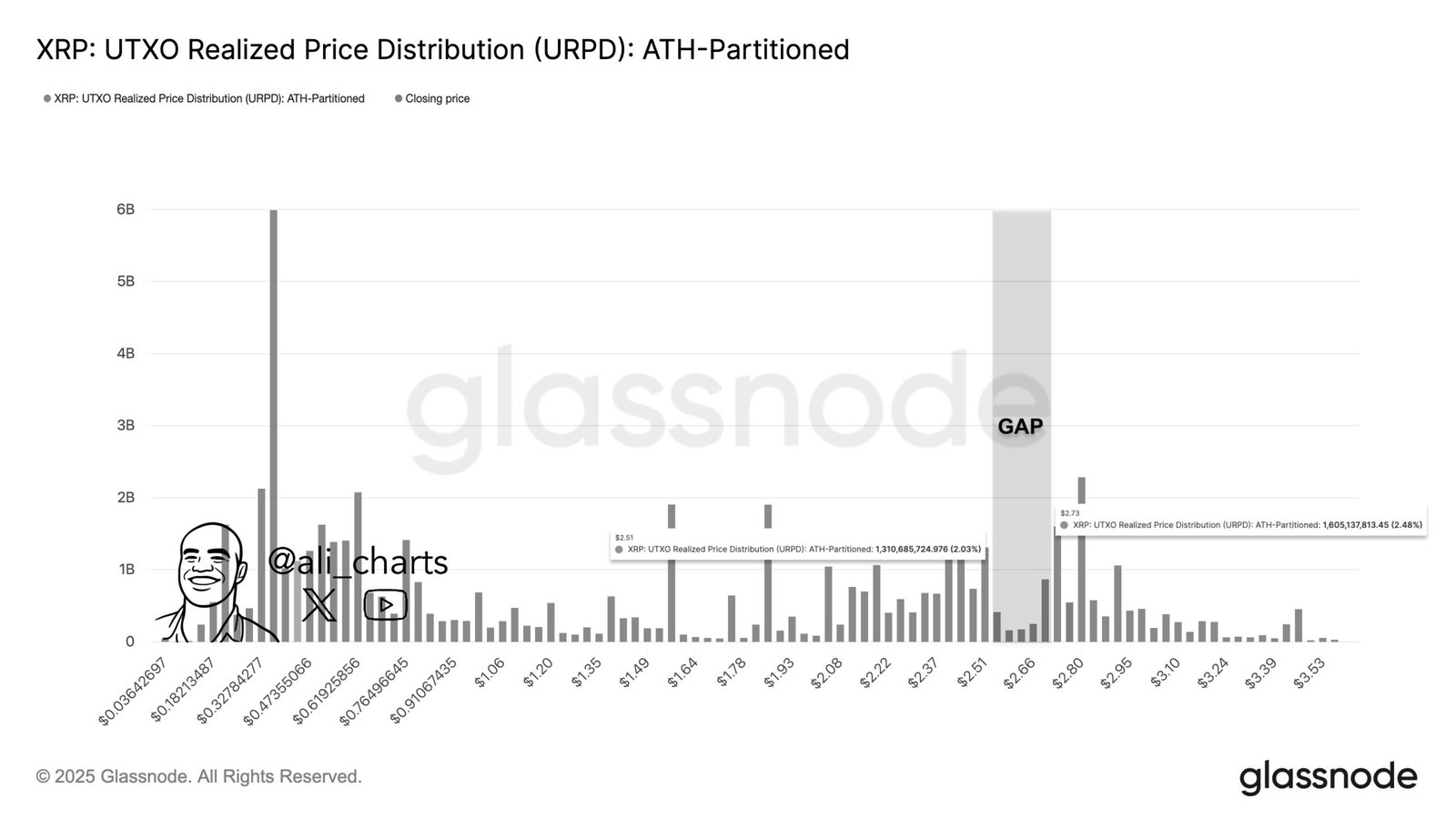
URPD charts map where coins last changed hands. Each bar marks the volume of XRP that moved at a given price. When bars are small, it signals fewer holders with a cost basis there. Therefore, on-chain supply looks light in that zone.
Such gaps often mark stretches with fewer natural stop points. Price can traverse them faster because fewer addresses are anchored to sell or break even. Conversely, once through, there may be less immediate support on a retest. The chart does not forecast direction; it describes where supply last shifted.
Method matters. These distributions reflect realized cost basis on the ledger, not order-book liquidity. They complement, rather than replace, exchange depth, funding, or spot flows. Still, they add useful context by showing how holder cohorts are positioned around historical price levels.
XRP whale activity spikes on-chain, CryptoQuant chart shows fresh large-holder moves
A CryptoQuant dashboard shows a sharp rise in the “whale last active 0–1 days” metric alongside XRP’s long-term price series. The purple area expands steeply in recent weeks, indicating more large entities moved coins within the last 24 hours compared with prior periods. Analyst account Dominus highlighted the surge and framed it as unusually strong activity among big holders.
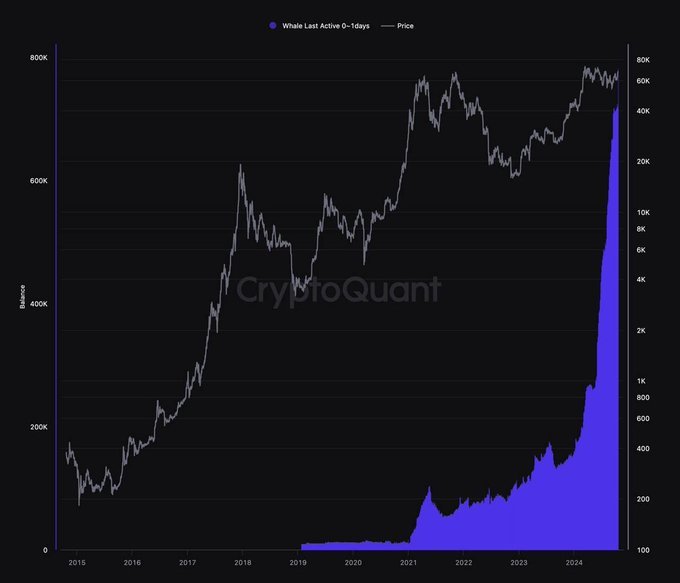
The metric tracks the balance of addresses tagged as whales that transacted recently. When it climbs, it means large wallets have been active on-chain, sending or receiving XRP in the measured window. It does not identify buyers or sellers; it only shows that big accounts moved funds. Therefore, the spike confirms unusual whale participation but does not, by itself, prove net accumulation or distribution.
Context matters. Rising whale activity can reflect internal treasury reshuffles, exchange flows, custody changes, or positioning ahead of events. Analysts typically pair this series with exchange netflows, order-book data, and realized distribution maps to separate accumulation from simple transfers. Still, the current slope stands out compared with earlier cycles, which makes it a relevant datapoint in today’s non-price XRP news.
XRP MACD shows momentum turning after a deep negative swing
The MACD histogram just flipped green as the MACD line curled up toward the signal line. Momentum improved from the heavy red stretch seen around September 23, and bars now rise toward the zero line. Buyers returned to the tape, but the trend still sits below neutral.
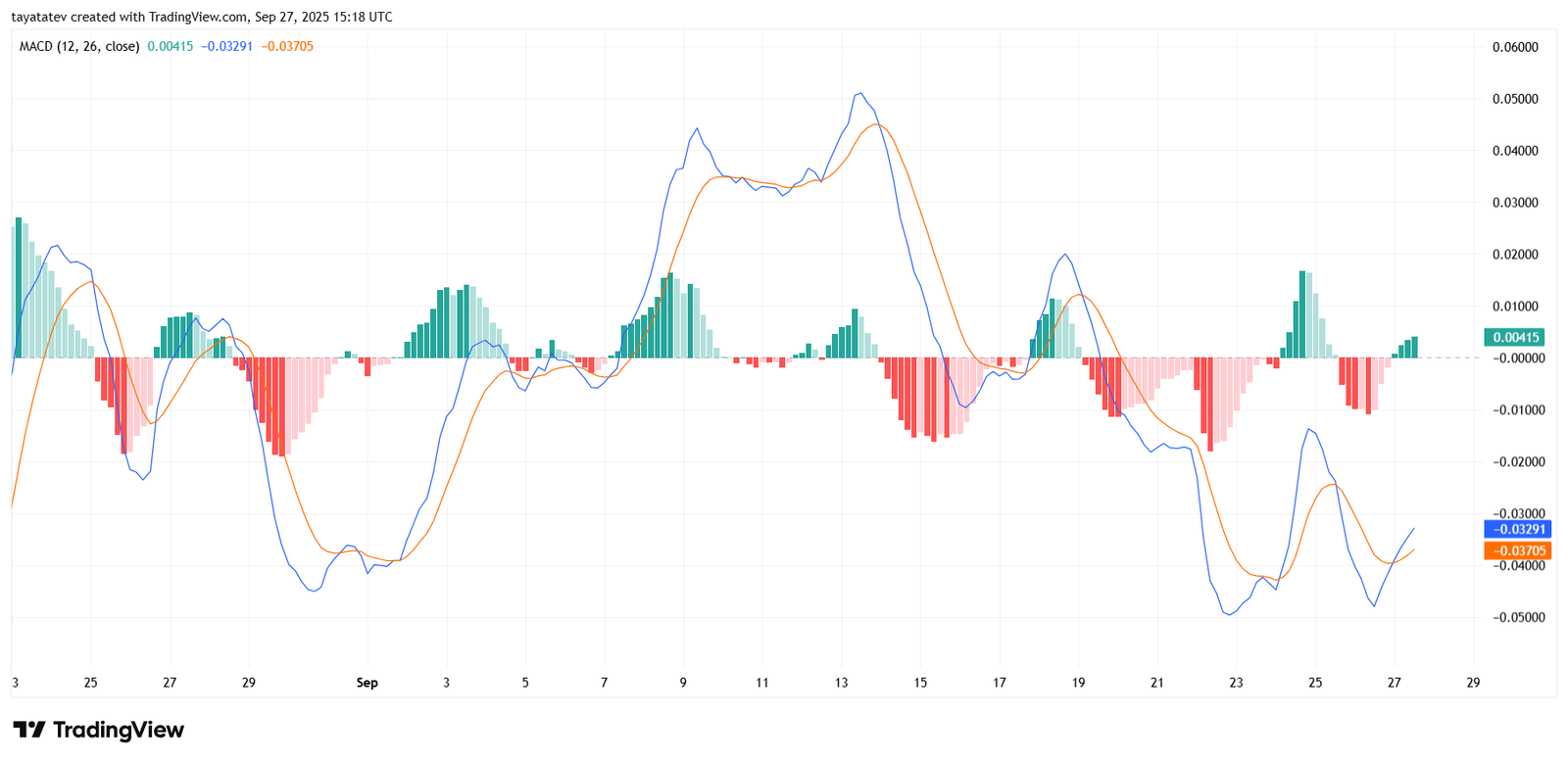
The setup is straightforward. MACD measures the gap between the 12- and 26-period EMAs, while the histogram tracks the pace of that change. When the MACD line climbs toward the signal, downside pressure fades. Here, the blue line bounced from its lowest print of the month and is attempting to cross the orange signal from below.
However, conditions remain fragile. The MACD stays under zero, so the larger backdrop is not yet bullish. To shift the bias, the line needs to clear the signal and then push the histogram above zero with expanding green bars. If momentum stalls before the crossover, the indicator can whipsaw and roll back into red.
In short, XRP’s short-term momentum improved, yet confirmation requires a clean MACD-over-signal move and sustained strength around the zero line.


