


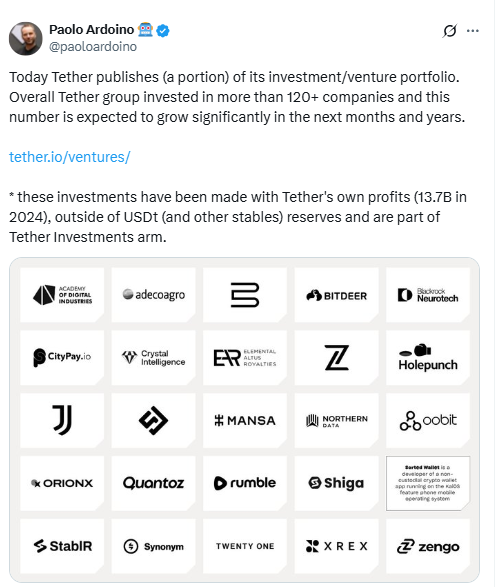
Tether has funded investments in more than 120 companies using $13.7 billion in profit from U.S. Treasury holdings. According to Tether CEO Paolo Ardoino, none of the invested money came from reserves backing USDT or other Tether stablecoins.
The Tether portfolio includes Bitdeer, Northern Data, Holepunch, Synonym, and Quantoz. These firms operate across AI, decentralized communications, digital infrastructure, and education. Other Tether Investments include Adecoagro, Crystal Intelligence, Neurotech, and Rumble.
The Tether profit used for this portfolio came from the yield on $130 billion in U.S. Treasuries. Ardoino confirmed the investment arm operates independently from stablecoin reserves. The firm shared part of the Tether Investments list on its official website on July 23.
Ardoino wrote,
“These investments have been made with Tether’s own profits ($13.7 billion in 2024) outside of USDT (and other stables) reserves and are part of Tether Investments arm.”
He said the list will likely expand in the coming months and years.
MiCA Regulation Delays Tether Europe Entry Despite Global Expansion
While Tether Investments grows in global markets, the company remains absent in Europe due to MiCA compliance issues. The Markets in Crypto Assets (MiCA) framework, active since 2024, enforces strict rules for stablecoin issuers.
MiCA requirements include full reserve backing, regular audits, transaction limits, and holding up to 60% of reserves in EU-regulated banks. The rules also cap daily transactions for non-EU stablecoins like USDT at 1 million.
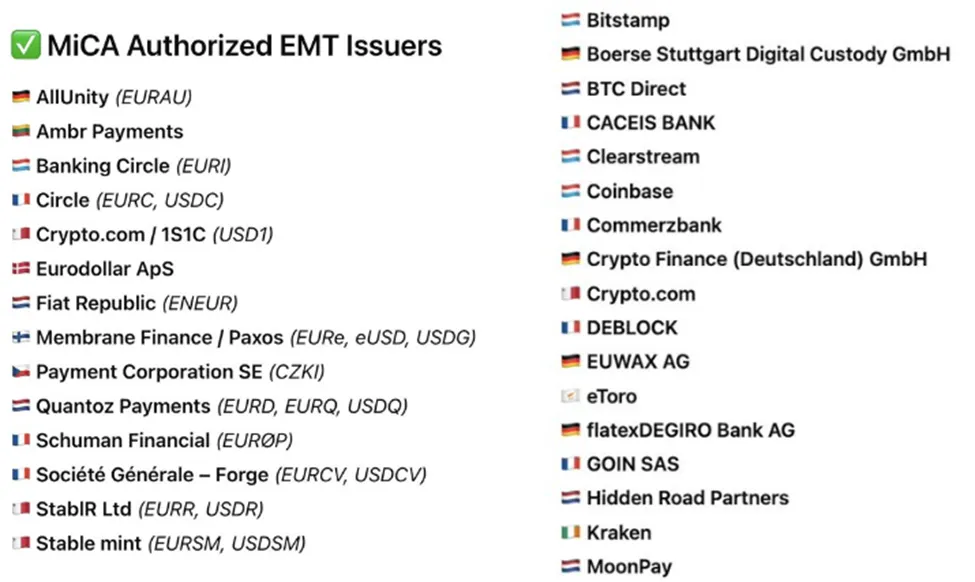
Tether has not joined the MiCA registry. In contrast, 53 other crypto firms have received approval. According to BeInCrypto, approved companies include Kraken, Coinbase, and Bybit. The European Securities and Markets Authority (ESMA) published the list.
Dessislava Ianeva-Aubert, Senior Research Analyst at Kaiko, said,
“MiCA’s main requirements for stablecoins are: full reserve backing with liquid assets… a significant part of reserves must be held in EU-regulated banks.”
Europe entry remains blocked as the company rejects these terms.
Tether Audit Absence Raises Barrier to Full MiCA Compliance
Tether has avoided full audits for years. The firm relies on attestations to show its reserves. In an April 2025 interview, Ardoino explained why top-tier audit firms are unwilling to work with crypto firms like Tether.
He said, “So, you are a Big Four auditing firm, and you have the entire banking industry that is your customer. Why would you risk 100,000 customers for a couple of stablecoins?” He also referenced past crypto failures like FTX, which made audit firms more cautious.
Despite multiple public statements since 2017, Tether has not completed a full independent audit. In August 2022, Ardoino said an audit was “likely months away.” As of July 2025, there is still no audit.
Consumers Research issued a public critique of the Tether audit issue. The group stated, “Tether’s continual failure to undergo an independent audit raises a distressing red flag for the company and its USDT product.”
The lack of audit transparency remains a critical point of concern under MiCA, which requires strong disclosures, conflict of interest policies, and liquid reserve backing.
Tether’s MiCA Opposition Continues as Next EU Update Nears
Tether has taken a public stance against MiCA, citing risks to users and stablecoin issuers. Ardoino previously stated that Tether will not enter the European market until MiCA offers better protection for consumers and companies.
Tether Europe approval remains uncertain. The next regulatory checkpoint comes in September 2025. ESMA is expected to publish its 9-month MiCA status report, which may include updates or changes to the framework.
Until then, Tether Investments will continue using profit from U.S. Treasuries to fund its portfolio. The firm has not announced any plans to change its audit position or adjust operations to meet MiCA requirements.


