


Crypto analyst Bitcoinsensus believes Ondo Finance (ONDO) could climb to $3.10, which would be a 350% gain from current levels near $1.00. The projection is based on Elliott Wave theory, a method that identifies price movements in repeating cycles. According to this approach, ONDO has already seen two major rallies of 240% and 270%. The analyst expects a third wave, called “Wave 3,” which could deliver the largest move.
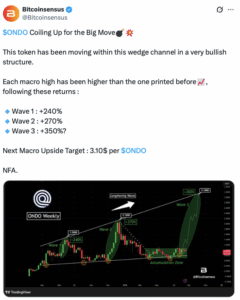
Wave theory, however, is not always reliable. Patterns often break if fundamentals do not support them. To test the outlook, it is necessary to examine both on-chain activity and broader market conditions.
Tokenized Treasuries Market Jumps to $7.4B With Ondo Crypto Holding 80% Share
Ondo Finance is at the center of the fast-growing tokenized U.S. Treasuries market. These products allow investors to gain exposure to government bonds directly through blockchain. The market has grown from less than $100 million in 2023 to $7.43 billion in August 2025. That represents a surge of more than 7,000% in just two years.

Ondo is the dominant platform in this space. It manages about $1.25 billion in tokenized Treasuries, giving it more than 80% of the market. Its two main products, USDY and OUSG, are widely used and together account for more than $250 million on Solana alone. The company has also expanded to the XRP Ledger, adding round-the-clock minting and redemption. Partnerships with BlackRock, JPMorgan, and Ripple have strengthened its position among institutional players.
These numbers show that Ondo’s growth is backed by real adoption, not only price speculation. Its market dominance gives the analyst’s bullish view a solid base.
Stablecoins Add $200B Demand for U.S. Debt, Supporting RWA Growth
Another factor supporting Ondo is the rise of stablecoins. Tokens like USDT and USDC hold U.S. Treasuries as reserves. Reports show that stablecoin issuers now hold more than $200 billion worth of Treasuries. This creates constant demand for short-term government debt. Platforms like Ondo benefit from this trend because they tokenize the same assets.
The stablecoin market itself is valued at about $256 billion today and could grow to $2 trillion by 2028. If this growth continues, it will likely increase the flow of capital into tokenized financial products. At the same time, regulation is becoming clearer. The GENIUS Act has provided legal guidance for stablecoins, and U.S. Treasury officials are now engaging directly with issuers. This alignment adds credibility to the RWA sector, which is key for Ondo’s long-term growth.
Ondo’s on-chain activity is also improving. The number of active addresses and daily transactions has been rising again after slowing earlier this year. However, activity has not yet reached the peaks seen in March. This suggests recovery is underway, but momentum is still building.
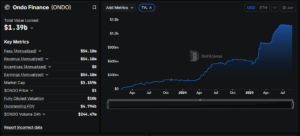
The protocol’s total value locked is $1.39 billion, with annualized revenues of about $54 million, according to DeFiLlama. These figures show that Ondo is generating income and attracting deposits, which strengthens the analyst’s bullish argument.
Technical Indicators Support Upside
On the technical side, ONDO to USD has recently broken above its 20-, 50-, and 100-day moving averages. This signals renewed strength after a period of consolidation. The relative strength index (RSI) is around 66. This level shows positive momentum but has not yet crossed into overbought territory, meaning there is still room for price growth.

Key resistance levels stand at $1.20, $1.50, and $2.15. The token must break through these checkpoints before the analyst’s $3.10 target can become realistic. Failure to hold above $0.95 to $1.00 would weaken the bullish setup.
Despite the bullish case, several risks remain. A fall in U.S. Treasury yields could reduce demand for tokenized debt and slow inflows into Ondo Finance. Competition from other firms, including Franklin Templeton and Matrixdock, could also erode its market share. Regulation is another factor. Although the GENIUS Act offers clarity, sudden changes in stablecoin rules could impact Ondo’s growth. Technical risks also exist. If ONDO loses its support range, the wave pattern would collapse.


