



Ethereum’s corporate footprint expanded this week as Ether Machine confirmed a $654 million private financing round ahead of its planned Nasdaq debut. The firm, created through the merger of Ether Reserve and the blank-check company Dynamix Corporation, has rapidly built a balance sheet that now holds more than 495,362 ETH alongside $367.1 million in liquid capital. The funding round included high-profile backing from Ethereum advocate Jeffrey Berns, who also joined the company’s board.
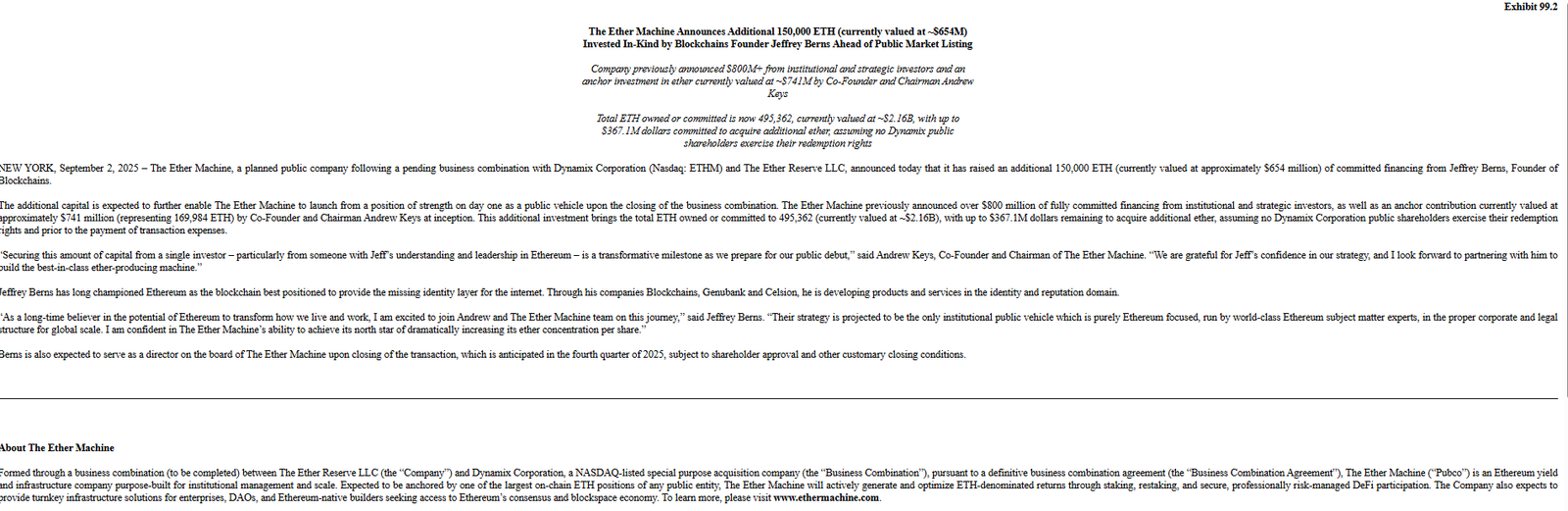
The move positions Ether Machine as one of the most capitalized entities in the Ethereum ecosystem preparing for a U.S. public market listing. Citibank is expected to lead the next fundraising round, signaling that traditional financial institutions are steadily moving closer to Ethereum’s infrastructure. The deal not only strengthens the firm’s immediate liquidity but also underscores the appetite of investors seeking exposure to Ethereum’s ecosystem through regulated equity markets.
Wall Street’s Push for Privacy on Ethereum
As institutional adoption gathers momentum, privacy has emerged as a central demand from traditional finance. Danny Ryan, co-founder and President of Etherealize, argued that existing public blockchain structures cannot satisfy Wall Street’s expectations.
“If we’re going to onboard the world to blockchains, ‘everyone sees everything all the time’ is not viable,”
Ryan said.
This perspective reflects a broader shift in Ethereum’s institutional narrative. While transparency remains a core principle of blockchain, the arrival of banks, funds, and corporations is bringing new requirements for confidentiality in transactions and portfolio management. As a result, Ethereum developers and infrastructure providers are now under increasing pressure to design tools that balance open verification with selective privacy. The debate is intensifying as Ethereum seeks to bridge its decentralized roots with the needs of heavily regulated financial players.
Exchange Flux Turns Negative for the First Time
In parallel with these corporate and institutional moves, Ethereum recorded a significant technical milestone. For the first time in its history, Ethereum’s exchange flux metric turned negative, indicating that more ETH is leaving exchanges than entering. The shift suggests a structural change in market behavior as long-term holders move their tokens into private wallets and staking contracts, reducing immediate selling pressure.
This development is particularly relevant for understanding Ethereum’s broader network health. Historically, high inflows to exchanges have signaled potential sell-offs, while sustained outflows have indicated accumulation phases. The negative exchange flux now points to a stronger foundation for the network, as investors continue to transition from speculative trading toward staking and other yield-generating activities within the Ethereum ecosystem.
Tokenized Equities Launch on Ethereum via Ondo Finance
Ethereum’s role as a settlement layer for real-world assets also expanded this week. Ondo Finance launched tokenized versions of more than 100 U.S.-listed stocks and ETFs directly on Ethereum. Each token is fully backed by securities custodied with U.S.-registered broker-dealers, providing investors outside the United States with exposure to traditional equities through blockchain infrastructure.
The launch represents another step in the merging of decentralized finance and traditional capital markets. By offering around-the-clock trading and direct on-chain settlement, Ethereum is positioned to become a key venue for tokenized financial products. However, access remains restricted for U.S. and U.K. investors due to regulatory boundaries, underscoring the uneven rollout of tokenized equity products across different jurisdictions.
Still, the availability in Asia-Pacific, Europe, Africa, and Latin America shows how Ethereum is being leveraged to reach underserved markets that historically lacked access to U.S. securities.
Validator Entry Queue Surges to Two-Year High
Demand for Ethereum’s staking infrastructure continues to climb. The validator entry queue has reached its highest level since 2023, with nearly 860,000 ETH awaiting activation. At the current pace, with 900 validators entering and 1,800 exiting daily, the queue could take up to two weeks to clear.
This surge shows rising institutional and retail interest in Ethereum’s consensus. The backlog signals more investors want to secure the network. They are also seeking to earn staking rewards despite locked liquidity. The demand for validator slots highlights Ethereum’s role as an income source. Staking is now a central feature of Ethereum’s economic model.
Ethereum Charts Signal Potential Breakout Toward $6,756
On September 7, 2025, Ethereum’s 4-hour chart against the U.S. dollar (ETH/USD, Bitstamp) showed a clear technical formation that traders closely monitor. The chart indicates Ethereum has been consolidating within a rising wedge pattern. This structure is defined by higher lows and relatively flat highs, where price action compresses into a narrowing range. Rising wedges often precede sharp moves, either as reversals or strong continuations, depending on the breakout direction.
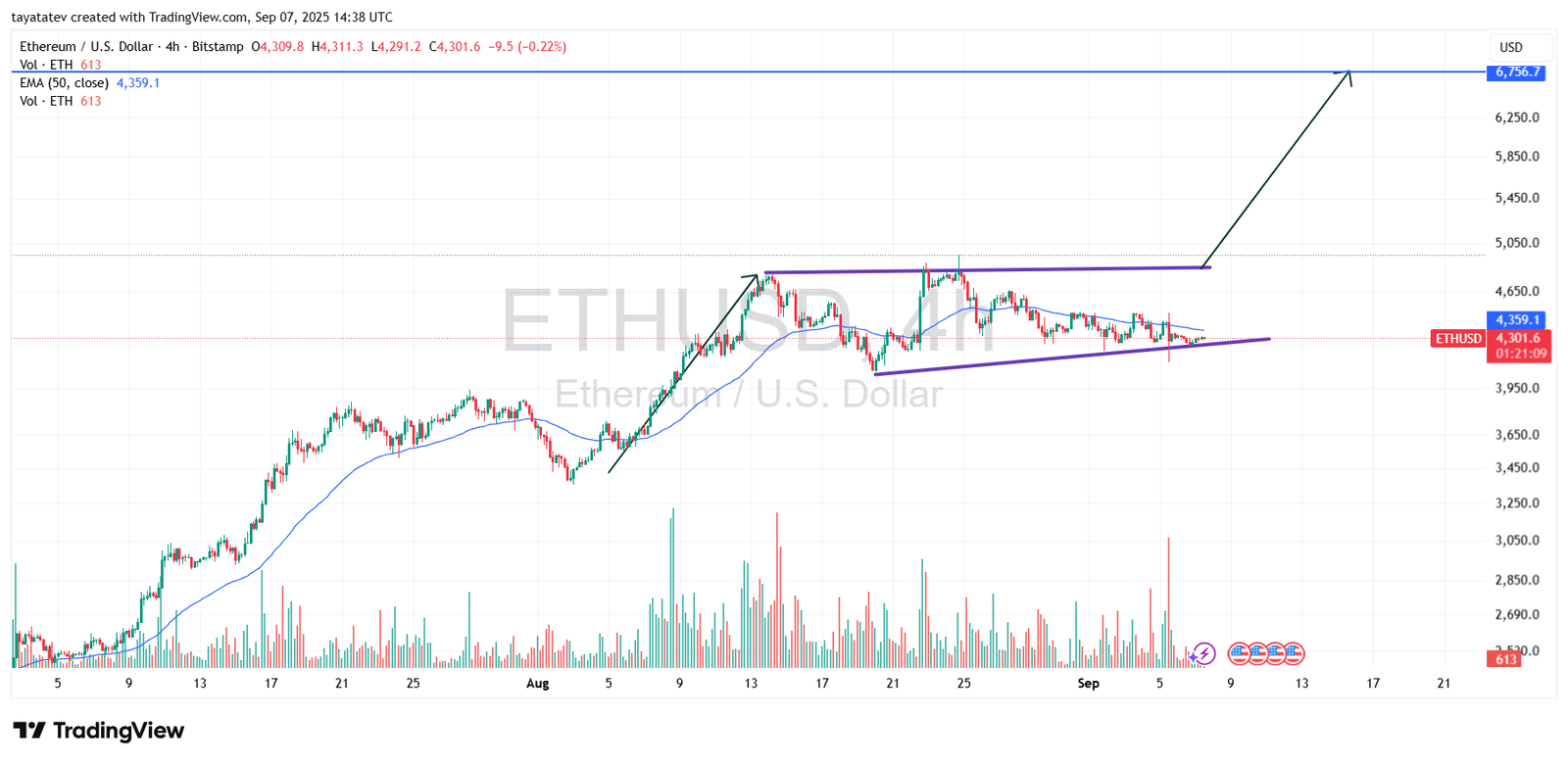
In this case, Ethereum is trading near $4,301 while holding close to the 50-period exponential moving average (EMA) at $4,359. The wedge shows a tightening price action since mid-August, with the apex forming in early September. The upper resistance is near $5,050, while support has gradually lifted from the $3,950 zone. If the breakout occurs above resistance, the measured-move projection suggests a strong bullish continuation.
The chart projects a possible upside target of $6,756, which would mark a 57% increase from the current $4,301 level. This target aligns with the vertical height of the prior rally in early August, which has been mirrored in the breakout calculation. The volume profile also supports this view: spikes during upward moves indicate underlying buying pressure, while declining volume during consolidation suggests sellers are weakening.
In conclusion, Ethereum’s rising wedge, if confirmed with a breakout above $5,050, points to a potential surge toward $6,756. The structure emphasizes that momentum remains intact as institutional demand and staking activity add further strength to the network’s outlook.


