


Bitcoin price traded near $105,300 on June 3, 2025, staging a modest recovery above $106,500 briefly before turning back. The price action stalled as macroeconomic uncertainty resurfaced. Volumes remained thin, and BTC’s intraday bounce failed to regain bullish momentum. However, despite heightened volatility across global markets, the digital asset remains above key technical thresholds.
Investor attention has shifted toward emerging macro headwinds, including renewed U.S.–China tariff tensions, a weakening dollar, and elevated bond yields. Risk assets have pulled back, while alternative hedges such as gold and oil have firmed up. The Bloomberg Dollar Spot Index extended its five-month slide, while Brent crude approached $65 per barrel.
James Toledano, Chief Operating Officer at Unity Wallet, told CoinChapter in a note,
“Investors are viewing Bitcoin as a hedge against macroeconomic turmoil. While global equities declined and U.S. Treasury yields climbed, the Bloomberg Dollar Spot Index dropped for a fifth consecutive month, and gold rose nearly 2% — clear signs of a move towards alternative assets.”
Toledano added that the weakening U.S. dollar and Brent crude’s climb toward $65 per barrel drive capital toward decentralized stores of value. He explained that Bitcoin’s resilience in this environment underscores its growing maturity and rising appeal as a strategic store-of-value asset, particularly as trust in fiat-backed instruments erodes and geopolitical risks escalate.
Moreover, the Unity Wallet COO said Bitcoin’s role in portfolios is evolving. While digital assets still react to macro shocks, past tariff events caused limited drawdowns. He noted that traders now view tariffs more as negotiation tactics than lasting policy changes. As a result, Bitcoin is increasingly seen as a strategic diversification tool rather than a high-risk, high-volatility asset.
Institutional Treasury Buys and Retail Access Catalysts Could Help Bulls
Institutional interest in Bitcoin seems to be increasing, with Norwegian digital asset brokerage and research firm K33 initiating its treasury allocation strategy with a 10 BTC purchase. While modest in volume, the move signals a broader structural shift in corporate finance, echoing the precedent set by Strategy, which now holds approximately $50 billion in Bitcoin.

Treasury adoption continues to scale, contributing to over 20% of spot market demand in Q2 2025, according to Glassnode. This demand is driving a persistent supply squeeze and help push Bitcoin price higher. The tighter float has enabled Bitcoin to maintain its footing above the $100,000 level.
Moreover, retail access is set to improve as ARK 21Shares Bitcoin ETF (ARKB) announces a 3-for-1 share split effective June 16. While share splits do not change the underlying value, they have historically enhanced retail participation by lowering per-share costs.

This structural change could mirror legacy market reactions—Apple’s 2020 split, for instance, boosted trading activity and triggered a 10% price rally post-announcement. With U.S. spot Bitcoin ETFs accumulating more than $10 billion in net inflows year-to-date, ARKB’s split positions it to absorb a greater share of the next retail wave.
These demand-side developments arrive amid macroeconomic instability, including a U.S. debt-to-GDP ratio above 120% and global M2 money supply outpacing real output. Together, institutional positioning and broader retail access, backed by constrained supply, create a multi-dimensional setup that could drive Bitcoin toward $120,000 in Q3 2025.
Bitcoin Price Faces Rejection Near $106K as Technical Weakness Emerges
Bitcoin price dropped 1.5% on June 3, retracing from its daily high of $106,560, but bulls managed to keep BTC above the $105,000 price level. The rejection near $106,000 reinforces this level as a key short-term resistance. Price action shows bears aggressively defending this threshold, leading to increased downside pressure as intraday momentum fades.
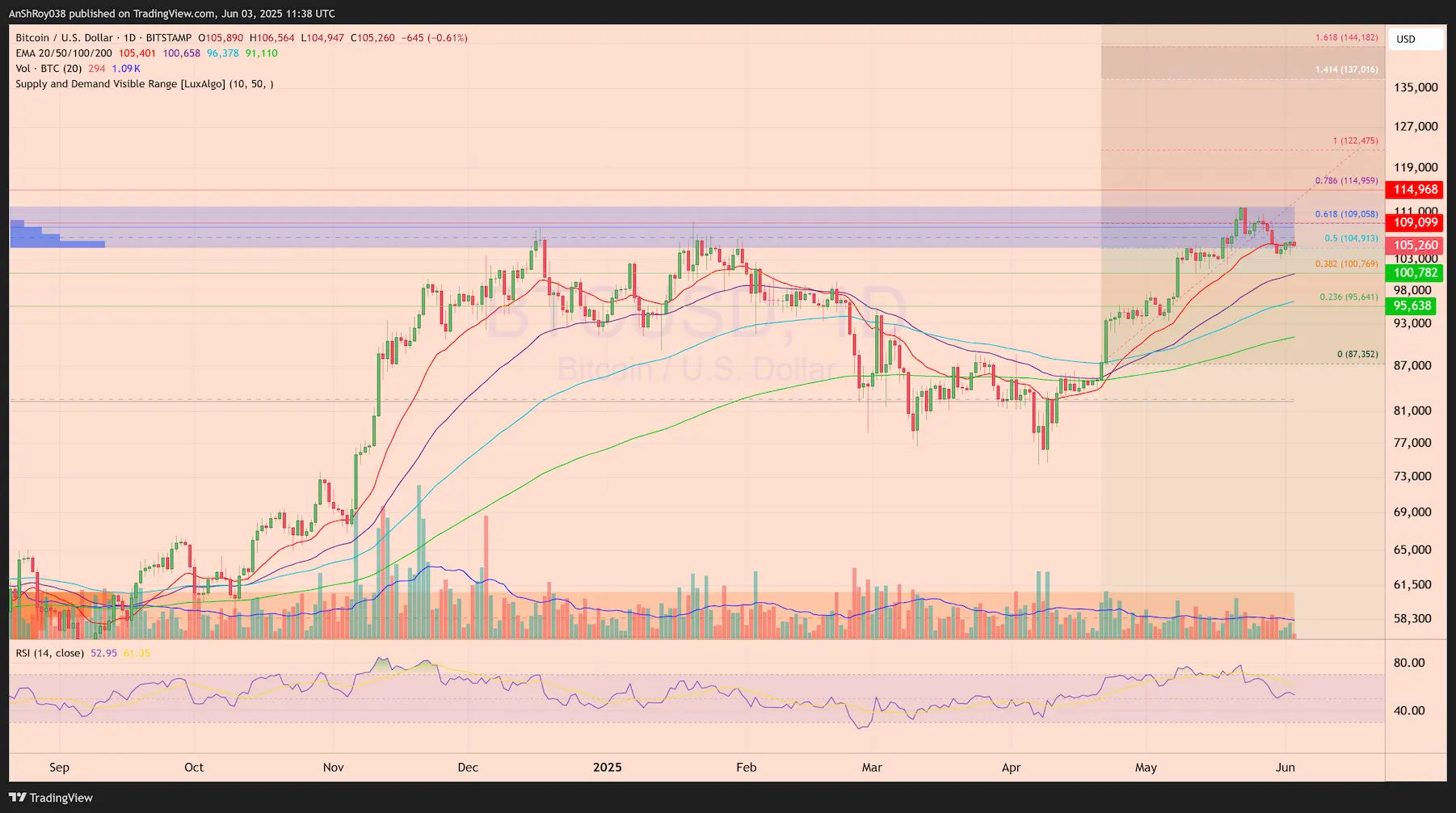
If selling persists, the BTC to USDT conversion rate may retest the 50-day exponential moving average, currently near $100,800. A breakdown below the immediate support level would invalidate the current uptrend and expose BTC to a deeper correction toward the next key support near $95,630, aligned with the 0.236 Fibonacci retracement. This zone could act as a make-or-break point for short-term bullish sentiment.
On the upside, reclaiming lost ground would require a decisive move above $106,000. The first resistance remains near $109,100. Flipping this level would shift market structure back in favor of buyers and clear a path for BTC to target the $114,970 resistance, charting a new ATH along the way.
Volume remains muted, suggesting a current lack of strong conviction among buyers. The Relative Strength Index has dipped to 52.9, reflecting fading momentum without signaling immediate oversold conditions. Until bulls reclaim initiative above $109,100, further downside risk remains elevated. Bitcoin’s price structure continues to hinge on its ability to defend the $100,800 support and attract renewed buying interest at lower levels.


