


Russia moved one step closer to allowing Bitcoin and other cryptocurrencies for international settlements. The finance ministry confirmed that it is working with the Bank of Russia on a legal framework that would permit companies to use digital assets in foreign trade. This approach aims to create alternatives to traditional payment rails blocked by sanctions.
At the same time, thegovernment is tightening internal control of the crypto sector. Authorities increased supervision of mining firms and launched new registration and reporting requirements. The move reflects a dual strategy: allowing crypto for external payments while keeping domestic flows under stricter oversight.
As a result, Bitcoin could gain a wider role in Russia’s external trade operations. However, any company using BTC for settlements would still face regulatory scrutiny, as the state wants to monitor inflows, outflows, and taxation inside the country.
Global Regulators Warn of Oversight Gaps
The Financial Stability Board (FSB) released a new assessment highlighting major gaps in how countries regulate crypto markets. The report said implementation of international standards remains inconsistent, especially in areas such as stablecoins, custody rules, and cross-border supervision. The warning comes as crypto usage continues to expand across multiple regions.
Regulators are concerned that companies can exploit weak jurisdictions to avoid stricter oversight. The FSB urged governments to accelerate adoption of global standards to reduce regulatory arbitrage. It stressed that crypto operates without borders, while laws still function on a national level, creating structural risks.
Although the review did not target Bitcoin directly, it increases pressure on national authorities to strengthen supervision. Exchanges, custodians, and service providers that handle BTC may soon face unified requirements in reporting, auditing, and licensing.
Bitcoin Core 30.0 Release Brings Policy and Network Changes
Developers shipped Bitcoin Core v30.0, the newest version of the network’s reference software. The upgrade introduced notable policy changes, including a larger data limit for OP_RETURN and enhanced node-to-node communication options. It also marked the end-of-life status for major legacy versions, pushing operators to modernize.
The updated rules affect how data can be stored in Bitcoin transactions. By increasing limits, the release broadens potential non-financial uses, including timestamping and document proofs. Developers highlighted that the change does not alter consensus, but it may influence how users interact with the blockchain.
Node operators are now encouraged to upgrade to maintain compatibility and security. The release continues Bitcoin’s incremental development model, focused on stability, predictable changes, and long-term network resilience.
Viral $1M Bitcoin claim meets the model’s limits
A tweet says Bitcoin “is going to $1,000,000 whether you like it or not.” The attached “Power Curve Cycle Cloud” is a power-law fit with a four-year cycle band, not proof of destiny. It extrapolates past log-scale growth and wraps it in a confidence-style cloud. Therefore, the chart suggests a path; it does not guarantee an outcome.
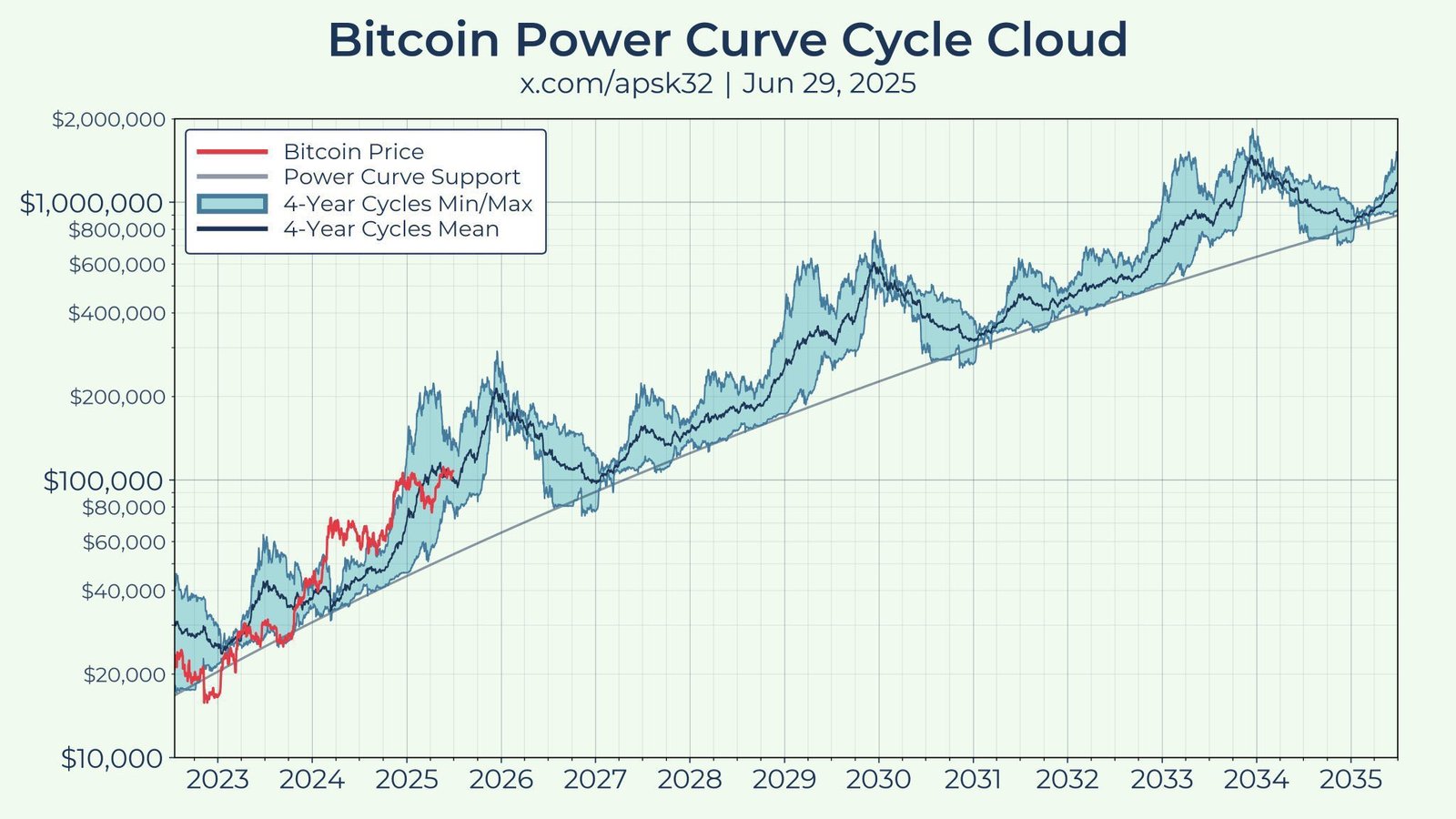
The graphic plots a rising “power curve support,” a darker “four-year cycles mean,” and a shaded min-max envelope. On log axes, straight lines can imply constant percentage growth, which makes long-run targets appear linear and inevitable. However, those bands come from historical volatility and halving cadence; they do not encode future policy, liquidity, or demand shocks. In short, the cloud reflects history more than it predicts catalysts.
Moreover, the model assumes cycle rhythm persists. It quietly bakes in continued adoption, stable mining incentives, and functioning market infrastructure. Yet regime changes can break fits. Spot-ETF flows, exchange rules, or security incidents can widen or collapse that band. Likewise, macro matters: real rates, dollar liquidity, and risk appetite will steer cycles as much as halvings do.
Additionally, reaching seven-figure prints requires sustained buying power. That means deeper institutional balance sheets, durable custody rails, and regulatory clarity across major jurisdictions. It also means on-chain activity, fee markets, and hash-rate economics must support higher settlement value without degrading user experience. The chart does not test those constraints; it projects through them.
Therefore, treat the image as one scenario among many. Power-law frameworks help compare cycles and anchor long-term discussions, but they cannot decree price. Newsrooms would present this as a claim backed by a model with explicit assumptions and wide uncertainty, not as a foregone conclusion.
Bitcoin breakout claim targets $136K, based on triangle pattern
A new BTC/USD chart shared by Titan of Crypto suggests that Bitcoin has broken out of a symmetrical triangle on the 4-hour timeframe, with a projected target near $136,000. The model applies a standard triangle-measurement technique, where the height of the pattern is added to the breakout point to estimate the move. The post argues that confirmation would require continued price action above the down-sloping resistance line.
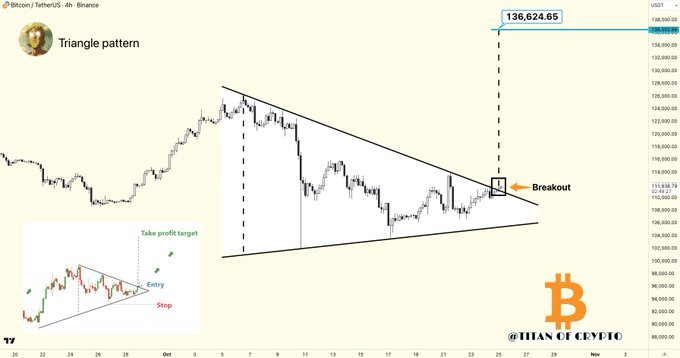
The analysis relies on the idea that symmetrical triangles represent periods of consolidation followed by expansion. In this view, compressed volatility can precede a directional move once buyers or sellers gain control. However, the projection assumes that momentum continues after the initial breakout, without rejecting back inside the pattern or creating a bull trap. Chartists typically look for volume expansion and a successful retest to improve confidence in continuation.
Additionally, short-term chart structures do not account for variables such as macroeconomic conditions, liquidity shifts, or regulatory headlines. Markets can break out and still fail if follow-through weakens. Therefore, traders often monitor moving averages, RSI, or horizontal levels alongside the triangle to confirm trend strength. While the technical setup highlights a bullish scenario, the outcome depends on sustained support and broader market participation.


