


The global crypto market added just 3% in the first half of 2025. The total market cap held near $3.27 trillion, while institutional buyers and major investors continued to outline bigger price targets for the rest of the year.
The crypto total market cap stayed within $3.2–$3.4 trillion through H1. A sharp Q1 drop was partly offset by a Q2 recovery but did not break above the key $3.4 trillion ceiling. The daily Relative Strength Index (RSI) is near 53.69, with daily trading volume around $145 billion.
Coinglass quarterly returns show Bitcoin (BTC) dropped 11.82% in Q1 but gained 30.23% in Q2, leaving BTC slightly positive for H1. Ethereum (ETH) fell 45.41% in Q1 and rebounded 36.03% in Q2 but remained negative overall.

Compared to recent years, the crypto market’s 3% gain is mild. Bitcoin climbed 71.7% in H1 2023 and 68.6% in H1 2024. Ethereum gained 52.1% and 59.7% in those same periods. By comparison, the S&P 500 gained about 5% in H1 2025, while gold jumped nearly 28%.
ETFs Bring $21B While MicroStrategy, Metaplanet Buy More BTC
Institutional capital stayed active despite limited price action. U.S. spot Bitcoin ETFs pulled in more than $21 billion in net inflows during Q1. By late June, Bitcoin ETFs recorded a single-day net flow of $501.20 million, with about $432.70 million added over the month.

Ethereum ETFs turned positive after a slow start, with net inflows of $77.50 million for June 27 and about $85 million in the past month.
Beyond ETFs, major companies continue to hold or expand treasury Bitcoin reserves. MicroStrategy raised its holdings to over 226,331 BTC by June 2025, remaining the largest public corporate holder. Japan’s Metaplanet recently added 1,005 BTC for $108 million, lifting its total to 13,350 BTC after issuing $208 million in zero-coupon bonds to fund more buying. Tesla, which still holds over 11.000 BTC, remains one of the earliest major corporates to adopt Bitcoin as treasury reserve.
ETF flows and direct treasury holdings together show that large players keep absorbing supply during dips.
Whales Build Positions, Miners Limit Buffer
On-chain data confirms Bitcoin whales — wallets with 100–1,000 BTC — added more than =93,000 BTC in January and 62,000 BTC in February. The largest whale tier (10,000+ BTC) sold about 58,000 BTC in Q1 but returned to moderate buying in April. The CryptoQuant Whale Ratio shows continued large-holder exchange use through late June.
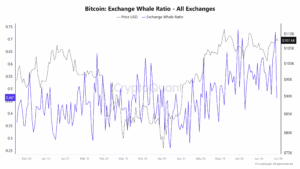
Smaller Bitcoin wallets under 1 BTC mostly trimmed positions during Q2’s bounce.
Ethereum’s top 1% of wallets now hold about 62% of supply, up about 1.8% since March. Staked ETH remains near 27%, keeping coins locked out of circulation.
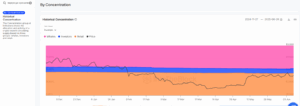
Bitcoin miner reserves stay near multi-year lows at about 1.807M BTC. “Despite low revenue and weaker fee income, miners are not heavily selling Bitcoin. Miner outflows have dropped about 74% since February, and total reserves remain near multi-year lows, showing that miners continue to cover costs with steady small sales but hold core reserves tight.”
Despite steady accumulation and inflows, Bitcoin’s Q3 is historically range-bound. Past cycles show lower liquidity as Western funds slow trading in summer, while big catalysts like ETF launches and policy moves typically appear in Q4. Miner reserve outflows add mild steady supply at a time when demand pauses. Furthermore, miners remain net accumulators but still release enough BTC to cover higher summer operating costs.
Analysts Put Bitcoin at $250K, Ethereum at $6K If Supply Tightens
Major crypto figures keep their high targets. Michael Saylor repeated his long-term view that every billionaire will eventually hold at least a billion dollars of Bitcoin, predicting a supply squeeze to reset valuation. He also echoed Fundstrat’s $250,000 Bitcoin target by year-end.

Bitwise CIO Matt Hougan said that there is “just too much structural demand” for Bitcoin to stay capped, projecting $200,000 by December. Fundstrat’s Tom Lee also agrees that $250,000 is realistic due to expanding global adoption and Bitcoin’s capped supply.
Historically, Bitcoin’s strongest runs appear late in the year. Q4 gains reached 47.7% in 2024 and 56.9% in 2023, while Ethereum added 28.3% and 36.7% in the same Q4s.
If ETF inflows and treasury accumulation continue, analysts expect Bitcoin could reach $150,000–$250,000. Ethereum forecasts range from $4,500–$6,000, assuming staking stays high and institutional demand holds.


