



El Salvador’s Legislative Assembly has approved the El Salvador Investment Banking Law, allowing Bitcoin investment banks to operate under separate rules from commercial banks. The law permits these institutions to hold Bitcoin and other digital assets on their balance sheets.
The law also authorizes Bitcoin investment banks to provide cryptocurrency services to “sophisticated” investors, a term similar to accredited investors in the United States. Juan Carlos Reyes, president of the Commission of Digital Assets (CNAD), confirmed that banks with a PSAD license can operate entirely with Bitcoin if they choose.
“The new Investment Banking Law allows private investment banks to operate in legal tender and foreign currencies for ‘Sophisticated Investors’ and to engage in digital assets like Bitcoin with a Digital Asset Service Provider (PSAD) license. With a PSAD license, a bank could choose to operate entirely as a Bitcoin bank,”
Reyes said.
A PSAD license is required for any bank in El Salvador that intends to offer Bitcoin or other digital asset services.
Institutional Investors and Bitcoin Adoption in El Salvador
The approval of the El Salvador Investment Banking Law is expected to attract institutional investors and banking entities that want to work with Bitcoin and digital assets. The country already recognizes Bitcoin as legal tender, alongside the US dollar, and has maintained regulations to integrate cryptocurrency into its financial system.
Institutional participation has been a major factor in Bitcoin adoption in El Salvador. The pro-crypto stance of the government has drawn companies providing blockchain services, trading infrastructure, and digital asset custody.
However, some observers have pointed out that Bitcoin adoption in El Salvador has mostly impacted larger companies and state-led projects, with fewer benefits seen at the individual level.
El Salvador’s International Bitcoin and Blockchain Cooperation
President Nayib Bukele recently met with Bilal Bin Saqib, Pakistan’s state minister of crypto and blockchain, to discuss national Bitcoin adoption strategies. Talks also covered energy policies for cryptocurrency mining.
Bin Saqib said, “The cooperation is essentially based on how emerging economies that are both under the IMF program can leverage technology and other financial instruments for national growth.”
These discussions show El Salvador’s effort to collaborate with other countries aiming to implement Bitcoin at a national level.
Bolivia Partners with El Salvador on Cryptocurrency Development
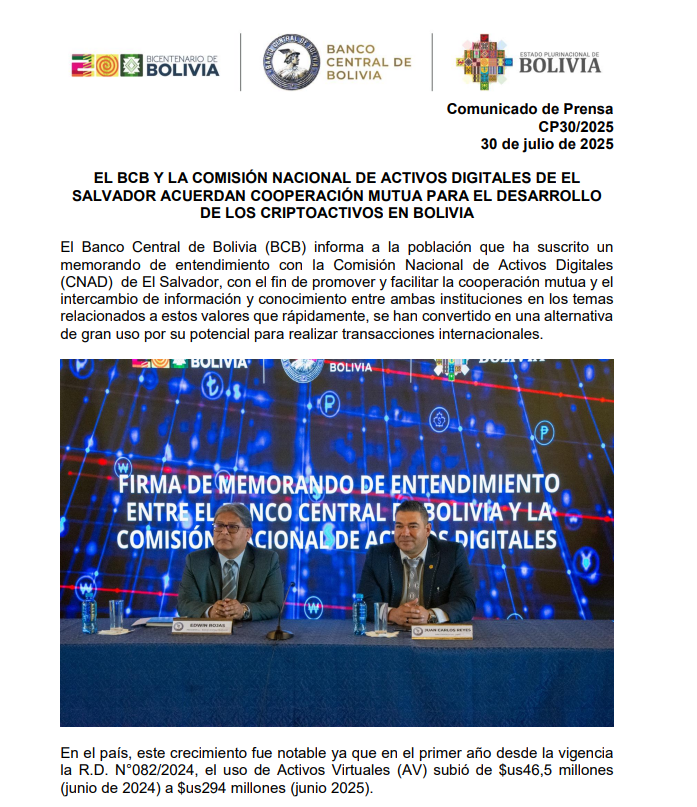
On July 30, the Central Bank of Bolivia signed a memorandum of understanding with CNAD to promote the use of digital assets as an alternative to traditional fiat. Edwin Rojas, acting president of the Central Bank of Bolivia, and Juan Carlos Reyes from CNAD signed the agreement.
The deal comes amid the Bolivia currency crisis, where US dollars are scarce and difficult to obtain, affecting international trade. This shortage has increased the use of US-dollar-backed stablecoins in the country.
Tether CEO Paolo Ardoino confirmed that US-dollar-denominated stablecoins are being used more frequently as a medium of exchange in Bolivia.

The cooperation between Bolivia’s central bank and El Salvador’s CNAD aims to expand the role of cryptocurrencies in cross-border transactions and domestic commerce.
Bitcoin Nears Resistance as Price Holds Above $118,000
In the past day, Bitcoin moved steadily higher, climbing from around $117,800 to touch an intraday high of $118,440. The movement followed a gradual build-up in buying pressure, with price action staying above the 50-period EMA at $116,139 on the four-hour chart. This consistent support from the EMA kept the short-term trend in positive territory.

Currently, Bitcoin is trading close to $118,140, positioning itself just below a key resistance level at $119,355. This price zone has acted as a barrier in recent sessions, with multiple rejections seen on previous attempts to break above it.
If Bitcoin pushes through the $119,355 resistance, the market could see an acceleration toward higher levels as traders respond to the breakout. However, until a clear move above this level occurs, the price is likely to remain within the recent consolidation range. Trading volumes have shown moderate increases during upward moves, indicating that market participants are gradually positioning for a potential breakout.
Bitcoin Forms Bearish Flag Pattern on August 10, 2025
On August 10, 2025, Bitcoin’s four-hour chart shows a bearish flag pattern. The move started with a sharp decline. After that, the price formed a gradual upward channel. A bearish flag forms after a steep drop. It often signals more downside if the pattern confirms.

Currently, Bitcoin is trading near $118,159, close to the upper boundary of the channel. If the pattern confirms with a breakdown below the lower trendline, the price could fall around 6 percent from the current level. This move would target approximately $110,977, which aligns with a previous support zone visible on the chart.
The structure indicates that sellers may regain control if Bitcoin fails to sustain its position within the rising channel, increasing the probability of a move toward the lower price objective.
Bitcoin RSI Signals Caution on August 10, 2025
On August 10, 2025, Bitcoin’s Relative Strength Index (RSI) on the four-hour chart stands at 62.55, with its moving average at 58.61. The RSI has moved steadily upward from oversold conditions earlier in the month, indicating that buying pressure has strengthened in recent sessions.

The current RSI stays below the overbought level of 70, so Bitcoin still has room to rise. However, the pace of the increase keeps pushing it closer to recent highs. As it nears that zone, momentum could slow if demand weakens. If the RSI moves toward or above 70, it signals overbought conditions. That move would raise the risk of a short-term pullback. For now, the index shows moderate bullish momentum. It is supported by recent price gains, but it also signals a need to watch for possible exhaustion.


