



U.S. spot Ethereum exchange-traded funds (ETFs) have attracted $3.71 billion in net inflows over the past eight trading days. The demand has prompted Standard Chartered Bank to almost double its year-end price target for Ethereum (ETH) from $4,000 to $7,500.
BlackRock’s Ethereum ETF Leads $639M Daily Surge
As Ethereum adoption accelerates, institutional investors are finding compelling reasons to integrate it into long-term strategies. On Aug.14, Ethereum ETFs brought in $639.6 million in net inflows. This marked the eighth straight day of positive flows. BlackRock’s ETHA led with $519.7 million, followed by $60.7 million into the Grayscale Ethereum Mini Trust and $56.9 million into Fidelity’s FETH. Invesco’s fund saw smaller contributions.
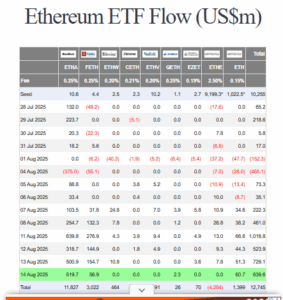
These inflows came just three days after the ETFs logged a single-day record of $1.02 billion on Monday. Across the eight-day stretch, combined inflows reached $3.71 billion.
Spot Bitcoin ETFs also saw strong demand on Aug. 14, adding $230.9 million — up from $86.9 million the previous day.
A spot Ethereum ETF is a regulated investment fund that holds Ethereum directly. When investors buy ETF shares, the fund purchases an equivalent amount of ETH and stores it securely. This gives investors exposure to Ethereum’s price movements without having to manage crypto wallets or private keys.
ETFs are popular with pension funds, asset managers, and other institutional investors because they provide a compliant way to invest in crypto. The U.S. approved spot Ethereum ETFs earlier this year, following the launch of spot Bitcoin ETFs in January.
Institutional Interest Extends Beyond ETFs
Institutional adoption is also visible outside the ETF market. Ethereum’s dominance in decentralized finance (DeFi) provides institutions with access to on-chain lending, staking, and yield opportunities that often outperform traditional fixed-income products. With robust developer activity and a growing base of enterprise integrations, Ethereum offers both the infrastructure and the liquidity depth to support large-scale institutional entry.
Nasdaq-listed Bit Digital reported second-quarter revenue of $25.7 million, down 11.7% year-over-year, as it wound down Bitcoin mining to focus on Ethereum.
The company shifted its treasury strategy in June, moving capital into ETH and building a large staking position. By June 30, Bit Digital had 21,568 ETH actively staked, earning a 3.1% annualized yield. By August 11, its staked holdings had grown to 105,015 ETH. CEO Sam Tabar said the goal is to build one of the largest on-chain ETH balance sheets among public companies.
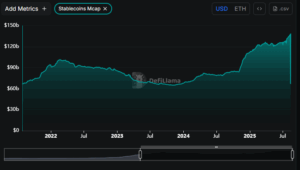
Ethereum’s ETF momentum comes as the network strengthens its position in the stablecoin market. According to DefiLlama, Ethereum hosts $138 billion in stablecoins — 51% of the global $270 billion supply. Stablecoins are cryptocurrencies pegged to fiat currencies like the U.S. dollar and are widely used for payments, trading, and decentralized finance.
In addition, Ethereum’s transaction fees include a “burn” mechanism that permanently removes part of the fees from circulation. This reduces ETH supply. Moreover, increased stablecoin use can therefore create additional upward pressure on ETH prices by lowering available supply.
With growing institutional interest in leveraging Ethereum as part of corporate treasury strategy, its deep liquidity, global reach, and thriving developer ecosystem position it as a strategic infrastructure play for long-term portfolios. Overall, Ethereum is evolving from a speculative digital asset into a strategic infrastructure play—a network where capital efficiency, global reach, and technological innovation converge.


