



Over 12,000 finance professionals are in Frankfurt this week, and Hedera is using the floor to court banks at booth DISM67. The team is demoing tokenization, 24/7 treasury, cross-border payments, digital identity, and AI use cases. Exhibitor and event pages list the booth and dates: September 29 to October 2.
Moreover, Sibos’ program centers on digital assets and interoperability across 250-plus sessions. This backdrop puts Hedera’s settlement and identity pitches in front of payment networks, custodians, and market operators. The Swift and Sibos hubs confirm the theme and schedule.
Finally, Hedera is funneling traffic from its own site to book meetings on the stand, signaling a focus on one-to-one enterprise conversations rather than broad announcements. The event microsite also highlights on-site activations tied to the booth.
Meanwhile, Africa Hackathon hits its September 30 cutoff
Today is the last day to submit for the Hedera Africa Hackathon, with the rules page listing the window from August 1 to 23:45 GMT on September 30. Organizers require teams to complete Hedera certification before the deadline. The Hashgraph Association runs the program with Exponential Science.
In addition, the prize pool started at $1 million when the campaign launched in May and later doubled to $2 million after a sponsor top-up. Posts from organizers and trade outlets track the increase during September.

Therefore, the closing aligns with Hedera’s developer push across finance, operations, gaming/NFTs, and AI/DePIN tracks. Program pages describe the scope, hubs, and target audiences across the continent. hashgraphonline.com
Moreover, Wyoming’s FRNT pick anchors public-sector talking points
Earlier this month, Wyoming selected Hedera for FRNT, billed as the first U.S. state-issued stable token under the Wyoming Stable Token Act. The announcement says FRNT will be fully backed by cash and short-term Treasuries, plus a two percent reserve.
Additionally, PR filings and company posts date the selection to September 4, reinforcing its recency for policy and payments discussions at Sibos. Officials frame FRNT as a way to modernize public finance with faster, more transparent payments.
Taken together, FRNT gives Hedera a concrete government case to reference in meetings with banks and infrastructure providers this week, alongside its settlement and identity demos on the Sibos floor.
Meanwhile, HBAR retests its “life support” trendline
A 3-day chart shared by @Steph_iscrypto shows HBAR pressing a year-long ascending trendline labeled “Life Support.” Price sits on that diagonal while the Bull Market Support Band (the blended EMAs on the chart) hovers around the same area, creating a confluence of support. The setup frames today’s action as a structural test rather than a routine dip.
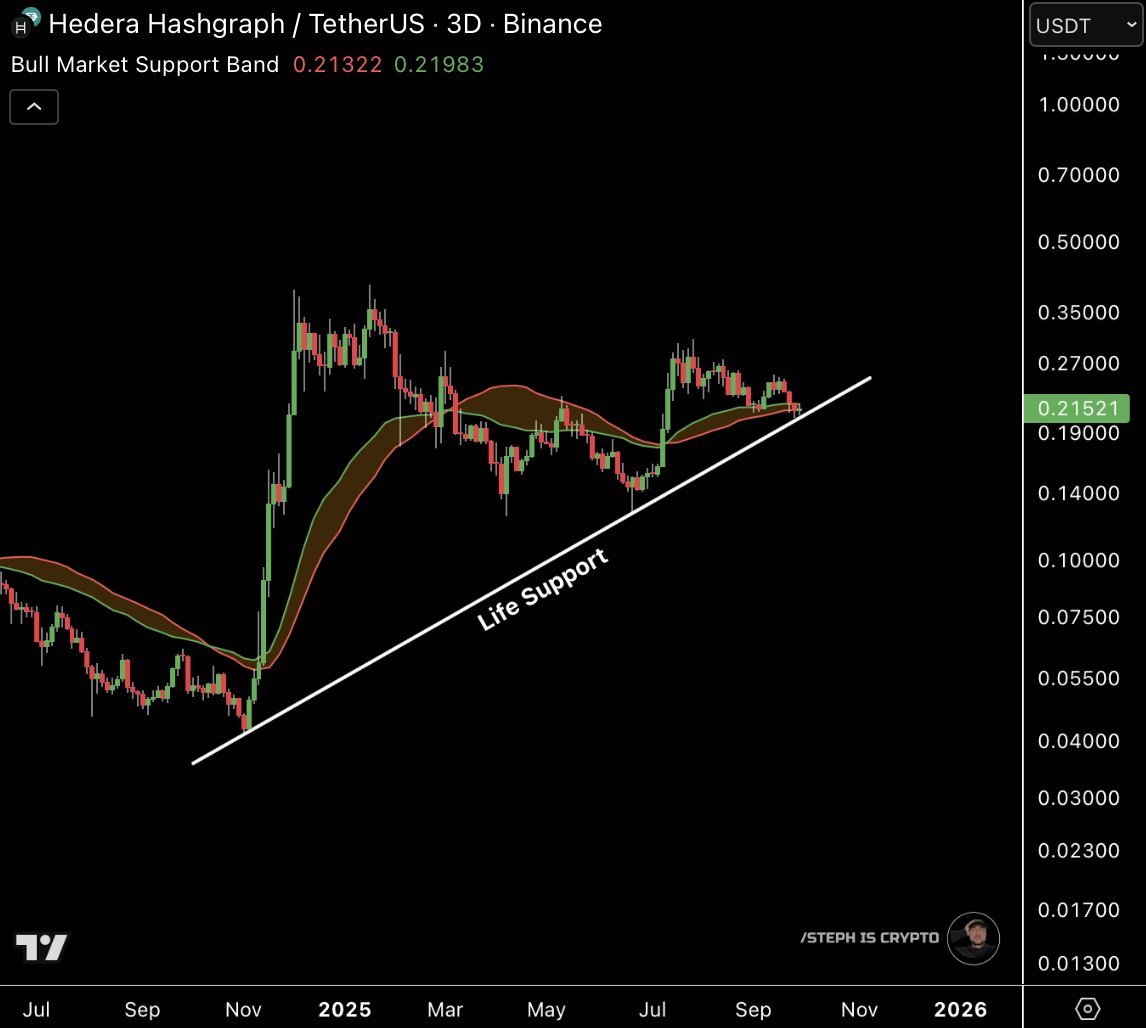
Moreover, recent candles trace a series of lower highs into the trendline, compressing momentum. That squeeze often precedes a directional break. If buyers defend the diagonal and reclaim the band, market structure stays intact and the prior uptrend remains technically valid. Participation and follow-through would then matter more than the first bounce.
However, a clean break below both the trendline and the support band would flip the picture. Then, sellers could force a retest of prior 3-day swing zones visible left on the chart, and the bullish structure would turn neutral. Until the chart resolves, the diagonal and the band define the battleground.
Meanwhile, MACD turns negative as momentum cools
HBAR’s MACD (12, 26, 9) sits below the zero line, and the fast line has crossed beneath the signal line. The histogram flipped back to red and hovers near flat, which shows weak but still negative momentum. This setup follows a fading upswing that peaked in August and rolled over through September.

Furthermore, the recent green burst in early September failed to drive a higher MACD high. That lower momentum high, followed by a downside cross, points to exhaustion rather than trend expansion. As a result, sellers keep a slight edge while the indicator remains sub-zero.
However, the histogram’s small bars signal compression, not acceleration. If the fast line curls up and reclaims the signal line, the first tell would be shrinking red bars toward neutral. A subsequent push above the zero line would confirm a momentum reset; otherwise, lingering below zero implies rallies risk fading at nearby resistance.
Meanwhile, RSI slips below midline as buyers lose control
HBAR’s 14-day RSI prints near 39, below the 50 midline, while its RSI moving average sits around 45. This placement signals bearish momentum in the short term. Moreover, the oscillator has trended down from late August, failing to hold above 50 on recent bounces.

Furthermore, the RSI has not hit classic oversold (<30), so downside room remains before a mechanical bounce triggers. The gap between the RSI and its moving average also widened through September, showing persistent pressure. However, small upticks late in the series hint at stabilization rather than an immediate reversal.
Looking ahead, a clean RSI reclaim of 50—paired with an RSI cross back above its moving average—would mark the first momentum shift. Until then, rallies risk stalling near resistance. Conversely, a drop toward 30 would keep sellers in charge and raise the chance of a reflex bounce only after deeper stress.


