


Nasdaq has submitted a request to the U.S. Securities and Exchange Commission (SEC) seeking approval for a rule change. The exchange asked regulators to allow U.S. exchanges to trade tokenized stocks under the same rules as traditional securities.
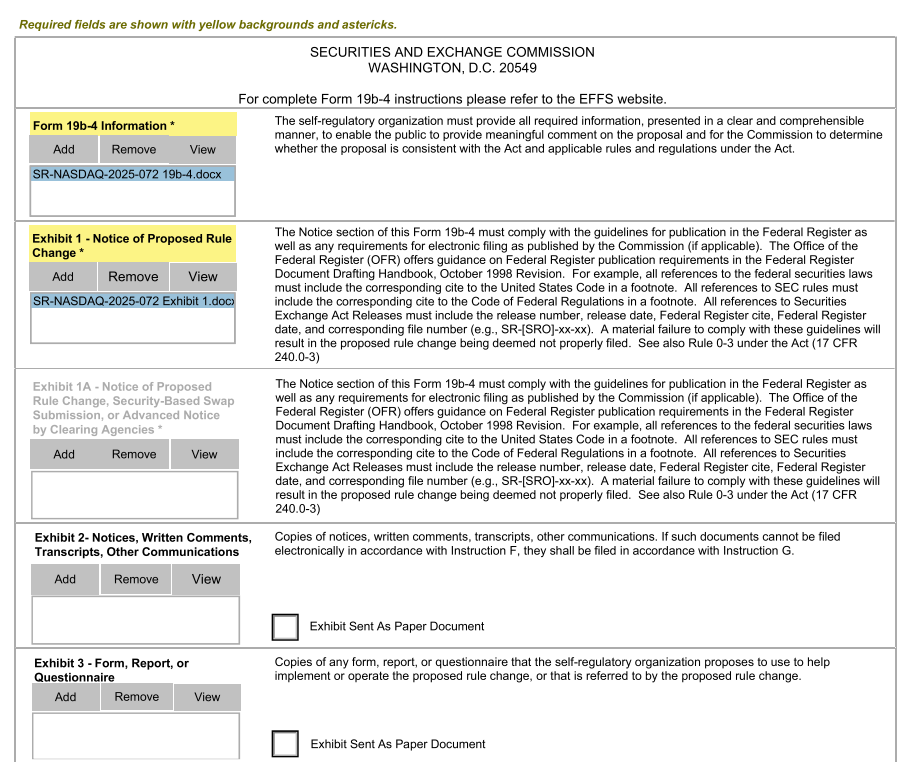
Nasdaq’s filing aims to amend existing rules, including the definition of a security. The proposal says tokenized stocks should follow the same documentation and execution rules as conventional shares if they are deemed equivalent.
According to Bloomberg, the request goes beyond a technical adjustment. It could affect how stocks are issued and settled across regulated markets in the United States.
Tokenized Assets Require Clear Labels
The filing emphasized that tokenized assets must be clearly labeled. Nasdaq said all participants, including the Depository Trust Company (DTC), need clarity to process tokenized trades correctly.
In the filing, Nasdaq wrote:
“A security may be traded in the Nasdaq Market Center in either traditional form (a digital representation of ownership and rights, but without utilizing distributed ledger (‘blockchain’ technology)) or tokenized form (a digital representation of ownership and rights which utilizes blockchain technology).”
Nasdaq confirmed that tokenized stocks would hold the same execution priority as traditional shares. This means that tokenized assets would not face delays compared with conventional securities.
Nasdaq Rejects Siloed Tokenized Trading Venues
Nasdaq used the filing to oppose siloed trading venues where tokenized stocks are listed outside regulated markets. The exchange argued that these platforms prevent investors from accessing consolidated prices across the market.
Nasdaq stated:
“Although tokenization technology presents novel capabilities by which to record evidence of securities ownership and transactions, the trading of tokenized securities can, and it must occur largely as Congress prescribed when it enacted and subsequently amended the Act.”
The exchange added that tokenized securities must be traded within regulated environments. This includes national securities exchanges, alternative trading systems, and FINRA-regulated broker-dealers. Nasdaq said this framework ensures tokenized stocks remain part of an interconnected national market system.
Nasdaq Raises Concerns Over Europe
The filing also pointed to Europe, where platforms offer exposure to U.S. tokenized stocks. Nasdaq said these services do not provide real shares of U.S. companies. Instead, they give investors digitally tradable rights to shares held by the platforms themselves.
Nasdaq stressed that these digital rights do not carry the same protections as traditional shares. In many cases, investors miss out on shareholder rights, including voting.
The concern arises as real-world asset (RWA) tokenization gains global traction. Platforms in Europe and other regions have listed tokenized shares of companies such as Tesla, along with tokenized exchange-traded funds (ETFs), for users outside the United States.
RWA Tokenization Expands Globally
The trend of RWA tokenization has grown in recent months. In June, Alchemy Pay’s Ailona Tsik noted demand for tokenized equities in markets with limited access to U.S. shares. She described a partnership with Backed’s equity tokenization platform xStocks.
“Our mission with this product is to bridge the gap for users outside of the U.S., especially in regions where direct access to such assets has traditionally been limited or unavailable.”
Nasdaq’s proposal shows its focus on placing tokenized stocks and RWA tokenization within regulated U.S. markets, while similar products continue to grow in Europe and beyond.


