



A Satoshi-Era whale moved 16,843 BTC worth around $1.99 billion on July 15, 2025, after holding the coins for over 14 years. The Bitcoin whale had been inactive since 2011, according to data from Lookonchain. This marked the first known activity from the address since acquiring the coins.
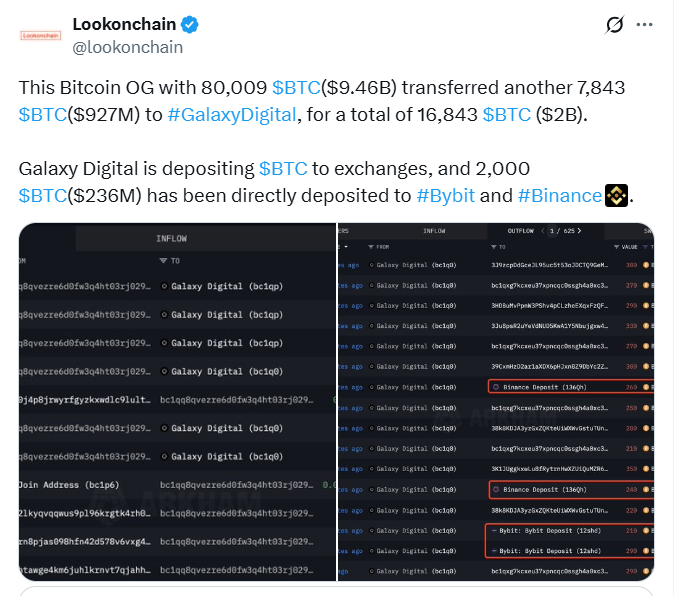
The two large transactions involved 9,000 BTC and 7,843 BTC, sent to Galaxy Digital, a major over-the-counter (OTC) trading firm. These transfers happened as Bitcoin reached an all-time high of $123,100, sparking concerns over a market correction.
Spot On Chain confirmed the whale’s reactivation, stating,
“This is his first cash-out in 14.3 years.”
Galaxy Digital Sends BTC to Binance and Bybit
After receiving the Bitcoin whale transfers, Galaxy Digital sent 2,000 BTC to Binance and Bybit, both centralized exchanges (CEXs). These transfers triggered immediate responses in the market. Within hours, the BTC price dropped over 5%, falling from $123,100 to $116,900.
The remaining 14,843 BTC stayed in Galaxy Digital’s wallets. There is no public data on whether more transfers will follow. These events raised the profile of the Satoshi-Era whale, who holds more than 80,000 BTC in total.
The whale’s activity caused a major rise in Coin Days Destroyed, an on-chain metric used to measure the movement of long-held coins. This metric often increases when old Bitcoin wallets become active again, as it multiplies the number of coins by the time they were held.
A high Coin Days Destroyed reading usually appears during periods of market volatility, especially after long BTC price rallies. July marked one of the highest spikes in this metric in 2025, linked directly to the Satoshi-Era whale transactions.
Binance Inflows Over $1 Million Rise Sharply
According to analyst Crazzyblockk, Binance inflow data from CryptoQuant showed a notable increase in large Bitcoin transfers. He reported that transactions over $1 million now make up 35% of all Bitcoin entering Binance.
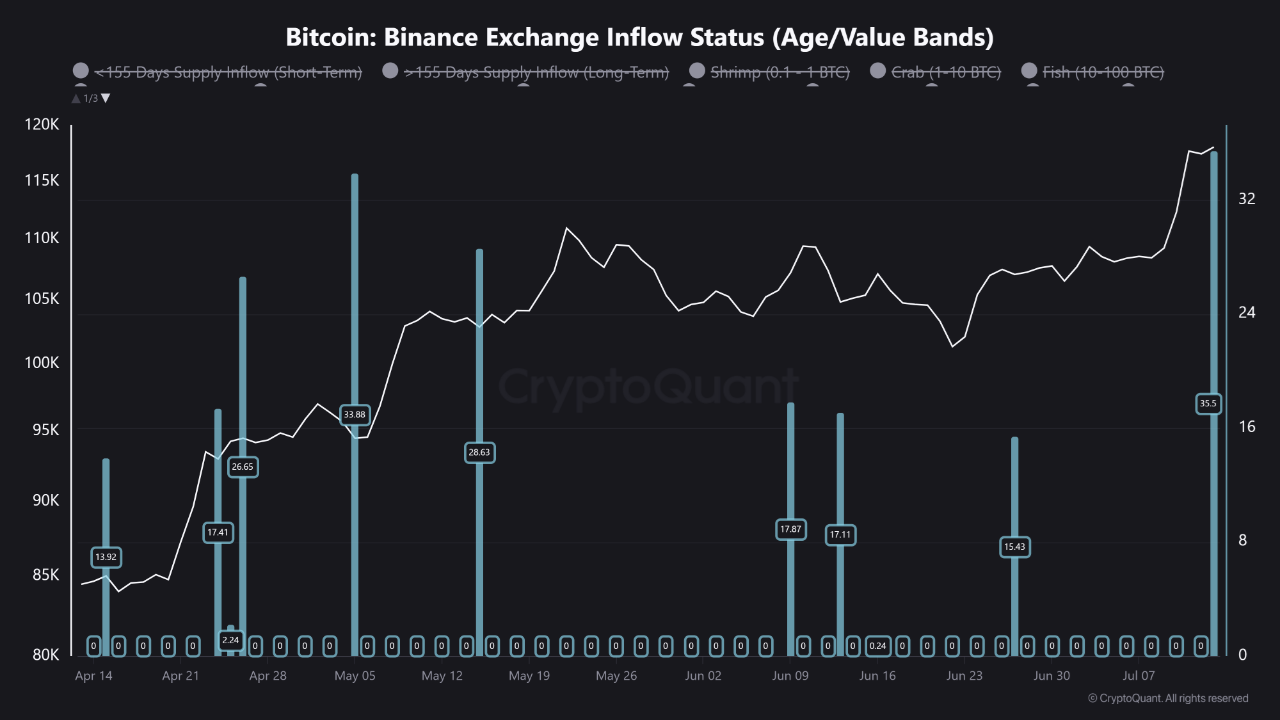
Crazzyblockk also observed that these inflows came from older coins, based on wallet age analysis. He identified two possibilities for this trend: profit-taking or market positioning. He added:
“This surge in deposits suggests that large-scale investors are preparing for two likely scenarios:
Profit-Taking – securing gains after a historic run.
Speculation – utilizing the exchange’s deep liquidity to hedge or open new positions amidst peak volatility.”
The increase in Binance inflows aligns with the timing of the Galaxy Digital transactions and the BTC price drop.
Bitcoin Price Faces Pressure From Old Wallets
The shift of over $1.99 billion in Bitcoin from a Satoshi-Era whale has added pressure to the market. At the same time, institutional buyers and public companies continue to add BTC to their reserves.
The result is a market balancing between long-term holders transferring coins and new buyers entering at high prices. Data from on-chain sources shows that the recent BTC price drop was tied to supply increases on major exchanges like Binance.
Bitcoin traded around $118,000 at the time of writing, showing a 4% decrease from its peak. Funding rates for BTC derivatives also declined, and traders on options markets started to buy more protective contracts.
All eyes now remain on Galaxy Digital’s BTC wallets. The movement of even a small portion of the remaining 80,000 BTC could influence the Bitcoin price again. Current market depth on Binance and other exchanges is being monitored closely.
Analysts continue to track the Coin Days Destroyed metric and large Binance inflows, especially from long-inactive wallets, to measure possible future moves from Bitcoin whales.


