


NOIDA (CoinChapter.com) — President Donald Trump’s economic policies and public statements suggest he may see a U.S. recession as a necessary tool to achieve three key objectives: lower interest rates, reduced inflation, and cheaper energy prices.
The president likely sees lower interest rates as essential for refinancing U.S. debt affordably, reduced inflation to ease economic pressure and bolster consumer confidence, and cheaper energy to curb costs and support industrial growth.
With the U.S. facing $9.2 trillion in maturing debt by mid-2025, rising inflation, and market instability, financial experts wonder if Trump might be willing to tolerate or even facilitate a downturn to meet these goals.
Refinancing $9.2 Trillion: Why Trump Needs Rate Cuts
The U.S. national debt crisis has reached a tipping point, with $9.2 trillion in debt due for refinancing by June 2025—70% of it in the first half of the year.

The average interest rate on U.S. Treasury debt is now 3.2%, the highest since 2010, driving government borrowing costs higher. In FY 2024, the U.S. recorded $7.8 trillion in total costs against $5.0 trillion in revenue, meaning the government spent $1.56 for every $1 earned.
Trump’s best chance to ease this financial burden? A recession. History shows that every U.S. recession since the 1980s has followed a peak in the Fed Funds Rate, forcing the Federal Reserve to cut interest rates to stimulate growth.

A recession would almost guarantee such cuts, reducing borrowing costs and refinancing U.S. debt more affordable.
According to The Kobeissi Letter, the 10-year Treasury yield has dropped 60 basis points in two months as markets anticipate rate cuts due to rising recession risks.
Meanwhile, economist Timothy Peterson warned in an X post that delays in Federal Reserve rate cuts could trigger a bear market, aligning with Trump’s potential willingness to let markets decline in exchange for long-term benefits.
Trump’s Trade War and Inflation: Why a Recession Could Be His Quickest Fix
Trump has repeatedly demanded lower interest rates and cheaper energy to fight inflation. In a Jan. 25, 2025, statement at the World Economic Forum and a recent Fox News interview, President Trump called on OPEC to lower oil prices and pressed the Federal Reserve for rate cuts.

However, the U.S. inflation outlook has worsened, with consumer expectations rising to 6.0% over the next 12 months—the highest since May 2023.
The trade war escalates the risk. In Feb. 2025, Trump imposed 25% tariffs on all Mexican and Canadian goods—including 10% on Canadian oil and energy exports—while adding more restrictions on Chinese imports.
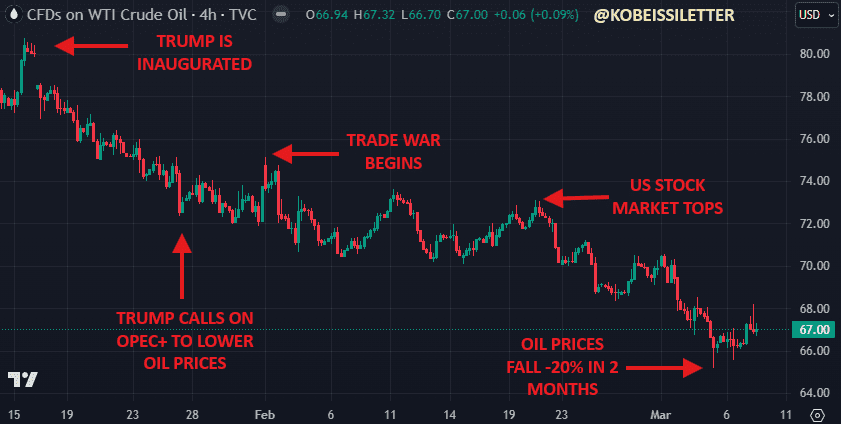
A recession, however, could force inflation down faster than any policy move. The Kobeissi Letter highlights that WTI crude oil prices have fallen 20% in just two months, driven by recession fears and trade war uncertainty.
Since economic downturns reduce demand for oil, commodities, and consumer goods, Trump might view this as an effective way to combat inflation while reinforcing his stance on economic nationalism.
Forcing the Fed’s Hand: Recession as a Policy Tool
Trump’s biggest roadblock to rate cuts? The Federal Reserve. Fed Chair Jerome Powell has warned that rate cuts aren’t guaranteed in 2025, citing uncertainty and inflation risks.
Moreover, according to Peterson’s recent analysis post, delayed cuts could lead to a bear market, further tightening economic conditions. Trump appears to be playing a longer game. On March 6, 2025, he claimed he was “not watching the stock market,” a stark contrast to his first term.

Moreover, Analysts interpret this as a sign that he’s willing to let markets decline if it forces the Fed’s hand.
Investor David Roche predicted a 2025 bear market due to a slowing economy, weaker-than-expected rate cuts, and an overvalued AI sector.
A recession could give Trump exactly what he wants:
- A forced shift in Federal Reserve policy, pushing interest rates lower.
- A market correction that could create new economic opportunities for his administration.
- A realignment of inflation, trade, and energy policies to fit his broader strategy.
However, this comes with risks—rising unemployment, economic contraction, and potential political fallout.
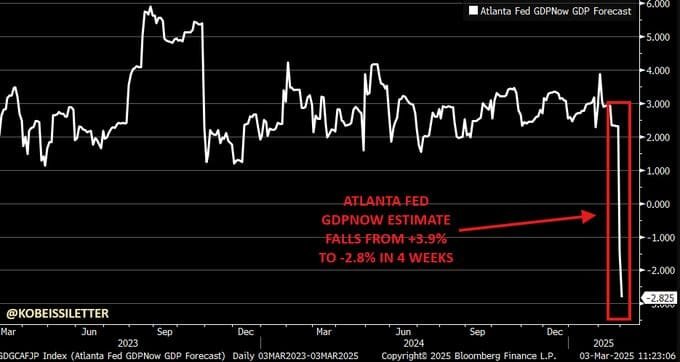
The Atlanta Fed’s Q1 2025 GDP forecast has already plunged to -2.8%, signaling a steep slowdown. Yet, Trump’s economic priorities—debt refinancing, energy price reductions, and rate cuts—may outweigh the risks in his calculations.
While a recession could facilitate lower interest rates and help manage the national debt, it carries significant risks, including market volatility, job losses, and potential political repercussions.
Recent market behavior reflects these concerns, with the S&P 500 experiencing a 2.7% drop, the Dow Jones Industrial Average falling by 890 points, and the Nasdaq Composite declining by 4%.
Despite these risks, President Trump’s recent statements suggest a willingness to endure short-term economic pain for long-term gains.
In a recent interview, the U.S. president referred to the current phase as a “period of transition” to restore wealth to America, indicating a strategic acceptance of potential economic downturns to achieve broader policy goals.


