

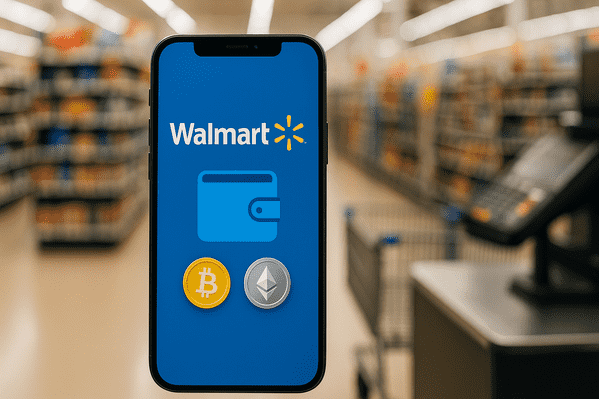

OnePay, the Walmart-backed banking app, plans to add Bitcoin (BTC) and Ether (ETH) trading and custody later this year, per CNBCreporting. The rollout timeline appears as “this year,” with no specific launch date. The feature will let users buy, sell, and hold the two assets inside the existing app.
A separate report says Zerohash will power the crypto infrastructure for OnePay. That setup would cover order routing, wallets, and settlement rails behind the scenes. It places OnePay alongside other U.S. finance apps that already support BTC and ETH.
OnePay is a fintech, not a bank. Partner banks Coastal Community Bank and Lead Bank provide the insured banking services. Card issuance relies on Synchrony Bank for the credit product. The app’s site and store listings show these arrangements.
OnePay Superapp Model: WeChat Template and Current Features
OnePay pitches a U.S. superapp model inspired by WeChat. The app already offers high-yield savings, debit and credit cards, loans, and a digital wallet. Users can also access wireless plans from the same interface. The approach keeps core money tasks in one place.
The Bitcoin and Ether integrations extend that stack. Trading and custody join savings and payments under one login. The plan mirrors how Asian superapps bundle chat, pay, and commerce in one flow.
Recent partnerships reinforce the finance bundle. Klarna replaced Affirm for OnePay Later installment loans at Walmart in the U.S. Media and filings show repayment terms from three to 36 months. These terms sit next to cards and savings inside OnePay.
OnePay Crypto Trading and Custody: Scope, Assets, and Providers
The first crypto trading phase focuses on BTC and ETH. Those two assets lead U.S. market liquidity and carry broad exchange support. Early phases often limit scope to reduce operational risk.
Reports identify Zerohash as the infrastructure partner. That partner typically supplies APIs for order execution, wallet management, and compliant custody. The move aligns OnePay with other consumer apps that white-label crypto rails.
Key details remain undisclosed. OnePay and media reports do not list fees, spreads, withdrawal limits, or insurance specifics. Those terms usually arrive near launch and shape adoption.
OnePay Superapp Context: SEC Signals and Market Competition
U.S. SEC signals now reference multi-service “super-app” platforms under a unified framework. SEC Chair Paul S. Atkins has promoted a “minimum effective dose” of regulation and encouraged a single umbrella for trading, staking, and lending where appropriate. These remarks frame how apps like OnePay could package services.
Atkins reiterated the “minimum effective dose” concept in September remarks and interviews. Policy summaries note a push to harmonize agency rules and reduce duplication. The comments did not endorse any single company.
Competitors are moving. Coinbase outlined a crypto superapp plan with cards, payments, and Bitcoin rewards. Toss announced a finance superapp for Australia plus a Korean won stablecoin plan pending approval. X continues to build payments and AI features toward a broader app. Recent updates document these tracks.
OnePay and Walmart: Fintech Expansion and Existing Footprint
Walmart has expanded beyond retail into fintech, advertising, and memberships. Reports say OnePay launched in 2021 with backing from Walmart and Ribbit Capital. The company also holds a majority stake in India’s PhonePe. These moves show a larger fintech strategy.
OnePay integrates with Walmart checkout flows and supports debit rewards tied to shopping. Its wallet accepts multiple cards for online payments. These features place OnePay inside daily retail behavior.
Public coverage also notes user-experience issues in past years. Fraud-related complaints appeared in press accounts. Those articles reflect historic cases rather than current crypto plans and include company responses.


