XRP Faces Legal Shift as Judge Torres Exits Ripple Case and Charts Turn Bearish

Tatevik Avetisyan
By Tatevik Avetisyan 7 Min Read
XRP Faces Legal Shift as Judge Torres Exits Ripple Case and Charts Turn Bearish

A former SEC lawyer clarified that Judge Analisa Torres is no longer involved in the ongoing securities litigation between Ripple and the U.S. Securities and Exchange Commission. This clarification follows speculation among market observers who had suggested that her final approval could influence the case’s trajectory. By removing Torres from the equation, the update narrows the focus to procedural steps handled by other judicial figures.
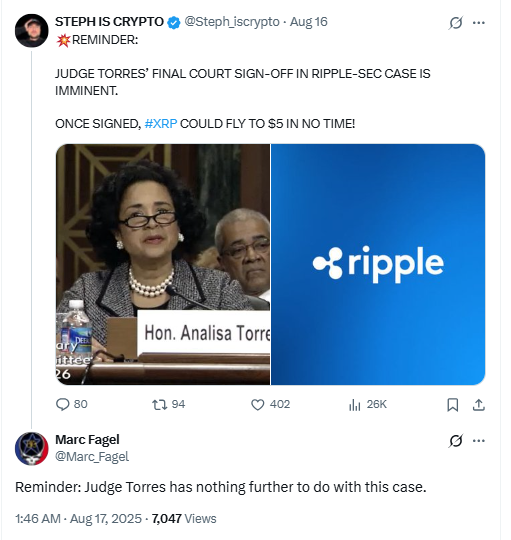
Marc Fagel Clarifies Judge Torres’ Role in Ripple CaseSource: X
Marc Fagel Clarifies Judge Torres’ Role in Ripple Case. Source: X

This shift highlights how legal interpretations around Ripple’s situation remain fluid. While Judge Torres had issued significant rulings in the past, the case’s progress now rests with different authorities. Legal experts emphasize that such transitions in responsibility are common in complex, multi-year cases. As the process continues, Ripple’s position in the broader regulatory landscape will depend on subsequent court developments and potential settlements.

- Advertisement -

Ripple Expands Network Scalability Alongside Shiba Inu

Ripple is actively working on enhancements to its network infrastructure to address rising demand. The company is advancing scalability solutions that aim to ensure the XRP Ledger can handle greater transaction volumes and maintain efficiency under heavier workloads. Shiba Inu’s development team is pursuing a parallel path, making similar adjustments to strengthen network resilience.

The shared emphasis on scalability underscores how blockchain projects are responding to an environment of growing adoption. Developers are focusing not only on throughput but also on minimizing transaction delays and reducing energy costs. Ripple’s efforts to reinforce the technical capacity of its ledger align with its broader strategy of positioning XRP as a reliable infrastructure layer for global payments and tokenization. By investing in scalability, Ripple signals a long-term commitment to ensuring system reliability even as use cases expand.

Beyond infrastructure and court updates, XRP faces external catalysts tied to macroeconomic and legal factors. Upcoming U.S. Consumer Price Index (CPI) data is expected to shape broader financial sentiment, with potential spillover effects into digital asset markets. Inflation trends remain a critical determinant of central bank policy, and any unexpected shifts could amplify volatility across cryptocurrencies, including XRP.

- Advertisement -

In parallel, expectations around a potential settlement in Ripple’s case with the SEC continue to influence market behavior. Although settlement details remain speculative, legal observers note that negotiations could conclude within weeks, aligning with other macroeconomic events. Together, inflation data and legal outcomes form a dual backdrop of uncertainty that may intensify market fluctuations in the coming days. Ripple’s legal clarity and technical progress position it to navigate these external pressures, yet the outcome will depend heavily on decisions outside the company’s direct control.
XRP Price Drops Below Key Support

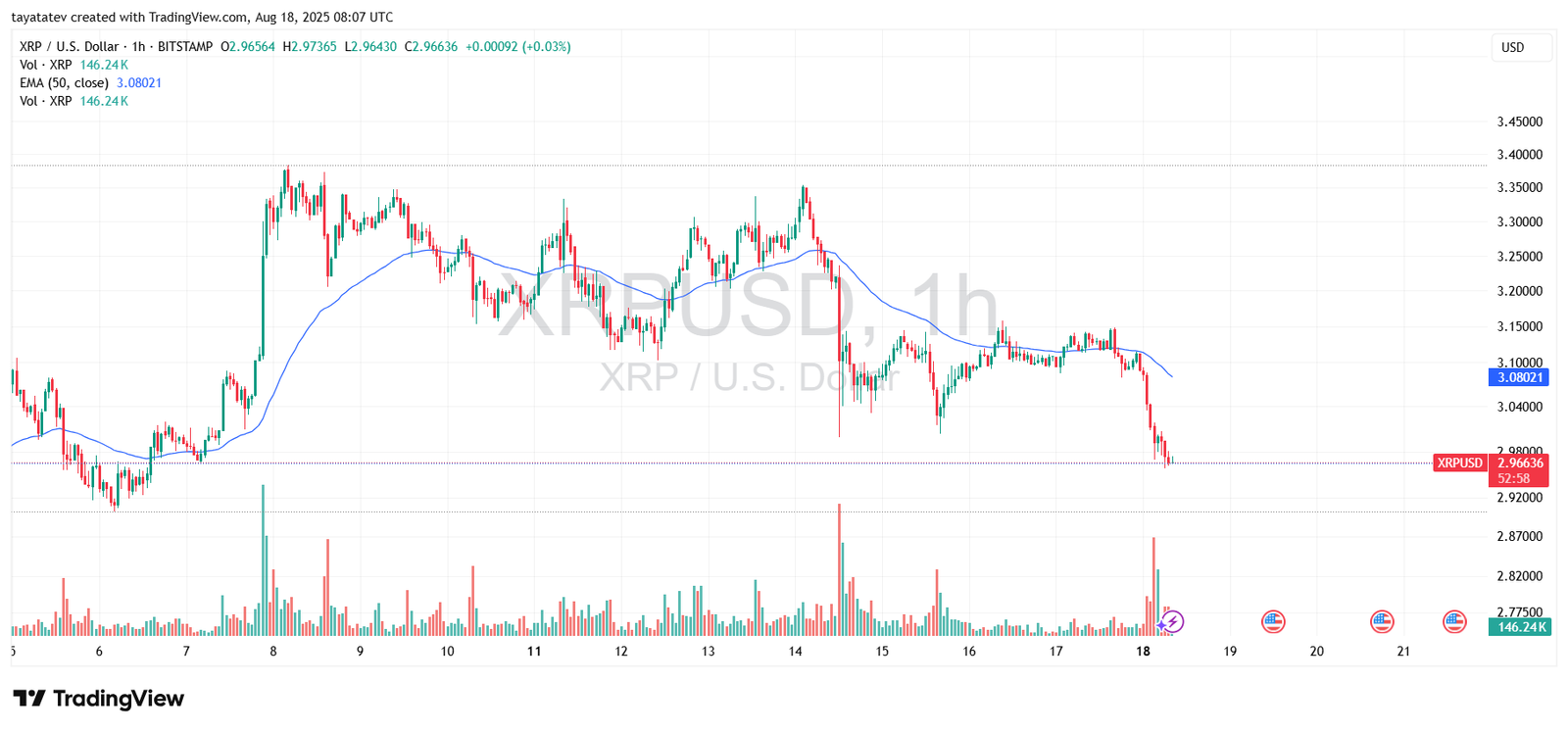
XRP’s price experienced a sharp decline on August 18, 2025, slipping from levels above $3.10 to around $2.96. The one-hour chart shows a steep sell-off beginning late on August 17, with price action breaking below the 50-period exponential moving average (EMA) at $3.08. Once this level failed, downward momentum accelerated, accompanied by a spike in trading volume. This indicates strong selling pressure rather than gradual distribution.

XRP/USD Price Chart (1h timeframe)Source: TradingView
XRP/USD Price Chart (1h timeframe). Source: TradingView

The recent breakdown signals that bears regained control after days of sideways movement between $3.10 and $3.25. Volume bars confirm that sellers dominated the market, pushing XRP toward its next psychological support near $2.90. If this zone fails, the chart suggests a possible test of $2.80, a level that previously acted as resistance in early August.

On the upside, XRP must reclaim the $3.08 EMA to reverse the bearish momentum. Consolidation above this level could open the path toward $3.20 resistance. Until that recovery occurs, however, price action remains under pressure with the short-term outlook tilted to the downside.

XRP RSI Signals Weak Momentum

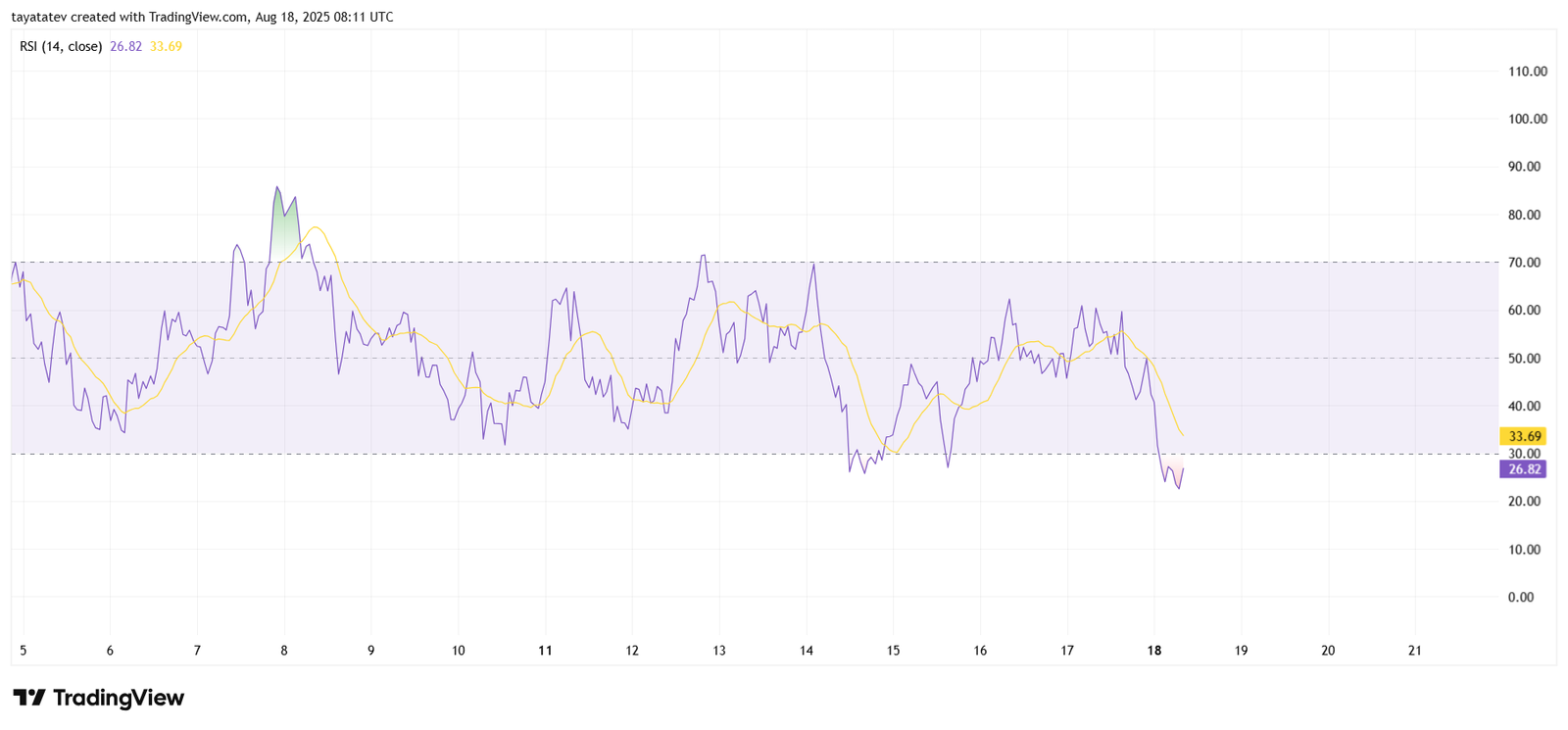
The Relative Strength Index (RSI) chart for XRP on the 14-period, one-hour timeframe shows the indicator sliding toward oversold conditions. Currently, the RSI stands at 26.82, below the neutral 50 level and near the critical 30 threshold, which typically marks oversold territory. The moving average of RSI, plotted in yellow, is also trending lower at 33.69, reinforcing the bearish sentiment.

XRP/USD RSI Chart (14-period, 1h timeframe)Source: TradingView
XRP/USD RSI Chart (14-period, 1h timeframe). Source: TradingView

This decline reflects strong selling momentum after XRP’s sharp price drop. The consistent move below 40 suggests that buyers have lost control in the short term. The RSI’s dip under 30 highlights that sellers may be exhausting their strength, although oversold readings can persist if downward momentum remains strong.

For a reversal to materialize, XRP’s RSI must climb back above 40 and align with upward price movement. A sustained recovery above 50 would indicate renewed buying interest. Until then, the indicator confirms bearish dominance, with limited signs of immediate relief.

XRP Balance of Power Indicates Weak Buyer Control

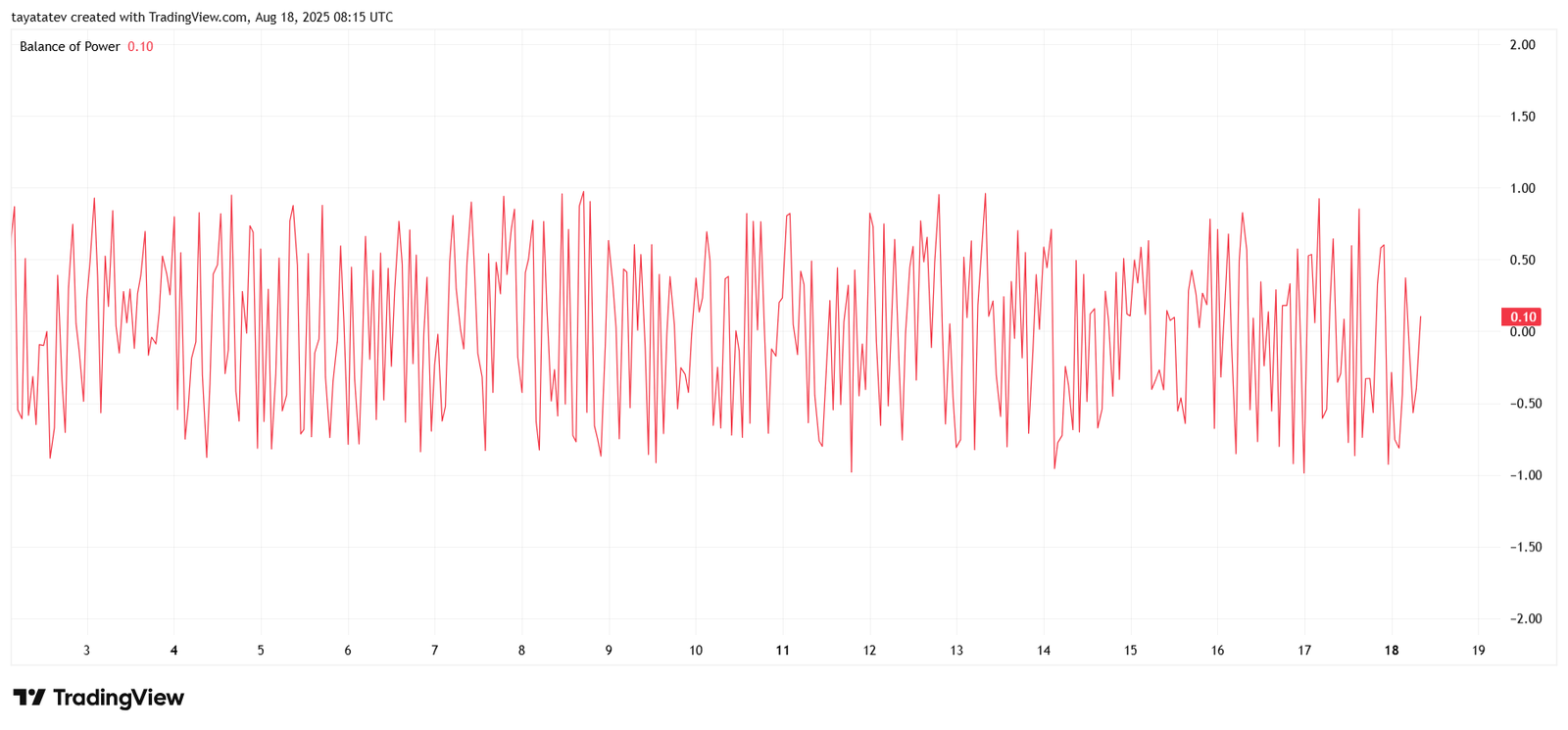
The Balance of Power (BOP) chart for XRP currently reads 0.10, a value close to neutral but leaning slightly toward bullish. This indicator measures the strength of buyers versus sellers, with readings above zero signaling buying dominance and readings below zero reflecting selling pressure.

XRP/USD Balance of Power Indicator (1h timeframe)Source: TradingView
XRP/USD Balance of Power Indicator (1h timeframe). Source: TradingView

Over the past sessions, the BOP line has fluctuated sharply between positive and negative territory, showing high volatility in control between bulls and bears. Despite occasional spikes, sellers have generally maintained the upper hand, as reflected in XRP’s recent price breakdown. The current value near neutrality suggests that neither side is showing clear dominance after the sharp sell-off.

For a stronger recovery, XRP’s BOP needs to hold consistently above 0.50, which would confirm that buyers are regaining control. If the indicator falls back below zero, it would reinforce the bearish momentum already confirmed by price action and the RSI. Until then, XRP remains in a fragile position, with balance shifting quickly between bulls and bears.

Tatevik Crypto Journalist CoinChapter

Tatevik Avetisyan

Tatev Avetisyan is a Markets Writer and Analyst at CoinChapter, covering cryptocurrency markets, policy, and regulation. With over seven years of experience in business and marketing development, she has spent the past two years specializing in digital assets and has authored more than 2,000 articles on crypto markets and regulatory developments. She contributes as a guest writer to leading industry publications and is a prominent Web3 advocate in Armenia through Web3Armenia. Her work reflects a broader focus on artificial intelligence and Web3 technologies. Tatev maintains a diversified crypto portfolio, with Bitcoin as her primary holding above CoinChapter’s $1,000 disclosure threshold.